Translations & Transitions Govert Loockermans, a Manhattan Merchant’s Correspondence & Papers More → |
Voyages Maritime routes that shaped the Dutch North Atlantic world More → |
Zotero Bibliography Research Source: 17th century scholarly, non-fiction publications More → |
Genealogical Research What’s in a Name? Discover your ancestors’ origins More → |
Translations & Transitions Govert Loockermans, a Manhattan Merchant’s Correspondence & Papers More → |
Voyages Maritime routes that shaped the Dutch North Atlantic world More → |
Zotero Bibliography Research Source: 17th century scholarly, non-fiction publications More → |
Genealogical Research What’s in a Name? Discover your ancestors’ origins More → |
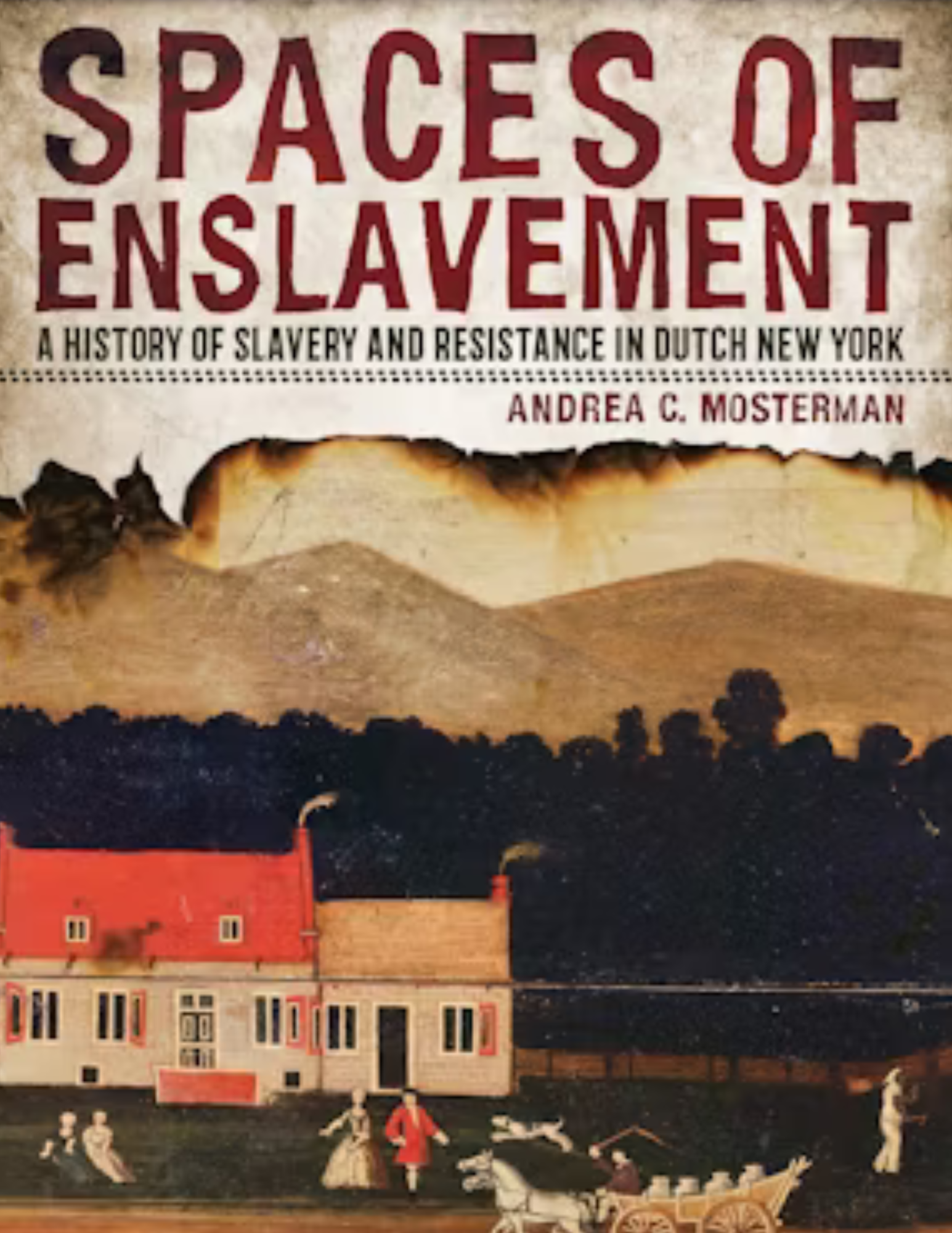
In Spaces of Enslavement, Andrea C. Mosterman addresses the persistent myth that the colonial Dutch system of slavery was more humane.
Investigating practices of enslavement in New Netherland and then in New York, Mosterman shows that these ways of racialized spatial control held much in common with the southern plantation societies.
In the 1620s, Dutch colonial settlers brought slavery to the banks of the Hudson River and founded communities from New Amsterdam in the south to Beverwijck near the terminus of the navigable river. When Dutch power in North America collapsed and the colony came under English control in 1664, Dutch descendants continued to rely on enslaved labor. Until 1827, when slavery was abolished in New York State, slavery expanded in the region, with all free New Yorkers benefitting from that servitude.
Mosterman describes how the movements of enslaved persons were controlled in homes and in public spaces such as workshops, courts, and churches. She addresses how enslaved people responded to regimes of control by escaping from or modifying these spaces so as to expand their activities within them. Through a close analysis of homes, churches, and public spaces, Mosterman shows that, over the course of the seventeenth and eighteenth centuries, the region’s Dutch communities were engaged in a daily struggle with Black New Yorkers who found ways to claim freedom and resist oppression.
Spaces of Enslavement writes a critical and overdue chapter on the place of slavery and resistance in the colony and young state of New York.
We use cookies to enhance your experience on our site. By continuing, you agree to our use of cookies. See our privacy policy page for the details.
Welcome! You can explore everything you're looking for in the NNI library. Simply type a keyword into the search bar and press Enter to begin your search.
Sign in to access exclusive features and keep track of your favorite content on NNI!
New membership are not allowed.
For over three decades, NNI has helped cast light on America's Dutch roots. In 2010, it partnered with the New York State Office of Cultural Education to establish the New Netherland Research Center, with matching funds from the State of the Netherlands. NNI is registered as a 501(c)(3) non-profit organization. Contributions are tax-deductible to the extent permitted by law.