

“Discovering” Australia: The Remarkable Fame of Captain Cook
With the New Netherland Institute’s dedication to Dutch matters, you may wonder what the English Captain James Cook is doing here. In many of the other Totidem Verbis articles you can witness the courage of Dutch navigators whose place in global exploration and discovery deserves attention and fair consideration.
by Peter A. Douglas
Regardless of nationality or time period, many of the Dutch explorers are the forerunners of James Cook and every other daring sailor who took to the largely uncharted oceans. Separated by time, the old Dutch explorers are still essentially Cook’s confederates, allies in intrepid global reconnaissance, and his spiritual ancestors that surely welcomed him into their maritime Valhalla following his untimely death in 1779. These words are intended to illuminate the achievements of all the historical navigators, and to help establish how history remembers these brave captains and their unsung crews who helped reveal and shape their world and ours.
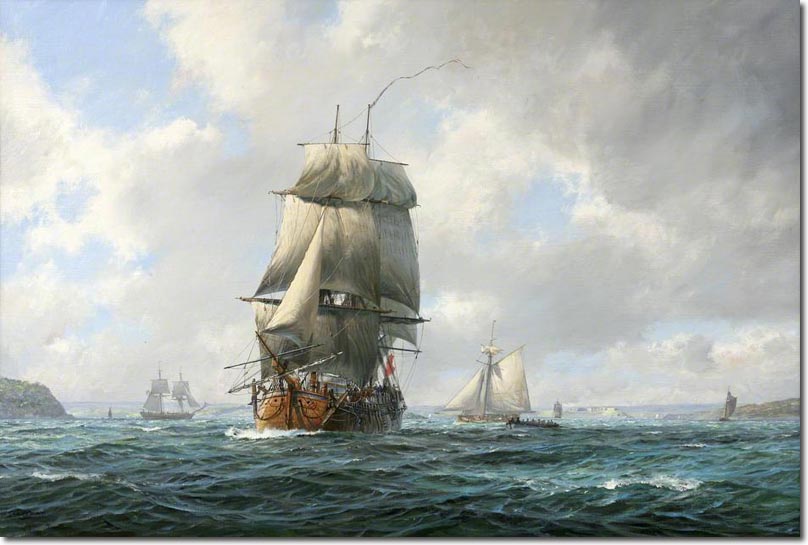
“Endeavour leaving Plymouth” by Geoff Hunt
There’s a certain natural partiality and gathering of reasons that determines which historical figures are remembered, and how their memory survives, if at all. To further examine this shift from historical truth and fair dealing, let us take a look at this one example of Captain Cook, and in particular his “discovery” of Australia. We can see that factors other than the nature of the courageous deeds themselves have had some impact — factors such as nationality, connections, influence, prejudice, character, language, fate, and sheer good fortune.
The definition of the word “discover” is to “obtain sight or knowledge of, to learn about, or encounter, for the first time.” The important phrase here is “for the first time.” In terms of the discovery of a new country, the second and subsequent people to go to that place are essentially just visitors to somewhere already discovered, though they are not always aware of that. With a country as large as Australia—with a coastline of more than 16,000 miles—“discovery” is a far from simple concept, and there are enough navigators to take credit, as various explorers— notably Dutch—found various parts of it, by accident or design, over centuries.
In Britain in Cook’s time he naturally got much of the spotlight for his exploits, which would, unsurprisingly, eclipse in that country anything the Dutch did. Before the name of Cook fell from fame to notoriety, as it would be to some in our century, few people have been as widely recognized and lauded. For the British, Cook is famous and much admired as an explorer, navigator, cartographer, and captain in the Royal Navy. In his home country his three Pacific voyages between 1768 and 1779 are deservedly celebrated.
As a schoolboy tbrough my reading I absorbed the information that it was Captain Cook who “discovered Australia.” Living in England, I was happy to believe that one of my daring countrymen was responsible for this important achievement, and there was no reason or opportunity to question it. It’s apparent now that what I learned about Captain Cook depended on when I went to school. After World War II to the mid-1960s, Australia had strong ties to the British Empire. If you were at school during this period, whether in England or Australia, Cook was seen as one of the greatest explorers in history, and textbooks gave the clear message that he “discovered” Australia, and in 1770 took possession of the land for his country. After this time, students were faced with the growing awareness of the negative impact of colonization on the country’s indigenous people, though appreciation of this did little if anything to eliminate Cook’s enduring cachet as its discoverer. Colonization and settlement was something different to—and much less exciting than—discovery, and didn’t detract from what we knew of Cook’s success.
Of course the matter is not that simple, and a deeper assessment is called for, one that goes beyond mere national pride. Any reputable history of Australia will tell us that Cook wasn’t the first European to set eyes on this country, and it must be acknowledged and constantly re-emphasized that, contrary to the widespread Cook myth, it was a Dutchman, Willem Janszoon, in the Duyfken, who was the first European to see this continent. This was early as 1606, more than a century and a half before Cook arrived. Cook’s precise claim to fame in this context is that he was the first to explore the continent’s eastern coast, and yet the larger legend is hard to shake. For the most part, Janszoon’s achievement has unfairly faded from the public mind and has failed to attain its deserved standing.
Cook’s Australian coup is easy to rationalize, judging by the many references to it, which nudge belief into bogus fact, often with a helpful patriotic edge stemming from an understandable national pride. Note the title of an article in the New York Times on May 10, 1970: “Captain Cook’s Discovery of Australia.” The article goes on to describe the commemorative stamps printed on the 200 th anniversary of Cooks landing on that country’s eastern seaboard. The error is not confined to a distant misperception of the facts, for in the November 7, 2013, issue of the Australian Geographic magazine we read: “Almost 250 years ago, Captain James Cook sailed on the voyage where he discovered Australia.” The article goes on to better and more accurately explain this sweeping assertion, but the overstated headline grabs the reader’s attention and is bold enough to inspire confidence in what it asserts. Again, we have the blurb on the Internet Movie Database (IMDb) for a film about Cook that describes the explorer as “the greatest explorer in history who discovered Australia and New Zealand.” The truth about Cook, which is extraordinary and inspiring enough, hardly stands a chance in this enduring blizzard of exaggeration.
It’s satisfying that most of the pieces above go on to make it clear that Cook landed on the east coast, and saw no more of the continent—not the interior, no other coast—though the embellished title is right out there. The articles often put “discover” in quotes, which tends to confuse more than it enlightens. Do the quotes mean he discovered it or not? In some cases the significance of this punctuation mark is not that someone else discovered Australia (no mention of the Dutch, naturally), but in the newly sensitive and exact sense that native people have lived there for tens of thousands of years, and thus it needed no “discovering.” The truism is that nowhere really exists until seen by European eyes.
These are just a few of such statements about Cook, and from these prominent assertions it’s easy to see how the truth of his achievement Down Under got muddied, and how he innocently received recognition for more than he actually did—contrary to how history has tended to treat the Dutch explorers. Moreover, if we make an analytical approach, the truth of that statement concerning Cook and Australia depends on what exactly is meant by “discovered,” and also on which part of that huge continent an explorer is said to have found.
As the first known Europeans to see and visit the continent, the Dutch truly discovered Australia on behalf of the wider world in 1606, and they did it again in 1616 when Dirk Hartog made landfall on the distant western coast. In 1770, along came James Cook. The fact is that Willem Janszoon found Cape York and the Gulf of Carpentaria in what is now northern Queensland, Dirk Hartog landed near Shark Bay in Western Australia, and Cook found New South Wales on the east coast. These discoveries are thousands of miles apart, separated by distance as well as years. It’s all the same enormous country, and each of these adventurers could assert the truth of his own encounter, so one can say that they all “discovered” it in different places at different times.
This question of “discovery” with respect to Captain Cook no doubt derives from the fact that on his 1768-71 voyage he and his crew were the first recorded Europeans to visit the distant continent’s eastern coast, and the British were content to consider that sufficient to give Cook the great honor – or to willfully misunderstand the precise nature of his achievement. This part of Australia is now the political and commercial center of the country, and the most heavily populated (approximately eighty-one percent of Australia’s people live in New South Wales, Queensland, Australian Capital Territory, Victoria, and Tasmania).
It’s the setting up of the colony of New South Wales in 1788 that is considered the founding of Australia. It may be that to have discovered and explored what came to be the country’s focal point is deemed a greater discovery than that of a wild western shore or the tropical savanna of the north. However, the Dutch East India Company was interested in this northern region too, sending in Jan Cartensz and Willem Joosten van Colster in 1623 south of New Guinea to investigate it. Van Colster named part of it Arnhem Land, after his ship, the Arnhem. (Naming territory after one’s ship was a popular maritime practice. In 1616 when Dirk Hartog came to Australia’s western coast he called it Eendrachtsland, for his ship, the Eendracht.)
Cook’s arrival in 1770 marked the beginning of Britain’s interest in Australia and the eventual colonization and settlement of this continent—the world’s sixth largest country by area (almost three million square miles). It’s fitting for these flag-wavers that a Yorkshireman might be able to take credit for all that, though the initial settlement was far from truly glorious, taking the form of a penal colony following the arrival of the “First Fleet” in January 1788, almost a decade after Cook’s death. A change of destination for the convict transports had to be made, as sending them to North America was impossible following the American Revolution. Britain also needed a Pacific base from which to counter French expansion.
Of course, Englishman James Cook besting his Dutch rivals and predecessors in the fame game for historical acknowledgement can perhaps simply be attributed to the fact that accounts of his deeds were, as you would expect, written in English—a language more accessible and widespread than Dutch. The latter is the most likely language for commemorating popular notables from the Netherlands, which would veil their equally epic tales from the rest of the world.
The particular importance of Cook for the British is that, fittingly at what he called Possession Island, he formally took possession of that land and claimed the entire 1,700 miles of coastline he had just explored as British territory, even though he had no authority to do so and there was no grand ceremony. Despite the geographical limitations of his explorations, Cook is thus very much associated with Australia as a whole; his standing is such, and the ground is sufficiently fertile, for broad comfortable legends to take root.
With the exception of further Dutch visits to the west, Australia remained largely unvisited by Europeans until the first British explorations. Yet the Dutch were inexhaustible explorers of the continent’s fringes: around thirty Dutch navigators explored the western and southern Australian coastlines during the seventeenth century. From 1616 to 1622 alone four Dutch expeditions explored the coast of Western Australia from 35ºS to 22ºS, or from Perth to the Northwest Cape. Between Willem Janszoon’s visit 1606 and 1770, when James Cook explored what would become New South Wales and Queensland, more than forty Dutch vessels approached this new land, so they were clearly fascinated by Australia. The Dutch explorer Abel Tasman christened the country “New Holland” in 1644 on his voyage to the northern regions, so the Dutch connection with the continent was early and unmistakable. They were nibbling at its edges, just like Cook, but were overshadowed by their later British rival.
The Dutch only named the land (New Holland); neither the Netherlands nor the Dutch East India Company claimed any Australian territory. We’ve seen that after 1606 there were many Dutch expeditions there, but there was no attempt to establish a permanent settlement. Those who came ashore decided that for various reasons it was unsuitable for colonization. The Dutch were traders more than empire builders, and they may have foreseen little commercial worth in their first impressions of Australia, much of it desert and wilderness beyond the equally inhospitable shoreline.
The British on the east coast found a more temperate and welcoming climate in which to put down roots—even if originally it was for a prison. For a Dutch merchant company, in the hinterland of Western Australia it must have appeared that there was little to gain or exploit—certainly nothing that was close to the value of spices obtainable to the north in the East Indies where their interests were already centered. This lack of interest in permanent occupation curtailed their participation in Australia’s future—and for us, its history.
For the Dutch, their lack of interest in colonizing the antipodean countries leaves the nation innocent and unblemished by the objections that eventually followed the celebration of Cook’s arrival. The protests have grown in recent years, often prior to Australia Day, January 26, which honors the establishing of the first European settlement on the continent of Australia in 1788. Indigenous groups and their supporters call it “Invasion Day” and “Survival Day,” and consider it the start of the violent European colonization. Nevertheless, opinion polls have shown that Australia Day is celebrated by sixty percent of Australians. Many are opposed to uprooting history in this way, and are in favor of a more positive, constructive, and educational way of approaching the strong division of opinions.
The holiday is boycotted by some, who now view it as a symbol of the adverse impact of the settlement on indigenous peoples. In many minds, even though as a sailor his role was limited to “discovery,” Cook takes the blame for this, and his many and lavish memorials have become the focus of the controversy surrounding Australia’s colonial past. Notably in Sydney and Melbourne, his statues and memorials have been vandalized, painted, defaced, toppled, and covered with graffiti. This is reminiscent of the fate of statues of those that are linked to the slave trade, with protesters saying that they promote white supremacy by presenting “racist” figures as heroes. For those who are fervently conscious of the effects of colonization on aboriginal tribes, memorials like those raised to James Cook are offensive because for them they rationalize foreign power, along with the supposed right to take over countries merely by dint of “discovery.” They are considered statements of a dominant point of view that reach into and affect the present day, as the past always does. Moreover, they naturally never allude to even any hint of injustice in the process of settlement. Along with the original flag raising and its assumption of a broad legitimacy of action, erecting statues and creating memorials strikes some as another of the rituals of discovery, acts that confirm the unchallenged reality that requires no justification or explanation. Memorials are seen to transform dispossession into the glorification of individuals, and Cook has certainly been glorified. Claiming territory in this way was common practice back then, and as we feel enlightened and scold historical figures we must remember that observing the past through the prism of the present gives a blurred image and evokes our own prejudices.
However they come to be perceived through plaques and statues, explorers are better remembered when something—especially an enduring geographical feature—is named in their honor. For example: Drake Passage, Barentsz Sea, Bering Strait, Flinders Range, Strait of Magellan, Cabot Tower, Dampier Archipelago, Brouwer Route, Block Island, Verrazzano-Narrows Bridge, Dirk Hartog Island, Tasman Sea, Tasmania. Most of these people, and other adventurers, have many things named for them, from the imposing to the commonplace—streets, towns, medical centers, squares, academies, trails, bays, parks, countries, societies, counties, peninsulas, ships. This is the tribute from those who came after. It’s a good way, and often the only way, in which so many explorers are popularly remembered. Not so much for their deeds as for their bridges and capes.
James Cook certainly left his mark in the few months he was cruising the Great Barrier Reef. He was responsible for many of the place names in that eastern region, well-known ones such as New South Wales, Port Jackson, and Botany Bay. He gave his ship’s name, Endeavour, to the Endeavour River, near whose mouth he was forced to beach the ship for repairs after running aground on Endeavour Reef, thirty miles to the southeast. Cook also named Endeavour Strait, between Cape York Peninsula at the northern tip of Queensland and Prince of Wales Island, his passage west to the Indian Ocean.
Navigators were also cartographers, and Cook was the first to chart Australia’s east coast, unknown to Europeans at the time, and he named a great many bays, capes, islands, and other features on that long coastline, most of which are still in use today, though some have a different spelling. In all there are 112 names assigned by Cook on the coastal map that was published in 1773. Places in eastern Australia that Cook didn’t personally name were named after him by a proud and grateful nation, such as Cooks River, and Cooktown, the latter being where the crew spent seven weeks in the winter of 1770 fixing the ship’s hull.
All over the world there are a great many names derived from Cook. These include a country, Cook Islands, in the South Pacific, even though the first European contact was by the Spanish and the Portuguese. Cook visited the islands in 1773 and 1777; the name Cook Islands, in his honor, first appeared on a Russian naval chart in the 1820s. Cook’s name was also given to a large variety of places and features: towns, bodies of water, islands, glaciers, and mountains (Mount Cook is the highest in New Zealand). Also there’s a university, a hospital, and an observatory. There’s a James Cook railway station on the Esk Valley Line near Middlesbrough, North Yorkshire, close to where Cook was born. There are even extraterrestrial features: an asteroid (3061 Cook), and a crater on the Moon, examples of a modern kind of exploration that Cook couldn’t possibly have imagined, but would surely have enthusiastically endorsed.
In one way or another, James Cook is widely remembered, and however he’s viewed few historical figures can compete with such a durable and conspicuous legacy. Along with his many triumphs, the shock of his murder by natives at Kealakekua Bay on the Kona Coast of the island of Hawaii at the age of 50, perhaps also accounts for the longevity of his reputation and for the abundance and variety of his memorials. Outstanding achievements along with a premature tragic death more or less guarantee it.