Translations & Transitions Govert Loockermans, a Manhattan Merchant’s Correspondence & Papers More → |
Voyages Maritime routes that shaped the Dutch North Atlantic world More → |
Zotero Bibliography Research Source: 17th century scholarly, non-fiction publications More → |
Genealogical Research What’s in a Name? Discover your ancestors’ origins More → |
Translations & Transitions Govert Loockermans, a Manhattan Merchant’s Correspondence & Papers More → |
Voyages Maritime routes that shaped the Dutch North Atlantic world More → |
Zotero Bibliography Research Source: 17th century scholarly, non-fiction publications More → |
Genealogical Research What’s in a Name? Discover your ancestors’ origins More → |
“For anyone seeking to answer the question, ‘What was New Netherland?’ this little volume is a richly packed resource. It gives you the background, the actors, the action, and the legacy. In clear prose, it covers a lot of history in a few pages.” Russell Shorto, author of The Island at the Center of the World Charles Gehring, Director, New Netherland Research Center says” the title of this work conjures up an elusive aspiration, which is difficult to approach and seldom achieved: conciseness.
Simply said, one of the most challenging tasks to ask of a historian is that she expound on a subject dear to her heart but with brevity. Few succeed. New Netherland in a Nutshell is an exception. Brevity, however, was not the only parameter. It also had to be written in a style accessible to young adults, be comprehensive in content, and factually correct. Firth Fabend has been able to put all of the above together without sacrificing one for the other. The story of New Netherland is told in a highly readable fashion suitable for anyone unfamiliar with this important chapter in U.S. colonial history.
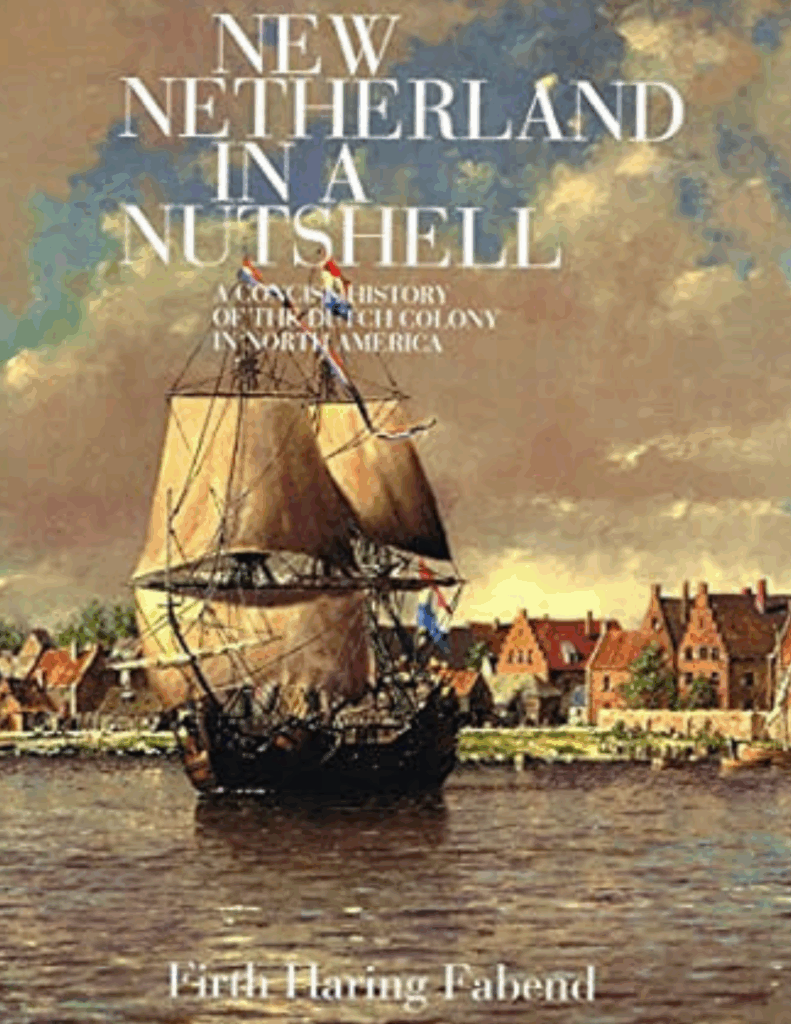
From the exploration of Henry Hudson in 1609 to the final transfer of the Dutch colony to the English in 1674, the work introduces key aspects of New Netherland: the multicultural makeup of the population, the privatization of colonization, the ability to survive with meager means against overwhelming odds, and the transfer of distinctive Dutch traits, such as toleration, free trade, and social mobility, all of which persisted long after New Netherland became New York, New Jersey, Delaware, and parts of Connecticut and Pennsylvania.
This book will satisfy the questions: who were the Dutch, why did they come, and what did they do once they got here? This unique episode in our history will no longer be “a secret” but finally available to a wide audience.”
Available from the New Netherland Institute for $20. To order email nni@newnetherlandinstitute.org
We use cookies to enhance your experience on our site. By continuing, you agree to our use of cookies. See our privacy policy page for the details.
Welcome! You can explore everything you're looking for in the NNI library. Simply type a keyword into the search bar and press Enter to begin your search.
Sign in to access exclusive features and keep track of your favorite content on NNI!
New membership are not allowed.
For over three decades, NNI has helped cast light on America's Dutch roots. In 2010, it partnered with the New York State Office of Cultural Education to establish the New Netherland Research Center, with matching funds from the State of the Netherlands. NNI is registered as a 501(c)(3) non-profit organization. Contributions are tax-deductible to the extent permitted by law.