
Significant Sources About Africans
Studying African presence in Euro American colonial history is about striking a balance between acknowledging the horrors of slavery and finding the traces of humanity and resilience in the archive. Because of the proportionally small population of enslaved Africans in the north, their lives are understudied and have only recently become the subject of significant scholarship. Enslaved Africans and their descendants are primarily found in the archive as goods to be bought and sold, and the details of these records are what preoccupied their enslavers; an enslaved person’s ability to bear children or do particular types of physical labor, for example. Scholars of African American history have to read between the lines of archival sources or cast a wide contextual net to make sense of the individual lives they find in their research.
One version of this process is called “critical fabulation,” a term coined by pioneering African American and African Diaspora studies scholar Dr. Saidiya Hartman, who teaches at Columbia University. She first mentions critical fabulation in her 2008 essay “Venus in Two Acts, and writes,
“The intention here isn’t anything as miraculous as recovering the lives of the enslaved or redeeming the dead, but rather laboring to paint as full a picture of the lives of the captives as possible. This double gesture can be described as straining against the limits of the archive to write a cultural history of the captive, and, at the same time, enacting the impossibility of representing the lives of the captives precisely through the process of narration” (11).
While the word fabulation might bring up notions of fiction-making, in this context it means attending very closely to the small details of presence in the archive, taking them seriously as significant stories in and of themselves. This is an especially important process when considering the sparser field of sources recording the history of northern slavery.
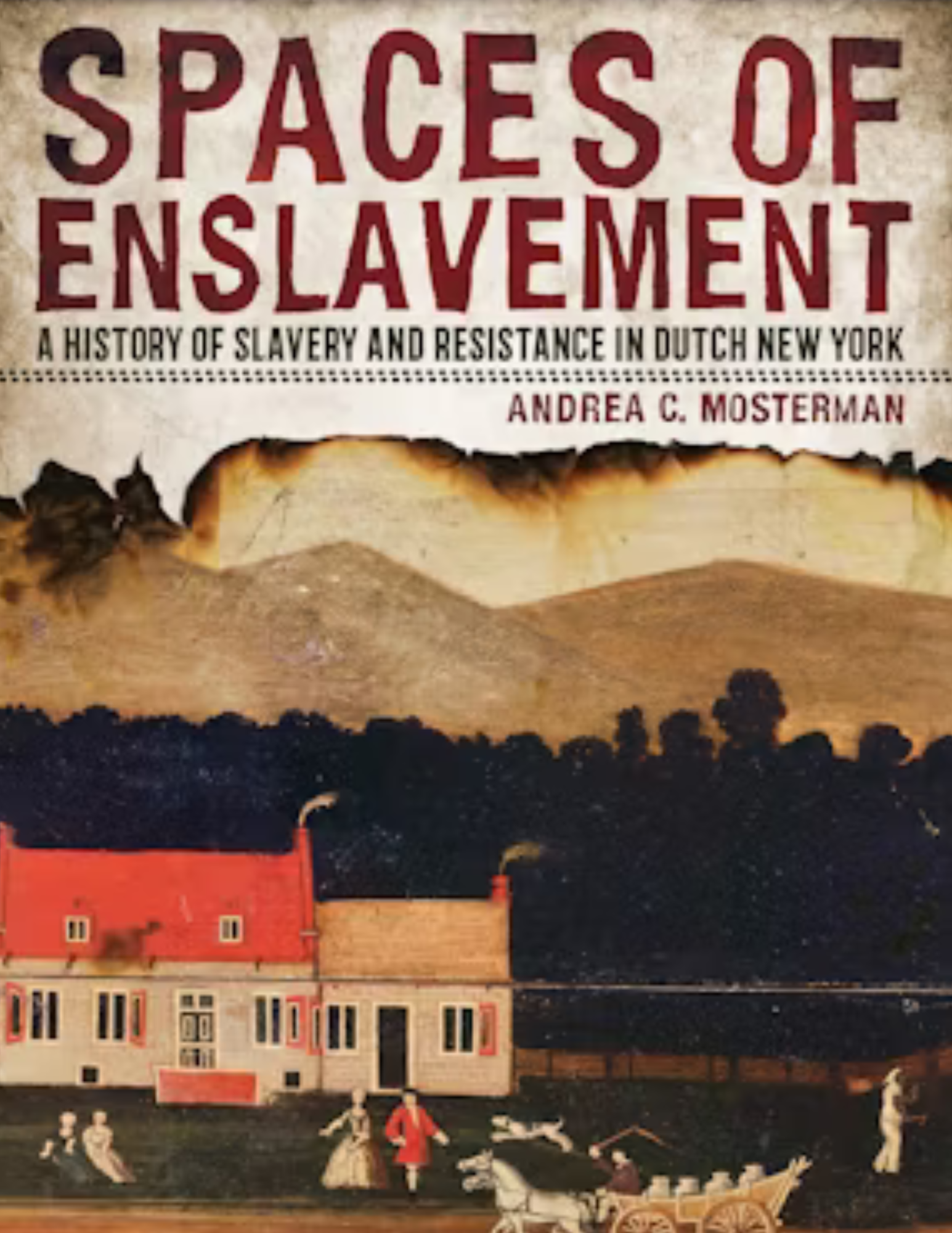
Two recent monographs are clear examples of the meticulousness that critical fabulation demands and provide critical re-framings of enslavement in New Netherland and Dutch New York. The first is Andrea Mosterman’s Spaces of Enslavement: A History of Slavery and Resistance in Dutch New York (2021). Mosterman hones in on the physical spaces in which Africans enslaved by the Dutch worked and lived as a crucial component for more clearly examining the forms of power and resistance that took place there. Spatial analysis is Mosterman’s way of addressing the paucity of archival sources. By placing herself in the church pews, attic and basements, kitchens and gardens, that enslaved people would have occupied she gains a more holistic perspective of the physical and social limitations that they experienced and the strategies of resistance that they enacted. Though Dutch settlers and the people they enslaved occupied ostensibly the same space, the ways the spaces were organized illuminate social stratification. With chapters that examine how enslaved people navigated Dutch colonial public spaces, homes, and churches this book is an excellent accompanying resource for touring any of the growing number of museums and historic homes who are revisiting their programs to include critical glimpses of the spaces where enslaved people dwelled. Mosterman also uses space as a lens to emphasize that enslaved people had particular communally generated knowledge that helped them avoid surveillance and even seize their freedom in some cases. Even within lives of restriction and violence they made space and time for agency and possibility.
Nicole Maskiell’s book Bound by Bondage: Slavery and the Creation of a Northern Gentry (2022) asserts that Dutch enslavers in the north were critical to the overall development of the economy of slavery in what is now the United States. Maskiell acknowledges that enslavement had different characteristics under the Dutch than it did under other colonial governments, but dispels the myths that slavery was “milder” under the Dutch or that the Northeast did not enter into the larger enslavement network of the Atlantic world until after the English takeover. In revisiting the archive of New Netherland and Dutch New York, Maskiell finds that Dutch trading families had “a stalwart and ultimately generational commitment” (4) to building their wealth through enslavement. She writes, “For a group assumed to be minor players, they were slave trading, expressing developed racist sensibilities, and showing up in some of the most ‘major’ places in the history of slavery at quite pivotal times” (4). In the chapters that follow, Maskiell attends closely to documentation of the changing social and political landscape that the Dutch enslaved faced and the strategies they engaged in to survive their precarious circumstances. Chapter 5 is particularly poignant; Maskiell brings together the stories of Diana, Ben, Isabel, and Caesar, an enslaved family who lived on Livingston Manor, from scant historical documentation, and puts their ruptured lives in the context of growing white settler distrust and violence following the 1712 Slave Revolt in New York and other regional conflicts, in what she calls “the tightening vice of enslavement” (99). Though their story is not a happy one, it does reveal that there were constant power struggles on Dutch patroonships and manors between enslavers, and indentured servants and enslaved people of many racial and ethnic backgrounds, who took advantage of any opportunity to assert their agency or seek their freedom.
Another significant site of power and cultural negotiation between Dutch enslavers and African enslaved was the Pinkster celebration. In Mighty Change, Tall Within: Black Identity in the Hudson Valley, editor Myra B. Young Armstead emphasizes that Black identity, like all identities, is relational, and in the context of colonialism and slavery, dependent on the relationships that developed between enslaved people, their particular European enslavers, and the lands they occupied. Pinkster appears in several essays in the collection as an example of the particular context of Dutch-enslaved relationality. Graham Russell Hodges discusses it as a part of the development of a new Black religious identity in the Hudson Valley starting in the Dutch colonial period. Though enslavers who were a part of the Dutch Reformed Church were reluctant to baptize or allow their enslaved to participate in church life, church celebration was incorporated into the social cycle of the year. Pinkster, the Reformed Church’s version of Pentecost, would have been familiar to enslaved people, many of whom were originally from what is today Congo where Roman Catholicism took hold in the 16th century. In New Netherland, Pinkster was a three day long holiday from work for the entire community, enslaved people included. Hodges writes that they took advantage of this by using the overall spirit of merriment to perform syncretic versions of religious ceremonies from the various African spiritual traditions they came from, replete with dancing, drumming, and singing. Therefore Pinkster provided a way to carry on indigenous practices even under enslavement. To return to Armstead’s point about relational identity development, Jeroen Dewulf’s monograph The Pinkster King and the King of the Kongo demonstrates that this is not unique to Dutch enslavement but one version of a practice being conducted across the enslaved African diaspora, including within Africa. As Africans spread across the Atlantic world they synthesized local and colonial celebrations and materials in order to sustain versions of their own cultural practices. Dewulf traces the similarities and differences in how Pinkster was taken up by enslaved people in other Dutch colonies in the Americas and the Caribbean.
Pinkster became such a source of cultural vitality for the enslaved community in Dutch New York that in 1811 it was banned in Albany for fear that it would spark enslaved uprising. Linda Pershing’s essay in Mighty Change, Tall Within is about the Pinkster revival in present day North Tarrytown, New York. She writes that today’s Pinkster celebration is a way for participants “to resist dominant cultural forces through coding and parody, celebrating interpretations of the past and present that remind viewers of the legacy of racism and slavery” (193). In this way, Pinkster persists as a practice that allows members of the African diaspora to reflect on and interpret their particular cultural context, shifting the particularities of the celebration to suit their communities needs in the same way their ancestors did in New Netherland and Dutch New York. The revival of this tradition both connects the North to histories of enslavement, and proves the resilience of northern African American communities who can trace their lineage back to Dutch colonial times.