


A Tribute to A.J.F. Van Laer
A.J.F. van Laer, though little known outside New Netherland scholarship, laid the foundation for modern study of the colony. His meticulous translations of 17th-century Dutch records remain essential, shaping the work that continues through today’s New Netherland Project.
by Peter Douglas
Those new to the New Netherland Project may be forgiven for not being familiar with the name A.J.F. Van Laer, but his work in translating and publishing Dutch colonial manuscripts forms the significant foundation upon which the current project stands. Although he died nineteen years before the current New Netherland Project was established in 1974, he remains an early pioneer of the drive to give New Netherland its rightful place in this country’s history. The first four volumes of his New York Historical Manuscript series (now called New Netherland Documents) “still stand as a model translation of 17thcentury Dutch,” wrote Charles T. Gehring, the Director of the New Netherland Project and spiritual successor of Van Laer’s labors.
Arnold Johann Ferdinand Van Laer was born in Utrecht in 1869, and in his 30th year graduated from the New York State Library School in Albany. In April 1899, the State Archivist of the New York State Library died, and Van Laer was appointed sub-librarian in charge of the Manuscripts Division. Within a year his position was changed to State Archivist, a position he held until 1914 when, under a reorganization plan, he was transferred, with his title, to the office of the State Historian.
Copying and translating the Dutch records and editing them for publication became Van Laer’s life work until his retirement in 1939. Being a Dutch native, and having a broad cultural education in that country, he was well qualified for the task. The State Librarian’s report of 1899 makes it clear that he was just the right man for the job:
“Mr. Van Laer brings to his work a rare combination of linguistic ability, professional training, accuracy, and enthusiasm which will render his services of great value in deciphering the rich collection of Dutch manuscripts … entrusted to his care.”
Much as we speak of Charly today, in fact! Hitting a rather somber but certainly realistic note, in his first report in 1900, Van Laer wrote of the responsibility he felt for the documents and, prophetically, of their precarious future:
“Many of the Dutch records are at present in such frail condition that any handling, however careful, puts them in danger of becoming torn and more illegible… Apart, therefore, from the danger of total destruction by fire or otherwise, always attending unique documents, it seems imperative that they should be preserved in print as soon as possible.”
The huge tragedy of the Capitol fire on March 29, 1911, was naturally a prodigious shock for Van Laer and a crushing blow to his work. He labored as hard as anyone in the chilly April weeks after the fire to locate and salvage the remains of the precious Dutch records. He dug in the dangerous ruins of the State Library, removing the burned overlay that was above the papers that had succeeded in preserving them from worse damage. Heaps of documents, burned on the surface, were frozen into black clumps, beneath which were the records he sought, charred around the margins but with much of the writing still decipherable. Van Laer personally inspected every shovelful of debris as it was removed, fearing the loss of the smallest of vital scraps. That so many documents were saved can be attributed to his knowledge of their location and appearance, as well as to his great efforts in the recovery process. His intimate acquaintance with the documents was crucial in enabling him, as no one
After the fire, Van Laer temporarily suspended his translating. The records that had survived must have presented a heartbreaking sight to him, ruined by water as they were, and scorched around the edges—damaged much as he had feared and uncannily foresaw back in 1900. The 12,000 manuscript pages now presented a far greater challenge to his skills—as they do to Charly today. The shock and distress brought about by the loss of and damage to the Dutch colonial documents, as well as the destruction of half a million books and 270,000 irreplaceable manuscripts the library held, seemed to stifle Van Laer’s former energy. It would be almost a decade before he would resume his work as translator and editor of his important scholarly publications.
In 1924 the tercentenary celebration marking the construction of Fort Orange provided Van Laer with the stimulus to translate and publish the Court Minutes of Fort Orange, and the Court Minutes of Albany, Rensselaerswyck, and Schenectady. In addition to these scholarly publications, he was also inspired to write a series of essays on the history of New Netherland for distribution to schools throughout the state. These essays are available in the Annals of New Netherland section of this website.
In her “Appreciation” to Van Laer in June 1955, following the scholar’s death at the age of 86 three months before on March 25, 1955, Edna L. Jacobsen, Head of the Manuscripts and History Section of the New York State Library, wrote:
“New York State is fortunate to have had the benefit of his scholarship, and has suffered an irreparable loss in no longer having the guidance of his counsel.”
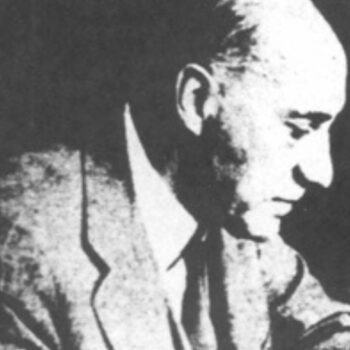
Editor’s note: The photograph above is the only known depiction of A.J.F. van Laer. It appeared in the Albany Evening News on October 12, 1932, illustrating an article relating to the tedious task of translating Dutch records.