
Volume XVI – Part II: Fort Orange Court Minutes 1656-1657, Part III: Fort Orange Records, 1660
PDF – Volume 16 Fort Orange Court Minutes 1652-1660
Parts II and III are grouped in the same volume. The two volumes (1652–1656 & 1658–1659) housed at the Albany County Hall of Records.
In the spring of 1652, the ongoing dispute between New Netherland’s director-general Petrus Stuyvesant and Rensselaerswijck’s director Brant van Slichtenhorst came to a head when Van Slichtenhort commited his final act of insubordination–his refusal to post a company ordinance. Consequently, Johannes Dijckman–the commissary of Fort Orange–accompanied by eight soldiers, hauled down the patroon’s flag, rang the bell, and proclaimed the establishment of the court of Fort Orange and village of Beverwijck. A new political entity had been created.
The newly created court was a court for the trial of civil and minor criminal cases, from which an appeal lay to the director general and council of New Netherland. The jurisdiction of the court comprised Fort Orange, the village of Beverwijck, Schenectady, Kinderhook, Claverack, Coxsackie, Catskill and, until May 16, 1661, when a court was established at the Esopus. Excluded from the jurisdiction was the colony of Rensselaerswijck, which maintained its own court, side by side with that of Fort Orange and the village of Beverwijck until 1665, when by order of Governor Richard Nicolls the two courts were consolidated.
The majority of the records document real estate transactions, such as conveyances of property from one individual to another, conditions of sale, conditions of auction, and surrenders of claims; records also include acknowledgments of debt, inventories of estates, warrants, powers of attorney, pledges of security, as well as some of the more common cases involving property disputes, acknowledgement of debts, slander and the use of abusive language. Such documents carried authentic signatures and could be submitted as legal instruments in court proceedings.
The records of the court, which under different names continued to exist until the erection of the mayor’s court of the city of Albany in 1686, have for the greater part been carefully preserved. They consist of eight books of minutes, all written in the Dutch language, of which six, containing the minutes for 1652-56, 1658-59, 1668-73, 1675-84, 1676-80, and 1680-85, are kept in the Albany County Hall of Records, and the remaining two volumes, containing the minutes for 1657 and 1660, form part of volume 16 of the New York Colonial Manuscripts in the New York State Library. The four books in bold are included in the present volume. These records were translated by Charles Gehring and published in 1990 as Volume XVI, part two in the New Netherland Documents Series.
Parts II and III are grouped in the same volume and two volumes (1652–1656 & 1658–1659) housed at the Albany County Hall of Records: published as Fort Orange Court Minutes 1652-1660.

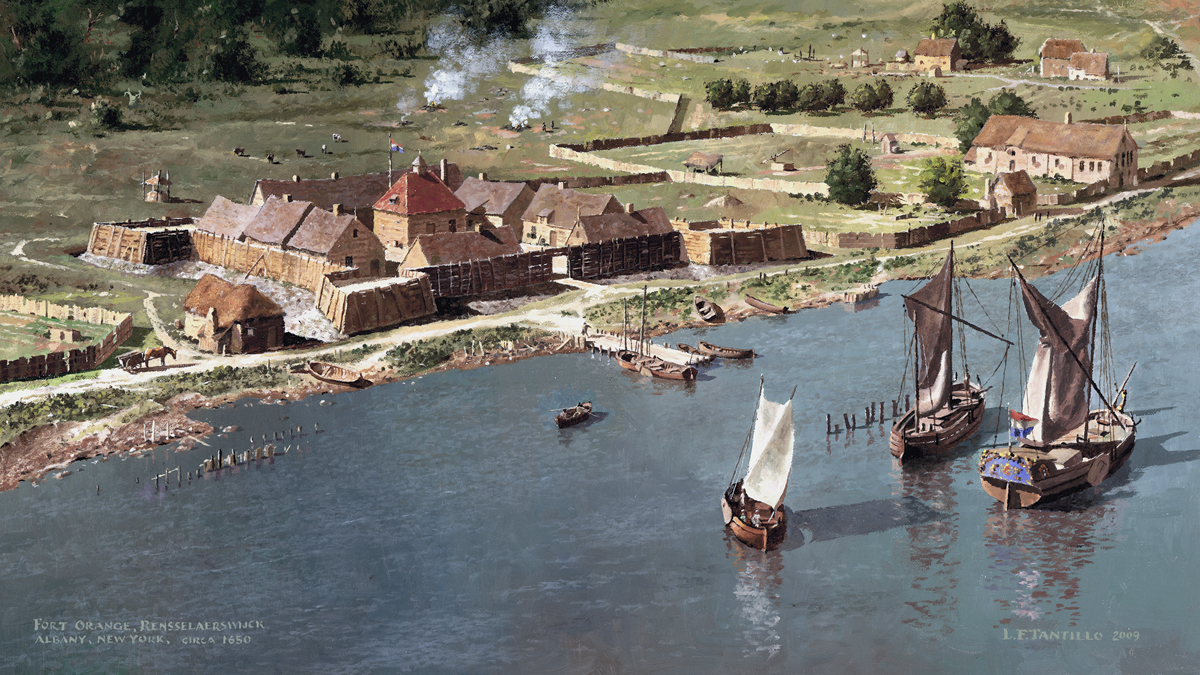
Artist's description:
This image shows us the simple wooden trading fort operated by the Dutch West India Company from 1624 until 1664. Contained within the fort's walls are a number of timber framed houses and a courthouse with a pavilion roof and cupola. The van Doosburgh house in the southeastern corner of the fort’s courtyard (lower left corner) was the subject of much attention when it was excavated by archeologists in the 1970’s. The fort was surrounded by a stone-lined moat on all four sides and accessed via a bridge through the main gate which faced the river. The defensive diamond-shaped bastions on the corners of the fort were earthen filled and served as elevated platforms for cannons. Outside the walls of Fort Orange was the community of Beverwijck. To the left of the fort stood a crude tavern, depicted in the painting with a straw roof. To the right of the fort, the most prominent structure, a long wooden building, served as the Patroon’s house and the church. It was of simple timber construction also with a straw roof. Killiaen van Rensselaer, the original Patroon, never visited the colony of Rensselaerswijck of which he was the chief administrator. After his death in 1643, his oldest son, Johannes, took the position of Patroon. In 1652 Johannes was succeeded by the second oldest son, Jan Baptist van Rensselaer. Jan Baptist became the first Patroon to live in the colony that his family had administered for so many years and was the first Patroon to actually reside in the house depicted in the painting Fort Orange and the Patroon's House.