Now Reading:

Explorers, Fortunes and Love Letters

Font Selector
Sans Serif
Serif
Font Size
A
A
You can change the font size of the content.
Share Page

Exploring Dutch Heritage Through Research 

Exploring Dutch Heritage Through Research 

Explorers, Fortunes and Love Letters

Published in 2009, this collection of essays pulls from diverse perspectives–social, cultural, intellectual, economic, and political–to weave together the dynamic and diverse history of the Dutch in America.

Explorers, Fortunes, and Love Letters
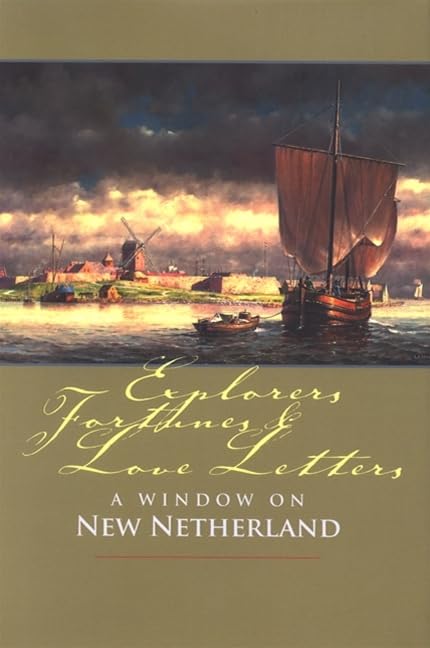
Purchase the book here.

Drawing on the latest research, leading scholars shed new light on the culture, society, and legacy of the New Netherland colony.

About the Book:
When Henry Hudson, sailing on the Half Moon for the Dutch East India Company, first laid eyes on the entrance to the Hudson River in 1609, a world of seemingly infinite possibilities lay before him and his crew. In 1624 the Dutch would take advantage of these opportunities and create the colony of New Netherland, building homes and communities that stretched from the Delaware Bay up along the Hudson River Valley to present-day Albany, New York.

The story of New Netherland is often overlooked in tales of the founding of America. The essays in Explorers, Fortunes and Love Letters: A Window on New Netherland offer a new perspective that takes the spotlight off the Puritans of New England and the settlers of Jamestown, Virginia, and instead offers striking arguments for casting the Dutch as central players in the American narrative.

These twelve essays, written by preeminent historians of New Netherland, pull from diverse perspectives—social, cultural, intellectual, economic, and political—to weave together the dynamic and diverse history of the Dutch in America. These scholars explore all aspects of Dutch life, ranging from sailing methods to factional politics to written expressions of love. The authors discuss how settlers retained traditions from the Netherlands, such as the baking of bread, and how these traditions changed over time and became engrained in American culture—including the transformation of the Dutch St. Nicholas into today’s Santa Claus. The colony of New Netherland was marked by its diversity, and this topic is explored in discussions of the relationship between Native Americans and Dutch settlers in the Mohawk Valley, the role of Jews in New Netherland, and the practice of slavery throughout the colony. The Dutch perspective on child-rearing practices is also examined, as well as the dream of attaining fortune in the New World.

Two of these essays are below. To read all of the essays, you may purchase the book.

Bread: Staff of Dutch Life in the Old and New World

By Peter G. Rose

Bread was the mainstay of the Dutch diet in the seventeenth century. It was consumed with butter or cheese for breakfast, paired with meat or hutspot—a one-pot dish of meats and vegetables—for the midday main meal, and served with, or as part of, the porridge at night. Baked goods accompanied the human life cycle, from the rusks with comfits served at celebrations of a birth to funeral biscuits offered at the time of death. Bread and koek—a gingerbread-style or flat, hard cake—were then, as now, prominent in Dutch food culture. These staples were brought to the New World, where they assumed a similar position in the diet of Dutch settlers and their descendants.

The detailed record books of the Amsterdam Municipal Orphanage provide valuable insight into the bread consumption of both the poor (the orphans) and the lower middle class (the staff). Ann McCants, in her analysis of the diet of burgher orphans in Amsterdam, found that the daily bread ration between the years 1639 and 1699 fluctuated between ten and eleven ounces per child, averaging about ten and a half ounces. Indeed, “bread occupied a prominent place in the daily diet of the Burgerweeshuis” and accompanied nearly every meal, as excerpts from the orphan menu for 1640 demonstrate:

Sunday noon: beans with a piece of bread; salted or smoked meat with a piece of bread
Sunday evening: whole milk with rice made into a porridge
Tuesday noon: white beans with butter and a piece of bread; smoked or salted bacon with carrots, turnip, or cabbage and bread
Tuesday evening: buttermilk with rye bread
Thursday noon: beans with a piece of bread; salted or smoked meat and bread
Thursday evening: buttermilk with wheat bread cooked together

Read the rest of the article here

Glimpses of Childhood in the Colony of New Netherland

Adriana E. van Zwieten

Within two decades of Henry Hudson’s exploration of the river that would later carry his name, children from Europe had crossed the Atlantic to a new home in New Netherland. Upon arrival, they worked alongside their parents to build settlements. They were present when the walls of Fort New Amsterdam—now New York City—were erected.

Imagine their excitement when a whale swam up the North (Hudson) River beyond Beverwijck (now Albany) in 1647, and their sense of wonder when comets were observed in the heavens in 1665. Children were rocked in their cradles, learned to walk on New Netherland’s soil, ran and skipped on the roads, dashed through the fields, and sometimes caused mischief.

Many grew to adulthood. Many died in infancy. Others became orphans. Filled with youthful exuberance, the healthy and capable went to school and worked, learning the skills that would carry them into adult life.

Yet children left no written record describing their experiences. Consequently, it is through the writings of adults that their activities are revealed. The numerous pages of extant colonial manuscripts show how important children were to their parents and to the broader community.

According to Nicasius de Sille, who was a prominent member of New Netherland’s society, children and pigs were abundant in New Amsterdam by 1654. Both multiplied, he wrote, “rapidly and more than anything else.”3 Little did De Sille realize that his oft-quoted words would be difficult to verify. The data required to corroborate his statement have, for the most part, been lost. The baptismal registers of the Dutch Reformed churches in New Amsterdam and Breuckelen (now Brooklyn) do chronicle the presence of over 2,600 children from 1639 through 1674,4 but such evidence is lacking for the colony’s other villages and towns and for other religious denominations for this period. Furthermore, the birth of some children was simply never recorded. Many were born elsewhere, then immigrated to the colony with their parents but remained nameless on ships’ registers or in various accounts. Furthermore, the total number of all children was greatly decreased by infant-mortality rates, which were high in the seventeenth century.

Birth and Baptism

It is possible, nevertheless, to begin with birth and baptism to tell the story of childhood in New Netherland, for the records reveal that babies of  European heritage generally were born at home, their mothers attended by midwives and surrounded by female family members and friends.5 Immediately after birth,

WHAT WAS NEW NETHERLAND?


About New Netherland Institute

For over three decades, NNI has helped cast light on America's Dutch roots. In 2010, it partnered with the New York State Office of Cultural Education to establish the New Netherland Research Center, with matching funds from the State of the Netherlands. NNI is registered as a 501(c)(3) non-profit organization. Contributions are tax-deductible to the extent permitted by law.