Now Reading:

Picturing the Flatts

Font Selector
Sans Serif
Serif
Font Size
A
A
You can change the font size of the content.
Share Page

Exploring Dutch Heritage Through Research 

Exploring Dutch Heritage Through Research 
Picturing the Flatts

“The two elements that plague me the most are speculation and certainty … All that work I’ve done to represent the seventeenth century in New York State is in some part certain and in some part speculation.”

– Artist Len Tantillo at the 2009 Rensselaerswijck Seminar, Albany

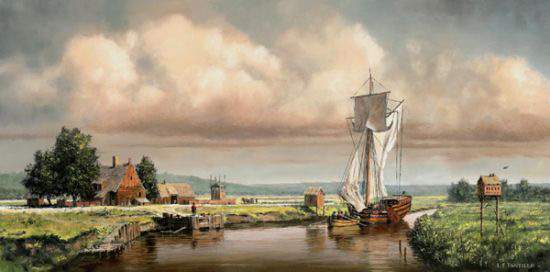
Homeport by Len Tantillo

A conjectural view of the 17th century farm of Teunis Dirckse van Vechten depciting the house, hay barrack and creek, c. 1650.

In 2004, archaeologists Paul Huey and Jim Bradley led Len Tantillo across a recently turned field along a creek on the east side of the Hudson. Paul and Jim told Len to look for any stone larger than a couple of inches. Sure enough about a hundred yards along, Len kicked a rock as big as a football. Then he noticed a few that were squared off, along with yellow bricks.

Len had just walked across the debris field of the seventeenth century farm of Teunis Dirckse van Vechten. From documents, he knew Van Vechten’s farm included a house, a barn and a hay barrack and that Van Vechten owned a share in a yacht. Now he was standing on the farm. From the way the debris spread out and then tapered off, he sized up how it might have been positioned beside the creek. Combining that information with many years’ study of land and maritime architecture of the 17th century Dutch, he painted “Homeport.” The painting depicts the key elements – house, barn, hay barrack, yacht and creek – in a conjectural view of Van Vechten’s farm, ca. 1650.

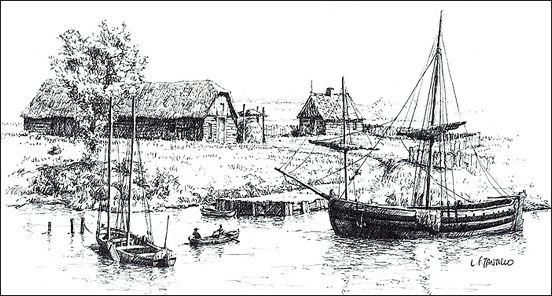
Applying the same techniques, Len sketched the Flatts farm, ca. 1644. The “long farmhouse” Arent laid out in his 1643 letter to the patroon rises back from the creek. The house for “the carpenters and the farmhands to live in” sits to the right, its roof “covered with tiles.” Arent’s “very tidy bark” is anchored offshore, her “bran-new sails” furled. A hay barrack lies between the two buildings, a speculation but how could a farm with the horses and milch cows Arent reported do without one?

A Sketch of the Flatts Farm, ca. 1644, by Len Tantillo
  • About New Netherland Institute

    For over three decades, NNI has helped cast light on America's Dutch roots. In 2010, it partnered with the New York State Office of Cultural Education to establish the New Netherland Research Center, with matching funds from the State of the Netherlands. NNI is registered as a 501(c)(3) non-profit organization. Contributions are tax-deductible to the extent permitted by law.