

Life at the Flatts
“Corlaer (a considerable Man among the Dutch) … had a mighty influence over the Indians, and it is from him that all the Governors of New York are called Corlaer by the Indians to this day.”
– New York Governor Cadwallader Colden in The History
of the Five Indian Nations, 1727
Before Arent could sail, Van Rensselaer died. When Arent reached Amsterdam in 1644, Van Rensselaer’s 18-year old son Johannes had succeeded him. Meeting the new patroon and the guardians managing his affairs, Arent realized many decisions lay ahead for the colonie that demanded his first-hand knowledge. The visit he planned as brief would not be. He sent for his bride Anthonia. The couple would not return to New Netherland for three years. Before they boarded ship, Johannes granted Arent a six-year lease to the Flatts.
Over the next decade, Arent developed the Flatts farm. He hired laborers for building and other work. From the Mahicans he bought islands he had coveted for years. His stallions sired horses prized locally and sold as far away as the Caribbean. His cows supplied milk, butter and cheese. His efforts with sheep and pigs were less successful. Wolves ate the sheep while the pigs escaped to the woods.
Arent continued to cultivate his contacts in the fur trade. The 1640s were a turbulent time. Wars waged among the various tribes. Disease swept through them. The next decade was little better. More traders chased a dwindling supply of pelts. New Englanders encroached from the east. The French attacked the Mohawks from the north. But Arent had a rare gift for understanding the native people and treating them as equals. With his connections in the Netherlands, he delivered the goods they wanted. Amid the turmoil he prospered.
The youth who arrived at eighteen grew into an affluent burgher. Arent bought property in the growing community of Beverwijck west of the Hudson. He filled his home with jewelry, paintings and fine furniture. He accepted appointments as a commissioner and a trustee to build a school.
Twice the community sent him to the Mohawks “to renew the former alliance and bond of friendship.” With so much respect did the Mohawks hold this friend that into the next century they addressed New York Governors as “Brother Corlaer.”
Read Related Documents in Translation:
Grant to Arent van Curler to support builders and workers at the Flatts, November 15, 1649
Appointment of Van Curler to mission to the Mohawks, September 23, 1650
Appointment of Van Curler as Commissioner, January 5, 1651
Record of a Meeting at Fort Orange between Mohawk sachems and several burghers, including Arent van Curler, November 19, 1655
Propositions Made to the Mohawks by delegation including Jeremias van Rensselaer and Arent van Curler, September 24, 1659
Purchase of Beverwijck property by Arent van Curler, March 1, 1661
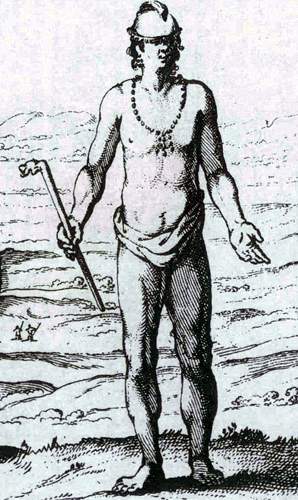
Van Curler’s relations with the Mohawks were critical to the success of the Flatts when he returned from Amsterdam. In 1644, Johannes Megapolensis, the dominie of Rensselaerswijck, published a pamphlet about them titled “A Short Account of the Mohawk Indians.” A later edition included the above engraving, leading to the Indian’s identification as a Mohawk. Scholars today believe the image is derived from a 1645 original by Wencelaus Hollar and probably represents a Munsee. The earliest confirmed image of a Mohawk dates from the mid-eighteenth century.