



for
Fur Trade
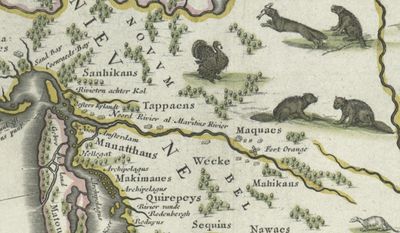
Beavers on a map of the Hudson River region indicating their importance to industry.
Beavers on a map of the Hudson River region indicating their importance to industry.
If it was the search for a short route to Asia that brought the Dutch to North America, it was the beaver that made them stay. In 16th- and 17th-century Europe, fur was more than a luxury: as standards of living rose, fur-lined coats, fur collars, fur capes and muffs became near necessities. The beaver was particularly prized because its fur had a special characteristic: under the long glossy coat was another layer of short, tightly-packed hairs. This layer was made into felt, which produced hats of every description and fashion, of great warmth and quality. Russia was the first major supplier of beaver and other furs. The decline in its population of furry animals coincided with the French discovery of rich beaver lands in Canada, and with Henry Hudson’s charting of the Hudson River. The West India Company founded New Netherland not as a colony for the growth of settlements but as a way to exploit the “soft gold” of the region. Within a few years of Hudson’s 1609 voyage, Indians of many tribes were bringing animal pelts along the three major river systems to Dutch trading posts. The trade was a much bigger business than is popularly thought: in one seven-year period, from 1626 to 1632, the Dutch traded shipped home to the Netherlands 52,584 pelts. The trade rapidly transformed the tribes of the region, causing them to hunt farther and farther afield and for a greater portion of the year in order to trap enough furs to trade for the supplies they now desired. This led to a breakdown of the traditional duties of men and women, and greater reliance on the Europeans. The Dutch also learned quickly how to adapt to the Indians. They had to have ready supplies of the kinds of products the Indians wanted-knives, axes, needles, glassware, kettles, and a coarse wool called duffel (after the town of Duffel where it was made, in what is now Belgium)-or the Indians would go to the English to their north. It was a system that was bound to end, as the beaver population simply couldn’t keep up with the demand, but for a time it benefitted both the Europeans and the native Americans who participated in it, even while it locked them in a complicated, and often dangerous, relationship.
- Information about beavers and other fur-bearing animals, from the National Trappers Association
- Or perhaps you prefer to protest the fur clothing trade