Translations & Transitions Govert Loockermans, a Manhattan Merchant’s Correspondence & Papers More → |
Voyages Maritime routes that shaped the Dutch North Atlantic world More → |
Zotero Bibliography Research Source: 17th century scholarly, non-fiction publications More → |
Genealogical Research What’s in a Name? Discover your ancestors’ origins More → |
Translations & Transitions Govert Loockermans, a Manhattan Merchant’s Correspondence & Papers More → |
Voyages Maritime routes that shaped the Dutch North Atlantic world More → |
Zotero Bibliography Research Source: 17th century scholarly, non-fiction publications More → |
Genealogical Research What’s in a Name? Discover your ancestors’ origins More → |

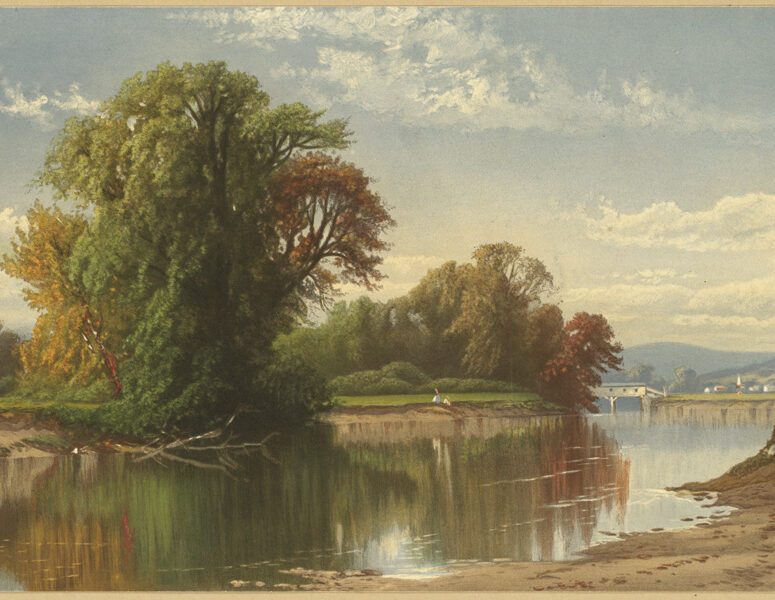
Artist: Alfred Thompson Bricher (ca. 1861–1897)
Source: Boston Public Library, Print Department
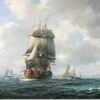
Throughout the 1620s and 1630s traffic on the North River moved steadily between New Amsterdam-the capital of New Netherland, located on the island of Manhattan-and Fort Orange, the outpost 150 miles to the north, which would eventually become the city of Albany. But, as Henry Hudson discovered on first exploring the region in 1609, the river grew shallower about halfway up. Dutch sea captains soon realized it made sense to move cargo onto lighter vessels once they reached this point. In 1652, a group of about 60 Fort Orange settlers moved south to this spot and formed a village. They named it Esopus after the Esopus Creek, a waterway that fed into the river here, and along whose fertile banks they farmed.
They weren’t alone, however. The Esopus Indians also farmed this stretch. The Dutch had known the Esopus for years; in 1640, the famed Dutch adventurer David deVries wrote in his journal on coming up the river: “The 27th, we came to Esoopes, where a creek runs in; and there the savages had much maize-land, but all somewhat stony.”
For a time after the founding of the village relations were peaceful, but eventually the two sides squared off in a series of bloody encounters called the Esopus Wars. In 1657, Peter Stuyvesant, the director-general of New Netherland, built a stockade to protect the Dutch, and renamed the village Wiltwyck.
In 1669, under English rule, the town-now the third most populous settlement on the river-was renamed Kingston. In 1777, amid the turmoil of the Revolution, patriot leaders met in Kingston and declared the new state of New York. Kingston thus became the first capital of New York. At least in the short run, it wasn’t the wisest move. A month later, British troops marched into town and burned it to the ground.
WHAT WAS NEW NETHERLAND?
We use cookies to enhance your experience on our site. By continuing, you agree to our use of cookies. See our privacy policy page for the details.
Welcome! You can explore everything you're looking for in the NNI library. Simply type a keyword into the search bar and press Enter to begin your search.
Sign in to access exclusive features and keep track of your favorite content on NNI!
New membership are not allowed.
For over three decades, NNI has helped cast light on America's Dutch roots. In 2010, it partnered with the New York State Office of Cultural Education to establish the New Netherland Research Center, with matching funds from the State of the Netherlands. NNI is registered as a 501(c)(3) non-profit organization. Contributions are tax-deductible to the extent permitted by law.
