

When the Dutch Invaded England
Over the centuries the seas surrounding Great Britain have helped to halt or deter many invading forces. The most significant of these were the Spanish Armada in 1588, Napoleon Bonaparte in 1803–05, and Nazi Germany’s Operation “Seelöwe” in 1940.
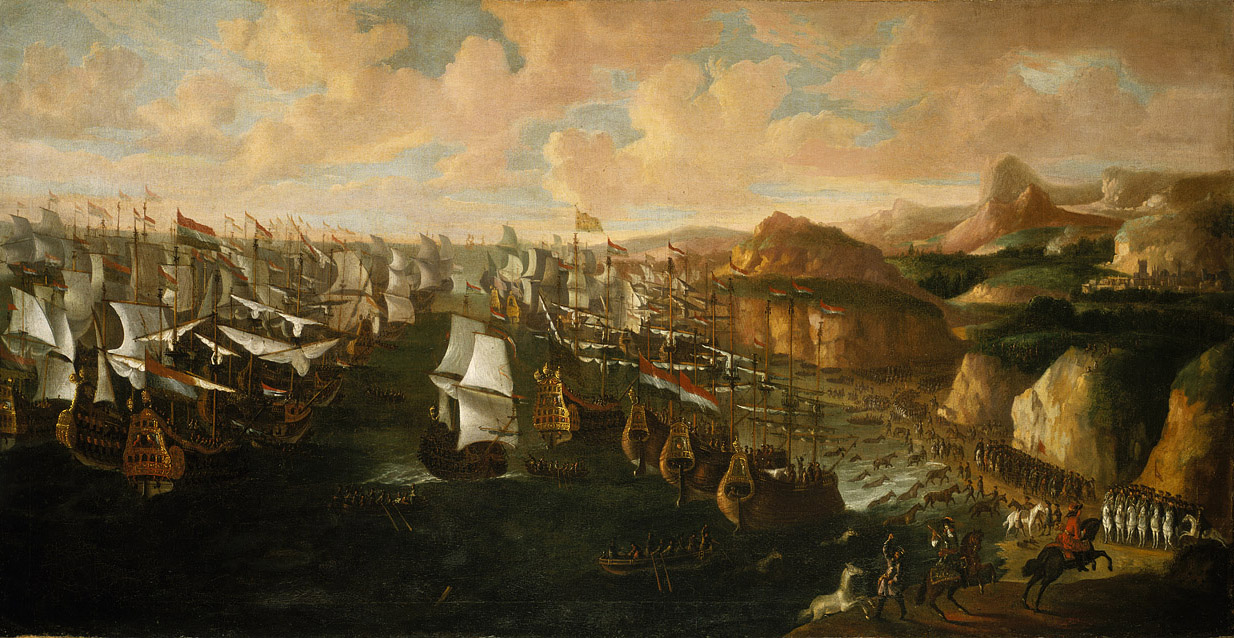
by Peter A. Douglas
At other times (mostly ancient times) Nature’s “moat defensive” has been less effective, and some invasions succeeded, notably the Roman conquest of Provincia Britannia under the Emperor Claudius, the Anglo-Saxon and later Viking raids and settlement, and the Norman Conquest in 1066. But there was another victorious force that landed on English soil; it is less well known, though it had, like the others, important and lasting consequences. This took place exactly a century after the Armada, and was the last successful invasion of England. The Dutch accomplished it in 1688.
This event came to be known as the “Glorious Revolution,” a curiously cheerful name for an invasion, suggesting that it was, in fact, not so much an aggressive incursion but one that was welcomed and even encouraged by many Englishmen.Well, by the Protestants anyway. Its outcome was a huge political and religious upheaval with lasting consequences, bringing about the removal and replacement of a king and the long, bitter Jacobite struggles in Scotland and Ireland, a whole series of uprisings and rebellions that were to continue well into the 18th century. It led too to the Bill of Rights of 1689, a landmark document in the establishment of civil liberties that served as inspiration for later statements of rights, including the United States Bill of Rights, ratified in 1791.
At the time, England was ready for a change. James II became king on the death of his brother, Charles II, in 1685 and his policies concerning his Catholicism and his close ties to France found mounting opposition. The crisis in public alarm came in June 1688 when James’ son, James Francis Edward, Prince of Wales, was born to his second wife, Mary of Modena, also a devout Catholic.This changed the line of succession by replacing James’ Protestant elder daughter Mary with this child, a Catholic heir apparent. Many in England now feared a revived Catholic supremacy in the government and the possibility of a lasting royal Catholic dynasty. A movement took root with the aim of replacing James with Protestant Princess Mary.
That same June, seven prominent Englishmen (a bishop and six nobles), later named the “Immortal Seven,” sent a letter to William of Orange in the Netherlands. Seeing William as a friend (he was also of royal lineage, being the grandson of Charles I), the “Immortal Seven” found no difficulty in rehashing all the grievances against James and inviting William to force James (William’s uncle and father-in-law) to make William’s Protestant wife James’ heir. They also offered their support if William were to land in England with an army to achieve this end.
This was not exactly a new idea to William. Disgruntled Protestant nobles and politicians had maintained secret communication with him for over a year concerning how to counter James’ pro-Catholic policies. Always searching for ways to diminish the power of France, William hoped that James would join the League of Augsburg, a 1686 European coalition to curtail France’s expansive role. When it became clear that James had no intention of joining the anti-French alliance, relations between the two men worsened. William had conceived of the invasion in April 1688. He wanted to protect his wife’s hereditary rights but his enmity with France was the chief motive that induced him to invade, for he hoped to align England with the Dutch in the coming war with France. While initially unwilling to aim for James’ crown, the French threat to the Protestant Netherlands provided him with a strong incentive, and in the end he committed to it.
England was in political turmoil and William took decisive advantage of this. His invasion plan was meticulous and on a grand scale. Well prior to the invasion he prepared an enormous propaganda campaign to promote and justify his brazen military intervention in a foreign nation. It was an ambitious and very modern piece of public relations. Though a collaborative effort, William’s Declaration is his personal manifesto, explaining his duty to support the basic rights, laws, customs, and liberties of the English people at a time when they are under threat, and “especially where the alteration of religion is endeavoured.” Tens of thousands of copies of the pamphlet were printed in secret and widely disseminated on the very day the fleet reached England.
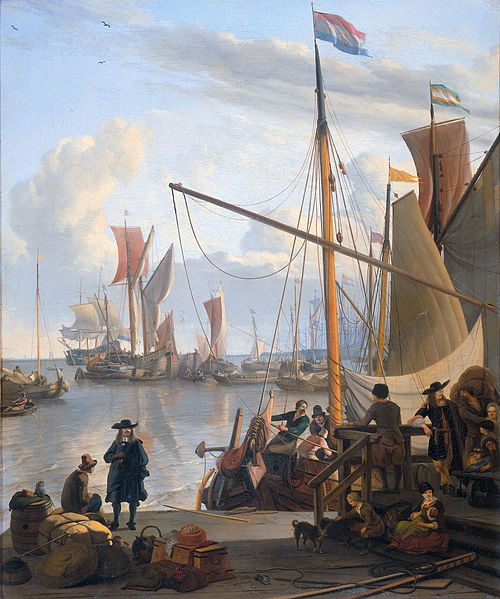
William’s invasion force was formidable, consisting of 53 warships and 400 transport vessels carrying some 15,000 infantry and cavalry, 7,000 horses, and supplies, weapons, and ammunition. He landed at Torbay near Brixham, in Devon, on November 5, 1688. (Significantly this was the anniversary of the 1605 Gunpowder Plot, an earlier deliverance from Popish perils.) From the start William had the strategic advantage, with James’ forces dispersed around the country. William’s progress towards London was unhurried. Having landed far from James’ army (Brixham to London is 160 miles), his strategy was to give James plenty of time to consider his position, anticipating that his English allies would act against the King. Supporters didn’t flock to join him, but there was little opposition. Faced with their first invasion in 600 years (and their last, as it turned out), the English people were hedging their bets.
William tried to avoid battle, hoping that James’ faltering support would soon collapse. Also, a slow advance would not over-extend his supply lines; his troops were forbidden to forage for fear that it might become plundering and so alienate the population. Less than a week after landing William entered Exeter in full pomp and ceremony and received a warm welcome from the townspeople if not the clergy.
King James refused an offer from the French to send military support, fearing that this would cost him the backing of his people. He finally gathered his forces at Salisbury, but his smaller army was inferior in training and experience.
With anti-Catholic riots in London, and later in many towns across the country, it became clear that his troops were not keen to fight and the loyalty of many of his commanders was in question. So many Protestant officers deserted to William’s side that James dare not commit his army to battle and he feared defeat if he were to fight. In early December William met James’ commissioners at Hungerford to state his terms.
It has also been called the “Bloodless Revolution.” This is not strictly true, but as revolutions go the body count was low. Most of the bloodshed occurred later in Ireland. There was an early skirmish at Wincanton in Somerset, and on December 9 the Battle of Reading was fought, the only substantial military action in England, which routed the Irish
Catholic troops and killed 20 to 50, depending on the account. Following this defeat, James withdrew to London in an abortive escape attempt, during which legend has it that he dropped the Great Seal of England into the Thames. Eventually he fled to France at the end of December, where he found support from Louis XIV. In effect, the King was
deported from his own country by a foreign army. James made an effort to restore himself to the throne by crossing to Ireland, where most of the population supported him. But his bid to regain the crown failed with his defeat by William at the Battle of the Boyne in July 1690, a crucial and, by the Protestant victors, a much-celebrated moment in the long and bloody conflict between Irish Protestants and Catholics. James returned to exile in France, never again to see any of his former kingdoms. He died in 1701, age 67.
The Jacobite struggle to restore the House of Stuart to the throne would continue for more than four decades after James’ death, the final confrontation being the Battle of Culloden near Inverness in 1746. Here the Hanoverian victory over Charles Edward Stuart (a.k.a. Bonnie Prince Charlie, James II’s grandson) ended the Jacobite cause and George II remained King. (Culloden is also notable for being the last pitched battle fought on British soil.)
Back in 1688, on December 18 William entered London to cheering crowds at the head of a powerful Dutch army. To be on the safe side he ordered all the English troops in the capital to leave and stay at least twenty miles distant, and his Blue Guards took up positions around Whitehall and St James’ Palace. In effect, London was under Dutch military occupation, and remained so until the spring of 1690. William was careful to avoid giving the impression of triumphalism and would only accept the crown after Parliament invited him to do so.There was some debate about how to transfer power, whether to recall James under strict conditions or under a regency, to depose him outright, or to treat his flight abroad as abdication. The last course was decided on. The throne was offered to William and his wife Mary, and in early 1689 they accepted Parliament’s invitation to rule as joint sovereigns, a unique circumstance in British history.
Parliament took the opportunity to impose certain conditions on the new sovereigns, who agreed to accept the principles of the newly passed Bill of Rights, which laid down limits to the powers of the sovereign, set out the rights of Parliament, and other stipulations. It remains a fundamental instrument of constitutional law and one of the great historical charters of British liberties. The Bill of Rights also determined the line of succession and barred Roman Catholics from the throne, a ban that still stands.
Thus a Dutch Stadtholder from The Hague became King William III of England and William II of Scotland (“Dutch Billy”), an event that shaped much of the history of his adopted country, and the country of his birth. William and Mary ruled together until Mary’s death in 1694, after which William ruled alone until his own death in 1702, age 51. He is still referred to familiarly in certain areas of Northern Ireland and Scotland as “King Billy.”
In Brixham today there remains a faint lingering Dutch flavor. Some of the Dutch soldiers who came over with William settled in Brixham and married local women, and Dutch surnames are still common in the town. There’s a steep road leading from the harbor to where the Dutch made their camp that’s still called Overgang, signifying a passage or crossing. Unveiled in 1889, a statue of William, cutting a somewhat pompous pose, stands on the Brixham waterfront to commemorate the invasion. The inscription states that William landed near this spot and issued his famous declaration: “The Liberty of England and the Protestant Religion I Will Maintain.” “Je Maintiendrai”remains the motto on the coat of arms of the Kingdom of the Netherlands. The monument also bears a Dutch inscription: “Engelands Vrijheid Door Oranje Hersteld” — “England’s freedom restored by [the House of] Orange.” This seems like a surprising accomplishment really, only fourteen years after the end of the Third Anglo-Dutch War, and following all the years of rivalry and enmity that had divided the two countries for much of the century. There were also, however, many similarities between the two countries, and much cultural and intellectual cross-pollination.
But we need to get a clearer and more accurate picture of all this. To do so we must dig a bit deeper beneath the Brixham monument’s glorious and generous chiseled claims and focus on William’s actual motive for bringing his army to Torbay. The changes that this so-called “Glorious Revolution” brought to England are only part of the story; for the rest we must lay bare and examine William’s true intentions, and the benefits that he shrewdly hoped to accrue from this bold take-over. Put plainly, the Dutch conquest of England had a crucial and calculated underlying purpose—to remove all possibility of an Anglo-French alliance in the greater European struggle. Only as King could William make that happen. On the face of it, merely to preserve English Protestantism does seem a rather limp reason for such blatant (and extremely costly) aggression from a foreign prince towards a sovereign nation. This is, however, how history has come to remember what happened in 1688. We’ve already had a glimpse of William’s proficiency in public relations, and his smoothly expressed concern for “the Liberty of England” and its religious partiality was all part of the spin control that he employed to camouflage the real reason for the invasion. The fact is that the closer we look at William the more he looks like a schemer, and his seemingly earnest Declaration becomes a hollow legitimization of his sheer opportunism. Soon after arriving in England he gave up pretending to behave altruistically. King of England he now was, but William’s nationalistic concern was still for the United Provinces, and his priority was simply to use his position to see to it that English resources, ships, and troops would oppose his long-time enemy, the French. England’s foreign policy came before England’s “freedom.”
William had much cause for apprehension. Following the rampjaar (disaster year) of 1672, when the French had almost overrun the United Provinces, the threat of a French invasion was unremitting, given the ongoing expansionist policies of Louis XIV. Charles II of England remained disappointingly neutral, and this isolationist attitude caused great anxiety for the States General. As we have seen, the situation worsened when James II came to the throne in 1685, removing hope of an Anglo-Dutch alliance. On the contrary, the nervous Dutch feared that Catholic James would enter into a compact with Catholic Louis, reinforcing the French ability to take control of the Netherlands along with the rest of Europe.Something had to be done. William was able to profit from the political instability created by James’ accession, as well as from the hopes of English Protestants who looked to him as the Protestant husband of James’ rightful heir. The growing alarm over England’s suspected intentions both provided the opportunity and strengthened his resolve to invade England and assert his and his wife’s claims to the throne. Since his marriage to his cousin Mary in 1677 William had anticipated his wife’s accession to England’s throne, and William himself was third in line after James’ daughters. (He actually thought he had a better claim.) His dynastic and politico-military aspirations were interlaced, and he was now where he needed to be.
By becoming King, William was able to propel England into an anti-French coalition and turn its resources against Louis, saving his homeland and the rest of Europe from French hegemony. Notwithstanding what’s carved on the Brixham monument, it can be truthfully said that it was the freedom of the Netherlands that was restored and by the House of Orange—and guaranteed by William’s audacity, and his new power base. In many ways it was a “Glorious Revolution” for the Dutch too.