



The Arctic Adventures of Cornelis Corneliszoon Nay
The famous Dutch navigator, cartographer, and explorer Willem Barentsz led three expeditions into the Arctic in the last years of the sixteenth century in search of a northeastern trade route to Asia. Accompanying Barentsz on the first two voyages was a Dutch navigator whose name has not survived to the present day with such prominence as his fellow explorer. Unlike Barentsz, no sea was named for Cornelis Corneliszoon Nay, who is known to history through his association with two of the Barentsz expeditions.
by Peter A. Douglas
Nay was a native of Enkhuisen and had gained valuable experience and information about the coastlines of northern Europe as a pilot or master of a merchantman in the Russian trade, a familiarity that would stand him in good stead in his later adventures. Such fame as Nay has derives from his role in the 1594 expedition to the Arctic.
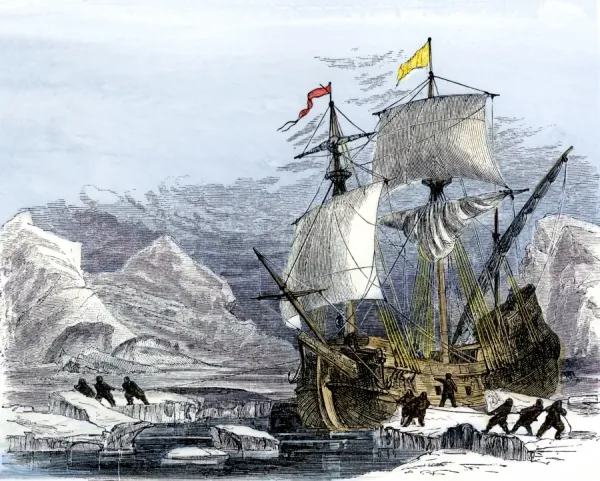
Willem Barents expedition in Arctic ice at Nova Zembla searching for a northeast passage 1500s. Hand-colored woodcut
Along with the English, who chartered the Muscovy Company in 1555, the Dutch had been interested in the Arctic for many years, and by 1578 their commercial sphere of influence had spread over the entire White Sea region of Russia, with a settlement founded on the present site of Arkhangelsk. Early inklings of a northern route come with Olivier Brunel, a Flemish merchant and explorer, who had lived in the White Sea area for years, working as a trading agent for Dutch merchants. Brunel learned from his contacts that Russian ships journeyed regularly from the White Sea to the Ob River and then farther east to the Yenisei River, running into the Kara Sea at the western edge of Siberia, where he learned there was good wintering. Travelers also told Brunel of open water beyond the Yenisei, leading him to believe that the Pacific could not be far beyond.
The truth was, of course, very different; there are some 5,000 kilometers of brutally frigid Russian coastline before the Bering Strait offers access to the Pacific Ocean. Naturally ignorant of the facts, and showing both courage and misguided confidence, Brunel set off on two missions, heading east in 1581 and again in 1584, with a ship laden with trading goods. On both occasions he failed to reach the Kara Sea, and on the latter voyage was wrecked and drowned in the Pechora Sea, the southeastern part of the Barents Sea.
The commercial allure of the Northern Passage proved irresistible. Such a route would offer access to the markets of Asia while avoiding Spanish and Portuguese harbors and patrols, and significantly shorten the long and punishing voyage around the southern tip of Africa. Thanks to Enkhuisen and Amsterdam entrepreneurs, including Franciscus Maelson and Balthazar de Moucheron, an expedition into the northern seas was organized in 1594 under the command of Willem Barentsz, his officers being Cornelis Nay and Brandt Tetgales. On June 5 of that year, four Dutch ships set out from Texel, all crews hoping to discover a passage east to the north of Russia. Two of the ships were the Zwaan, commanded by Nay, and the Mercurius piloted by Tetgales. Aboard the latter was Jan Huyghen van Linschoten, whose journals provide the best account of the voyage. Barentsz commanded another Mercurius, outfitted by the merchants of Amsterdam. The fourth vessel was a smaller fishing sloop.
After braving storms, on June 21 they reached calm waters at Kildin Island, 120 kilometers from Norway on the Kola Peninsula. The plan now was to divide the fleet, with Barentsz sailing up the west coast of Novaya Zemlya and east into the northern Kara Sea, while Nay and Tetgales were to head south of Vaygach Island via the Yugorsky Strait, between the island and the mainland, and travel as far east into the Kara Sea as possible. As it turned out, Barentsz could not get around the northern tip of Novaya Zemlya because of extensive ice fields, and was forced to turn back.
Nay and Tetgales sailed east, reporting no sea ice between July 19 and 24. On July 25 they entered the Yugorsky Strait, the sound between the Pechora Sea and the Kara Sea, the Zwaan and the Mercurius being the first Dutch ships to approach the strait in over two decades. This called for some tricky navigation, not only because the strait is only three kilometers wide at its narrowest point, but also because the ships encountered a lot of ice in the strait, including huge icebergs, drifting westwards with the wind and current. However, at the beginning of August most of the bergs and sea ice had melted and the weather cleared, allowing the ships to continue eastward and enter the Kara Sea.
Here they sailed east some 300 kilometers, meeting open water, high waves, and a blue sea free of ice—all promising signs. This prospect persuaded Van Linschoten that they had found the way to Japan and China. This misapprehension was reinforced when they came across a southerly bend of the coast, and the ships turned sharply starboard into Baydaratskaya Bay, a large inlet lying between the northern end of the Ural Mountains and the Yamal Peninsula. The mouth of this bay is a substantial 78 kilometers wide, encouraging the explorers to believe that this was indeed the route to the Far East.
In the present day, we are doubtless surprised that this deduction could be made with such confidence on such slim evidence. But before we scoff at the idea, let us, in our heads and from our cozy chairs, sail for a few days in one of these stinking, cramped, and freezing ships, pitching in the violent seas and bitter gales, the sails and rigging stiff and heavy with spray-ice. With all our modern paraphernalia—accurate sea charts and maps, satellite images, and global positioning systems—it is perhaps too easy to smile, even with a hint of comfortable condescension, at the naïveté and urgent optimism of sailors who, dreaming of a warm bed and a family in distant Hoorn, and seeing a few hundred miles of open sea, had so colored their desperate hopes that they saw their imagined Cathay and fragrant Spice Islands just beyond those glacial shores and endless Siberian forests. Who on this ship would not wish their goal to be just over the horizon and their perilous voyage at an end?
Before long the wind and threatening ice forced them to abandon the coast and head farther out to sea, where thick fog and massive icebergs, some home to aggressive walruses, offered additional dangers. Nay and Tetgales decided to turn back while it was still possible. On August 15 the ships sailed westwards, back through the Yugorsky Strait and, close to the islands of Orange, Mauritius, and New Walcheren, met up with Barentsz. By September 10 the returning fleet had entered the North Sea and put in at Texel six days later.
An examination of the results of the expedition might seem to show scant success, apart from having survived three months in some of the harshest conditions the planet has to offer. However, this small advance in the knowledge of the Arctic regions stimulated confident hopes among both the navigators and their backers, who were convinced that a Northeast Passage to China and the East Indies was real and that the entrance and the course to take had been discovered. Everyone felt that the prize was within reach, and, buoyed by what they saw as a successful mission, a second expedition was planned soon after.
With great enthusiasm the towns of Amsterdam, Zeeland, and Enkhuisen furnished ships and men, and in July 1595 the second fleet was sent northward under the command of Nay, and including Barentsz and Tetgales. This time it was a larger fleet, consisting of seven ships, the large investment clearly showing great confidence in Nay’s report. Faith in Nay’s assurances was also demonstrated by the fact that the ships were fitted out not so much with a view to mere exploration but to the actual discovery of their objective, being laden with merchandise for the purpose of trade.
The July departure date was still summer, but somewhat late in the season for sailing in far northern latitudes, and this was to cause problems. High expectations fell with the temperature. They found much of the Kara Sea frozen over, and in mid-September a severe storm struck the fleet with a vicious wind that choked the Yugorsky Strait with thick sea ice, reminding the crews that it was too late in the year to linger. Further progress was deemed impossible. A council was formed to determine a course of action, and the following resolution was passed: “We, the undersigned, declare that we have done our best before God and before the world, to penetrate by the north to China and Japan, as ordered by our instructions, until we have seen that it does not please God that we should continue our voyage, and that it is necessary that we should desist. We therefore have resolved to make our route back to Holland with due diligence.” And who can blame them? On October 26 the expedition returned to Amsterdam, having never left the immediate vicinity of Novaya Zemlya.
Despite the frustration and failure experienced on this expedition, the promise was still there. Barentsz remained hopeful and was still eager to pursue the northern route, even though the States General had lost their generosity along with their fervor for what seemed futile ventures. However, persistence is clearly a Dutch virtue, and with support from townships in Holland, Zeeland, and Utrecht, yet again two ships set sail for the Arctic in May 1597 under the general command of Willem Barentsz, with the ships captained by Jan Cornelisz Rijp and Jacob van Heemskerck.
Cornelis Nay did not accompany Barentsz on this his third Arctic expedition, a fact that no doubt delighted him in retrospect because this was the voyage from which Barentsz failed to return. This third expedition discovered Bear Island and Spitzbergen, and more previously undiscovered coastline was extensively mapped, a valuable resource for future navigators, traders, and whalers. But all did not go well, and Barentsz’s ship became trapped in the ice. Barentsz and many of his crew were forced to overwinter on the northern island of Novaya Zemlya. With the return of open water in the summer of 1597, the remaining crew set out southwards in a couple of patched-up boats, reaching the Kola Peninsula three months later. By this time, Barentsz had died, and was either buried at sea or in the icy ground of Novaya Zemlya. Van Heemskerck survived the Arctic to die in 1607 at the Battle of Gibraltar, when a Spanish cannonball took off his leg. His armor (minus the left cuisse), helmet, and sword are on display in the Rijksmuseum.
While Barentsz’s name stands taller among Dutch explorers, Cornelis Nay did have his time in the sun. Upon his return from his 1594 voyage he was fêted as a hero, having boldly declared that he had found the Northern Passage. His cocksure assurances fueled the national pride that naturally followed a fruitful expedition, and in this excited mood parts of northern Russia were even renamed as Dutch: Nieu Hollant (New Holland—not to be confused with this place name for Australia and Brazil) and Nieu West Vrieslant (Friesland), along with the rechristening of the Kara Sea as the Nieuwe Noort Zee (New North Sea), while the Strait of Vaygach became the Straet van Nassau. Another Staten Eylant also appeared on subsequent maps. One can only imagine what the Russians thought of this cheekiness.
Nay’s dream would have to wait nearly three hundred years to be realized. The first ship to navigate through the entire Northeast Passage was the SS Vega, a Swedish three-masted barque with an auxiliary steam engine, built in Germany as a whaler. Finnish born Adolf Erik Nordenskiöld led the expedition. The Vega left Sweden in 1878 and spent eleven months stuck in pack ice at the Chukchi Peninsula, very close to the Bering Strait. Nordenskiöld returned to Sweden in April 1880, having also achieved another “first,” the first voyage circumnavigating Eurasia. Cape Vega, a headland projecting into the Kara Sea, is named for the ship.
In spite of Nay’s sanguine 1594 pronouncement, sailing the northern route to the East as a valid commercial proposition would not be practical for more than four centuries, by which time climate change had shrunk the polar ice cap enough to permit ships to travel more readily all the way over the top of Russia. In 2009, the retreat of the ice in both thickness and extent allowed the first commercial cargo ships to sail north of Russia between Europe and Asia. In 2013, 71 ships made the transit. In 2015 the Chinese trimaran Qingdao China set a speed record by sailing the 3,240 nautical miles from Murmansk to the Bering Strait in only thirteen days. Cornelis Nay would have been impressed.
After the disappointment of Nay’s second arctic voyage in 1595, the optimism that had built up following his earlier journey was diluted, and was seen to rest on frailer foundations than his pipe dreams warranted. Nevertheless, the two voyages of Nay and Tetgales still merit an honored place in the history of exploration. With the first passage of the Yugorsky Strait by European explorers, they extended significantly navigators’ knowledge of the northern regions, and, like Barentsz and the many other courageous explorers, deserve much credit for carrying out their assigned tasks with great skill, bravery, and resolve.