

Spices and Spying: How the Dutch Found Their Way to the East Indies
In the 1590s, the Dutch began to turn their attention to the East Indies, the lands and islands of Southeast Asia, and in time this interest grew into a vast moneymaking concern.
by Peter A. Douglas
When we think of the lucrative seventeenth century spice trade in the Far East what generally comes to mind are the great mercantile companies: the Dutch East India Company, founded in 1602, along with the English East India Company, which received a royal charter from Elizabeth I in 1600.
The former was known as the Vereenigde Oostindische Compagnie (VOC) and can be thought of as the world’s first multinational corporation. From the seventeenth to the eighteenth century, trading companies such as VOC and its English counterpart acted on behalf of European governments in Asia. As joint stock companies they were private merchant entities with a guaranteed long-term trade monopoly in exchange for rights paid to their respective governments. They were almost states in themselves, with their own ships, both military and commercial, and military forces. Their initial goal was to develop trade links for prized commodities such as pepper, nutmeg, and cloves, and as time progressed they gained an ever more dominant position in world trade, and became increasingly involved in the control and development of their respective territories.
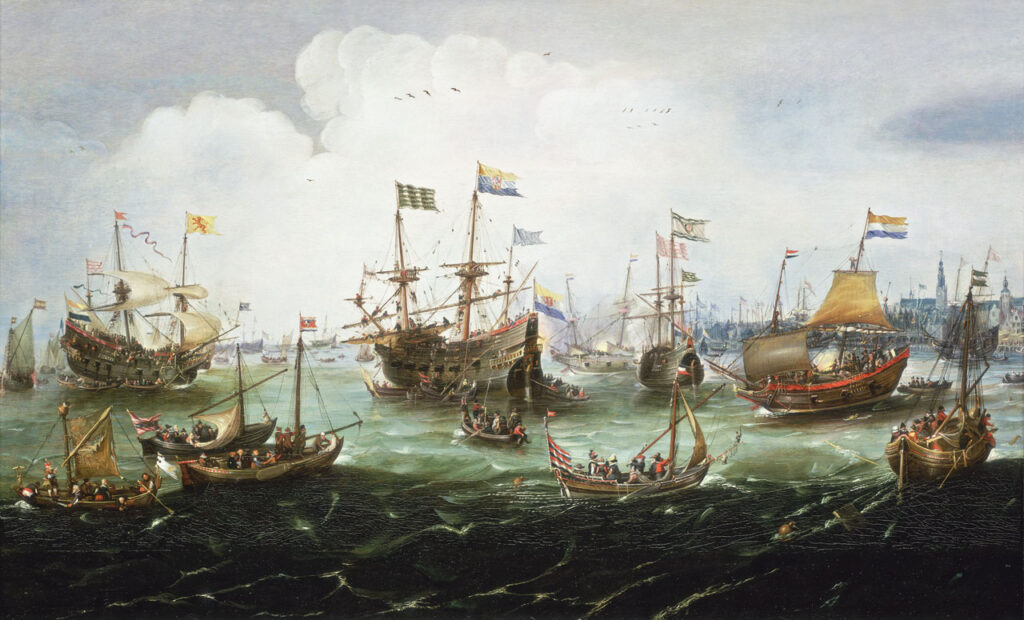
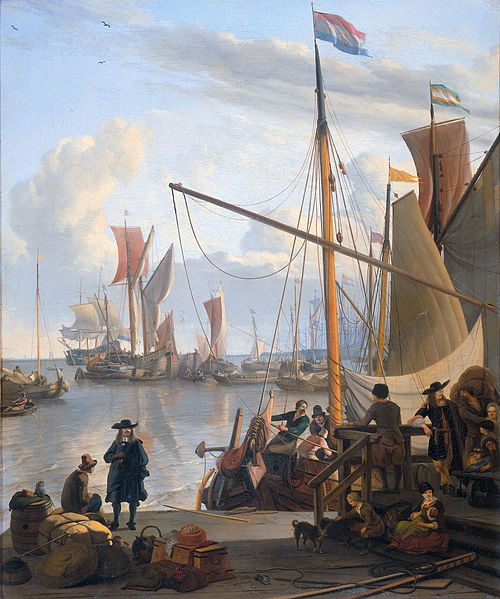
The Return to Amsterdam of the Second Expedition to the East Indies on 19 July 1599, courtesy of the Rijksmuseum
But before the Dutch and the English there were the Portuguese. In the fifteenth and sixteenth centuries this country established the first global empire, becoming a major economic and political power. Portuguese navigators pioneered marine exploration, notably under the patronage of Prince Henry the Navigator (1394-1460) and King John II, with such notable explorers as Bartolomeu Dias, who sailed around the southern tip of Africa in 1488, Vasco da Gama, the first European to reach India by sea in 1497-98, and Pedro Àlvares Cabral to whom is credited the discovery of Brazil in 1500.
It was Portugal that early on had cornered the market for the spice trade, having been importing these commodities since the 1520s, long before any other country could compete. Gradually its empire expanded with its military campaigns in Asia. In 1505 the Portuguese State of India (Estado Português da Índia) was founded following the discovery of a sea route between Portugal and the Indian subcontinent, and, headquartered in Kochi and then in Goa in 1510, it acted as the governing body of the Portuguese colonies and their fortresses. In 1557, the Portuguese established a settlement farther to the east in Macau, and their interest in this colony only ceased in 1999 when China assumed formal sovereignty over the territory.
Portugal’s only real competitor was Spain, but with the Iberian Union—the dynastic joining of the countries’ two crowns in 1580—that rivalry was no longer an obstacle. This union lasted till 1640, and brought not only the Iberian Peninsula under the rule of the Spanish king Philip II (then also Philip I of Portugal) but also the Spanish and Portuguese overseas possessions, including Brazil and the Far East. The downside for Portugal was that Spain’s enemies now became Portugal’s enemies, and this included the Dutch Republic, which had long been engaged in the Eighty Years’ War (1568-1648), or the Dutch Revolt, against Spain. This alliance made it impossible for the Dutch to continue to get their spices from Lisbon, and encouraged them to make strong efforts to circumvent the Portuguese monopoly. The Portuguese empire had become an appropriate target for military and other incursions. Naturally the other European countries, and especially the Dutch Republic, were eager to share the profits from the spice trade that the Portuguese were enjoying from their Far East enterprises, and Portugal now being a political as well as an economic adversary fanned the hostile flames that burned in the Seven United Provinces even more.
But before they could achieve any trading advantage, Portugal’s rivals faced the problem of finding the right sea route to the Far East. On a 15,000-mile voyage that took (with luck) some eight months, many hazards had to be endured and survived, so knowing the best route was vital. Sea captains were obliged to rely on maps, astronomical observations, and, especially for new routes, what the Portuguese called roteiros, French routiers, and English rutters or ruttiers. These were handbooks of sailing instructions and details of safe routes collected and shared by sailors on earlier voyages. Information included sights to keep an eye out for, such as particular islands, channels, landmarks, and other clues to show that the ship was on course, as well as dangers such as shoals and reefs. They also often contained mathematical or astronomical tables. Before nautical charts, rutters were the main source of geographical information for maritime navigation. Given the wealth of supplementary information in rutters, navigational charts never fully replaced them.
Dutch navigators were among the best in the world, and would surely, in time, have worked out the best, safest, and speediest routes to the East Indies, but the pressure of the profit- motive in the spice trade added a great urgency and resolve, as did the fact that the reward of all this fruitful and money-spinning commerce was completely in the hands of an enemy of their country. Because of the insatiable demand for spices and the fact that the Portuguese controlled the trade, they could demand high prices, so the profits were enormous, even considering all the expenses and risks of transporting the valuable cargoes home. The great value of pepper back then is still reflected in the modern Dutch word pepperduur (pepper-dear, or as expensive as pepper), meaning very expensive.
The Portuguese had the necessary information for safe passage from Europe to the East, and to preserve their exclusive possession they kept it closely guarded as a national secret. Needless to say, these navigational details were highly coveted by their European rivals, but this information eluded their grasp for a long time—until a couple of enterprising Dutchmen made their separate attempts to discover the secrets.
One of the self-appointed agents to pit himself against the Portuguese trading monopoly was Cornelis de Houtman (1565-99). We will meet de Houtman later in the role of the first explorer to take advantage of the navigational information that he and another were responsible for gathering and disseminating. In 1592 de Houtman was sent to Portugal by a group of Amsterdam merchants to investigate the workings of the Portuguese trade, to gather as much information as he could about the Spice Islands of the Far East, and to try to verify the accuracy of existing maps. After two years there he returned to Amsterdam with this important information. Now that the merchants had what they needed, they began making plans for an exploratory commercial expedition.
Around the same time, another Dutchman was engaged in similar patriotic espionage. Jan Huyghen van Linschoten (1563-1611) was born in Haarlem and grew up in Enkhuisen. At age sixteen he went to Seville, and then to Lisbon, where he lived for almost three years, engaged in financial and commercial business. With the help of his stepbrother Willem he secured an appointment as a clerk or secretary to the new Archbishop of Goa, João Vincente da Fonseca (1530-87). A city and region on the western coast of India, Goa was at this time a Portuguese administrative center and trading post, and had been since the early sixteenth century. Soon thereafter, in April 1583, van Linschoten sailed for Goa with his new employer, in search of the adventure he had so often dreamed of.
Van Linschoten took a great interest in learning about Goa, and studied the people, their culture, religion, and the local flora and fauna. His description of daily life in Goa is of great historical value. He soon won the confidence of the Archbishop, and remained in Goa for five years. In his position as an official to his august employer, van Linschoten was in a most favorable position to satisfy his curiosity about every aspect of life in Portuguese India, including its military and naval strength, and the prices of merchandise, including the trading conditions in various ports of call and the sea routes for sailing from one to another. In his position van Linschoten was able to look at and copy various Portuguese documents, archives, and other sensitive information to which no other foreigner would have had access. He was a tireless compiler, and enthusiastically collected and annotated information on Hispanic-Portuguese sea traffic, making copies of secret maps and of the invaluable rutters that contained a century’s worth of experience of Portuguese pilots. This theft of intellectual property and strategic plans may be the earliest instance of commercial or economic espionage.
For facts and figures about places outside his purview he relied on others, such as his fellow citizen of Enkhuisen Dirck Gerritszoon Pomp, or “Dirck China,” who gave him information about China and Japan. Van Linschoten’s social circle, and hence his sources, would have included Portuguese inhabitants of Goa, foreign members of staff, merchants, and willing or unsuspecting sailors fresh from an ocean crossing. He could have picked up a lot of mercantile and nautical information hanging around the docks and taverns. It’s clear that he was a keen observer of everything, and was eminently placed for turning his observations to his and his country’s advantage. All in all, he acquired a great deal of facts, news, and gossip that laid the groundwork for the writing of his future publications.
Van Linschoten greatly enjoyed his life in Goa, but his appointment was brought to an end, along with any hope of preferment, by the death of Archbishop Fonseca at sea off South Africa in 1587 while heading for Lisbon. His assignment over, van Linschoten set sail for Lisbon in early 1589 aboard the Santa Cruz, one of a fleet of six ships returning to the home country. The government of Portuguese Asia was unaware that it had made a big mistake letting van Linschoten go because the contents of his sea chest included numerous notes on Portuguese trade and navigation in the East Indies. They had unwittingly let slip the man who, more than any other, was destined to strike a fatal blow against their continued prosperity.
The fleet ran into heavy weather and the Santa Cruz was partly crushed by the waves, and some cargo was thrown overboard. After many hard months the six ships anchored at Terceira Island in the Azores archipelago in July 1589. Van Linschoten spent two years here, after the other ships had left, overseeing the salvage of the lost cargo. He also took the opportunity to devote some attention to the writing of two books that would secure his lasting fame. In November 1591 van Linschoten sailed home via Lisbon among a fleet of a dozen Dutch ships, again exposing his precious secret papers to danger on a difficult voyage.
Van Linschoten finally arrived in Enkhuisen in September 1592, but he hardly could be said to have settled down. In fact in 1594 he took part in Willem Barentsz’s expedition to the Kara Sea in search of the mythical Northeast Passage to the Indies. He was also on Barentsz’s second voyage the following year, though happily not on his third and last expedition in 1596-97 when Barentsz died. Van Linschoten wrote an account of his Arctic experiences.
Van Linschoten’s rutters and writings attracted the attention of the Amsterdam publisher, printer, and bookseller Cornelis Claeszoon, who saw great potential in publishing the books. Claeszoon had much experience in publishing books on travel, geography, and seafaring, and his involvement had a strong influence on the development of van Linschoten’s books. The books in question were: Reysgheschrift vande navigatien der Portugaloysers in Orienten (Travel Accounts of Portuguese Navigation in the Orient), and Itinerario: Voyage ofte schipvaert van Jan Huyghen van Linschoten naer Oost ofte Portugaels Indien, 1579-1592 (Itinerary of the Voyage of Jan Huyghen van Linschoten to the East or the Portuguese Indies, 1579-1592). Originally published separately in 1595, the Reysgheschrift was reprinted as the second part of the Itinerario in 1596. Translations followed, into English and German in 1598, and then into Latin and French.
Comparing van Linschoten’s data with that of a modern pilot’s guide there is a high degree of coincidence, enough that we can admire the skill and precision of the Portuguese pilots he pilfered from. The impact of the Itinerario was immediate and dramatic, launching Dutch trade in the East, and quickly took the author to patriotic prominence. Van Linschoten had set in motion a process of commercial and colonial change that led ultimately to the decline of Iberian supremacy in the East and the rise of Dutch (and English less so) power in its place.
This process began in 1594 when nine Amsterdam merchants set up the Compagnie van Verre, or Long Distance Company, with the intention of breaking Portugal’s spice trade monopoly. It was one of several competing Dutch Voorcompagnies from different regions that traded in Asia from 1594 to 1602 when they merged into the Dutch East India Company. In April 1595 the Compagnie van Verre sent east an expedition of four ships—Amsterdam, Hollandia, Mauritius, and Duyfken—with orders to trade for spices in the East Indies, basically poaching on Portuguese territory. It was the first major Dutch exploratory fleet to the Indian Ocean, and went down in history as De Eerste Schipvaart (The First Navigation).
The leader of this expedition was Cornelis de Houtman (previously encountered as a spy in Portugal), and when de Houtman sailed he carried with him a newly printed copy of van Linschoten’s Reysgheschrift. This was fundamental for the mission, and its printing was accelerated in advance of the rest of the Itinerario to make it available to de Houtman. The book made both men famous, each in his own way. This voyage is notable too because on it navigator Pieter Dirckszoon Keyser made the first celestial observations of the southern sky.
It was a troubled expedition from the start, and only three ships and much-depleted crews made it back to Texel in August 1597 after numerous problems and hardships. The cargo of pepper, nutmeg, and mace, was disappointingly small and the expedition was hardly a success from that standpoint, and the merchants just about broke even. However, the Dutch viewed it as a triumph nevertheless for it confirmed the accuracy and value of the Reysgheschrift and thereby the feasibility of trading in the Indies via southern Africa. The ships had successfully arrived at Banten, a port in northwest Java, in June 1596. Van Linschoten’s directions had told them not to pass through the Malacca Strait (between the Malay Peninsula and Sumatra) because the Portuguese controlled it, but through Sunda Strait (between Sumatra and Java), which ultimately became the gateway to the Spice Islands. This was the first of many such voyages, and between 1598 and 1601 fifteen expeditions and sixty-five ships were sent to this region before the establishment of the Dutch East India Company in 1602.
Cornelis de Houtman did not enjoy his reputation for very long for he was killed in the Sultanate of Aceh in the north of the island of Sumatra in 1599. As for Jan Huyghen van Linschoten, in the coming years poets and pamphleteers would honor him for his farseeing ideas, his pioneering work, and his intrepid service to his country. His celebrity was, however, short- lived. Despite the impact and influence of his books, it is remarkable how quickly their importance declined. On reflection, this is not so surprising. As more expeditions to the East followed, knowledge of this area increased rapidly. This led to van Linschoten’s information becoming outdated, or was proved to be incorrect in some respects. Later travel reports, frequently updated with new navigational know-how, began to supplant his as the most essential. The last Dutch language reprint of the Itinerario appeared in 1644.
For all the natural transience of his works, van Linschoten enjoyed a period of appreciation and renown. While his books’ use and popularity waned in the seventeenth century, this did not happen in his lifetime, and he became a man of recognition and influence. He married well and mixed with the socially elite, and spent his last years as the treasurer of Enkhuisen. Even so, he faced disappointment near the end of his life when he applied for a state pension and was rejected. It was thought that past royalties and earnings from his well-received books had provided him with enough money. We don’t know if this was so as he died soon after in 1611. Van Linschoten’s travels and labors were, in due course, responsible for the founding of the Dutch East India Company, along with its associated rewards and returns, including the Dutch Golden Age, which enriched his country in so many ways. This is perhaps legacy enough for one man.