

John Watts de Peyster 1821-1907
John Watts de Peyster (1821–1907) was an American military historian, philanthropist, and New York militia officer who was later breveted major general. Though not a battlefield commander, he influenced Civil War tactics through his writings and supported many historical and educational institutions.
- John Watts de Peyster
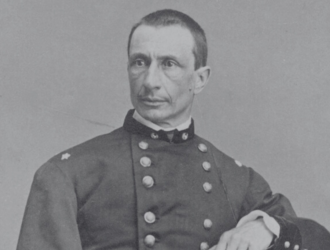
John Watts de Peyster – Wikipedia |
Britannica
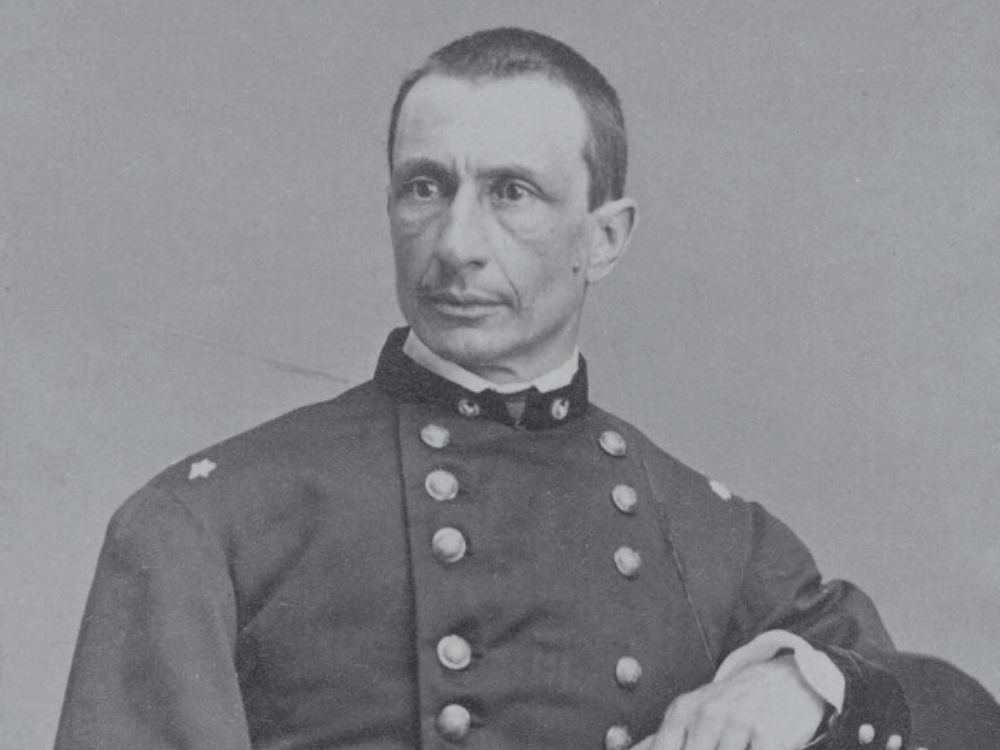
Military Leader
John de Peyster was a student and author of war, an indirect participant in the Civil War, rising to the rank of major general. In his later years he became a philanthropist, leaving his name on a number of buildings and institutions. He was born in New York City in 1821, and was the son of a wealthy and old Dutchess County family. His great great grandfather was Abraham de Peyster, an early mayor of New York City, and his great great great grandfather was also a mayor of New York City. His ancestors originally came from Flanders to the new world. Since Flanders at that time was part of the Netherlands, and since a name like de Peyster is clearly Dutch, it was considered appropriate to include John Watts de Peyster in the listing of prominent Dutch Americans.
De Peyster was well educated during his early years. He attended Columbia College, now Columbia University, as an undergraduate. But he apparently did not graduate because of health reasons. Later he did earn a M. A. degree from Columbia College, a LL. D. degree from Nebraska College, and a Ph. D. degree from Franklin and Marshall College. Although he did obtain a law degree, it is not clear if he ever practiced law. He, however, was engaged in many volunteer activities. He was one of the organizers of the New York City Police and Fire Departments, and was active as a volunteer fireman himself. He was also active in the New York State Militia, and was promoted to brigadier general in 1851. At the State level he also served as Judge Advocate General, and later Adjutant General, before he resigned over a conflict with New York Governor Myron Clark in 1855.
At the start of the Civil War, de Peyster was already in his forties. He did offer his services to the Union Army, but was rebuffed, probably for younger candidates. His three sons did serve in the Union Army during the war, and his name sake, John Watts de Peyster, Jr., actually rose to the level of brevet brigadier general.
During the Civil War, de Peyster wrote a series of articles on war tactics, and some of these tactics were adopted and proved to be practical in the field of battle. For his indirect contributions to the Civil War, the State of New York later elevated de Peyster to brevet major general.
Prior to and following the Civil War, de Peyster was a student of military history and authored books in the area. He published the following books listed below. “New American Tactics”, a series of articles published in The Army and Navy Journal during the Civil War, “Life of Field Marshall Torstenson”, published in 1855, “The Dutch at the North Pole”, published in 1857, “Life of Baron Cohorn”, published in 1858, “The Decisive Conflicts of the Late Civil War, or Slaveholder’s Rebellion”, published in 1867, “Personal and Military History of General Philip Kearney”, published in 1869,
“The Life and Misfortunes and the Military Career of Brigadier General Sir John Johnson”, published in 1882, and “Gypsies: Some Curious Investigations, Collected, Translated, or Reprinted from various Sources”, published in 1887.
De Peyster was a developer and collector of real estate properties and valuable books. He willed most of the books and the real estate properties to institutions prior to his death. In 1901, he donated several thousand books and maps to the Smithsonian Institution. He also built, and then donated the first library building of his alma mater, to his alma mater, Franklin and Marshall College. He then also donated his rare collection of books on European history to the library. In 1905, de Peyster purchased the first baronial mansion of Sir William Johnson, known since 1755 as Fort Johnson, and donated it to the Montgomery County Historical Society, of Amsterdam, New York. And last but not least, he willed his Tivoli village mansion, named “Rose Hill”, in New York City, to a local children’s home.
De Peyster passed away on May 4, 1907. His life had been focused on making contributions to society, the community, history, and his country. To this day he is remembered by the various communities that benefited from his generosity during his lifetime.
Explore More Dutch Americans