



Discovery and Disaster: The Five Ships of Rotterdam
Discovery, commerce, and patriotism were the fundamental driving forces that committed the Netherlands, along with other European powers, to sending fleet after fleet of ships into the many hazards of the scarcely charted maritime world of the sixteenth and seventeenth centuries. These forces had to be undeniably powerful to convince so many men so many times to risk their fortunes and their very lives to sail the world for years on end, in extreme danger and discomfort, to bring back home the strange seeds, fruits, roots, and bark of exotic plants that grow only in hot climates. In a word: spices.
by Peter A. Douglas
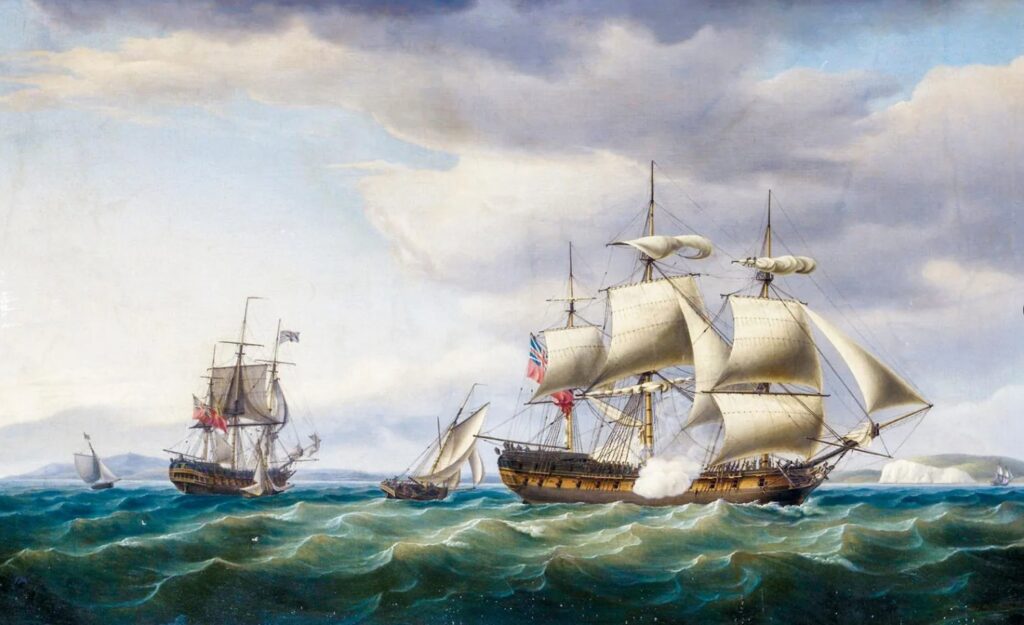
Painting of East India Company ships
Not to diminish the honest nationalistic sentiments of the navigators and cartographers and their curiosity about the world beyond the horizon, but plain profit was certainly a huge motivation. At the time, cloves, for example, were valued at more than their weight in gold, and a full cargo of spices was worth more than the ship that carried it. When the carrack Victoria, the only surviving ship of Ferdinand Magellan’s fleet, returned to Spain in 1522 under the command of Juan Sebastián Elcano, the 381 sacks of cloves it brought back were worth more than the five ships that set sail on the expedition three years earlier. Remarkably, the voyage had been profitable, despite the loss of four ships.
Today we probably appreciate spices solely in the culinary context, but four hundred years ago and beyond, they were not only for flavoring food but also for preserving it, along with a variety of other uses. Spices were used for making perfumes and incense, and were associated with certain rituals or superstitions, or to fulfill a religious obligation. Moreover, spices have been used for their reputed medicinal properties as far back as traceable history, and doubtless beyond, to enhance or suppress certain sensations. They were used as digestives, stimulants, diuretics, antiseptics, to ward off colds, as a local anesthetic, and for the treatment of liver problems, scurvy, gastric ulcers, fainting fits, anemia, and many other complaints and needs.
Given the state of medieval medicine and the prevalence of disease, it’s no wonder that these supposed remedies were so highly prized. For his initial heavy investment to fit out ships bound for the Spice Islands, or to find a safer and faster route to get there, a rich merchant could expect a huge return when, eventually, sacks of pepper, nutmeg, cloves or cinnamon landed in his dockside warehouse. This idea of making one’s fortune in a risky adventure—from the return of a ship from foreign parts laden with a rich cargo—is a universal theme, and is thus the origin of the expression, “When my ship comes in,” meaning when my fortune is made, when more affluent times arrive.
In the case of the Dutch such a motivation was equally tinged with their deep hostility towards Spain and Portugal (dynastically united with Spain), strong rivals in this enterprise. The Dutch were, after all, between 1568 and 1648, engaged in what’s known as the Dutch Revolt, the uprising of the northern, largely Protestant, Seven Provinces of the Low Countries against the rule of the Roman Catholic Habsburg King Philip II of Spain, hereditary ruler of the provinces. Enjoying their maritime mastery, the Dutch trading empire covered the globe. As various European countries created their own overseas empires, so the rivalries and wars between the countries broadened to their colonies. The most significant of these conflicts would become known as the Dutch-Portuguese War, which started in 1602 and lasted throughout the first half of the seventeenth century, involving drawn out colonial conflicts in the Americas, Africa, Ceylon, India, Macau, the Philippines, Formosa, and the East Indies.
So it was to extend this lucrative Dutch global commerce that in 1598 two wealthy merchants in the southern Netherlands, Pieter van der Hagen and Johan van der Veeken, formed a voorcompagnie called the Magelhaensche Compagnie to fund an expedition of five ships bound for the Moluccas in the Dutch East Indies. A voorcompagnie, or “pre-company,” was a Dutch company that traded in Asia between 1594 and 1602, before they all merged to form the Dutch East India Company. The investors were “very desirous of promoting, to the utmost of their power, such discoveries as might prove beneficial to their navigation and commerce.”
This voyage was, however, to be somewhat different from others. The usual route east was by way of Africa, around the Cape of Good Hope, and then bearing northeast across the Indian Ocean, past Madagascar and the tip of India. But the intention of this expedition was to avoid the waters controlled by Portuguese and Spanish ships and get to the Pacific (known as the South Sea) by way of South America, then head northwest across the ocean and approach the Indies from the east.
This alternative route had extra risks, given the severe weather conditions at that southern latitude, especially the strong westerly winds known as the “Roaring Forties,” between 40 and 50 degrees south. By providing a strong west to east tailwind, these were a great help to ships sailing what came to be called the “Brouwer route” after 1611, when the Dutch explorer Hendrik Brouwer conceived this new faster route from Europe to the East Indies—from the Cape of Good Hope due east and then, at the right point, north to Java. The trick was to know when to turn north. Without an accurate way to determine longitude it was the captain’s skill that was paramount. Hence the discovery of western Australia and the many shipwrecks there.
These winds would not favor this Rotterdam fleet. However, it was not planning to go around Cape Horn where the worst weather in that area was to be found, but through the Strait of Magellan, a winding 350-mile long navigable sea route in southern Chile that leads from the Atlantic to the Pacific. Magellan was the first European known to have sailed through the strait on his circumnavigation voyage in 1520. It’s a tricky route to navigate on account of the narrowness of some stretches of the passage and the unpredictable currents and winds, but it’s shorter and offers greater shelter than the often-stormy Drake Passage south of Cape Horn. The Strait is two miles across at its narrowest point, and twenty-two miles at the widest. In modern times, piloting is compulsory for sailing the strait, so clearly there are still hazards to be avoided. In 2008, 2,258 ships passed through it.
So in 1598 the Dutch fleet was assembled. The names of the ships in the expedition, often referred to as the Five Ships of Rotterdam, represented Christian virtues. They were the Hoop (Hope, 500 tons), the flagship, captained by Jacques Mahu, Admiral and leader of the expedition; the Liefde (Love or Charity, 300 tons), captained by Simon de Cordes, Vice Admiral and second in command; the Geloof (Faith or Belief, 320 tons), captained by Gerrit van Beuningen; the Trouw (Fidelity or Loyalty, 220 tons), under captain Jurriaan van Boekhout; and the Blijde Boodschap (Glad Tidings or the Gospel, 150 tons), under captain Sebald de Weert. The last was previously known as the Vliegend Hart (Flying Hart).
The Liefde used to be called the Erasmus, and it has been conjectured that the ship’s name was changed to fit in with the biblical theme of the fleet. The vessel still featured the stern carving of the famous Rotterdammer, which is now on display in the Tokyo National Museum (for reasons that will become clear later). This carving is often referred to as a figurehead (boegbeeld), and was thought to be one for a long time, but at the time Dutch ships did not generally feature figureheads. When Dutch scholars saw a photograph of the figure when it was displayed at an exhibition in Rome in 1926 they concluded that it was not a figurehead but a hekbeeld, a decorative image that was attached to the ship’s stern. The statue is the sole surviving tangible symbol of the maritime and human drama that was the voyage of the Liefde.
These five ships had a combined crew of around 500 men. The veteran pilot, on whom Mahu chiefly depended, was an Englishman called William Adams, born in Gillingham, Kent, in 1564, who found a special place in Dutch history at the conclusion of this expedition, achieving, in fact, it’s only success. The ships were well provisioned for the voyage, and furnished for both war and trade, with powder and shot as well as a variety of trading merchandise, as part of the plan was to visit Spanish settlements on the coast of Chile and Peru in hope of getting some booty before crossing the Pacific to the Indies. Should there be difficulties with the East Indies destination, the secondary goal would be Japan.
In spite of the inspirational names of these ships, this expedition was a great misfortune for all involved, and one of the most disastrous in the history of Dutch navigation. Things started to go wrong before they crossed the Atlantic. Sails were set on June 27, 1598, and the fleet departed from Goeree / Rotterdam in high but soon to be dashed hopes when contrary winds delayed their passage into and out of the English Channel, the ships being forced to lie at anchor at the Downs off the coast of Kent until mid-July. More provisions were taken aboard as a precaution.
By August the fleet had reached the Cape Verde islands off the coast of Africa, where they remained for almost a month, creating a lot of friction with the Portuguese governor in their quest for supplies. Many crewmen died of fever and scurvy here and in subsequent days, including their much admired Admiral and commander, Jacques Mahu, who was buried at sea. Mahu’s death necessitated a reshuffling of captains among the ships, and Simon de Cordes then became the expedition’s leader in the Hoop, with van Beuningen moving to the Liefde. This opened up the command of the Geloof, which was given to Sebald de Weert, and Dirk Gerritsz Pomp took over the Blijde Boodschap.
On September 15 they proceeded south, sailing with increasing difficulty as in the Hoop scurvy took its toll and there were too few crew members to work the ship. In November, assailed by contrary winds and rain, they next went ashore at Guinea on the western bulge of Africa, but were unable to replenish their provisions. They proceeded farther south and next made landfall on the island of Annabón, where they hoped to find fresh meat and oranges, but they again fell foul of the Portuguese and attacked the town there. They procured a few supplies, though not as much as they needed on account of the poverty and distrust of the natives. From here they sailed, on January 2, 1599, for South America, though not before burying their dead. They were glad to leave the island, as pilot William Adams wrote: “the unwholesomenesse of the aire was very bad, that as one bettered, an other fell sicke.”
During the passage across the Atlantic the fleet lost thirty more men to scurvy. The food situation was so grave that at this point de Cordes decided that it was necessary to impose rationing on the crews, and the daily bread allowance was limited to a quarter of a pound a day, with a small amount of wine and water. Such a scant allowance weakened the crews and brought about ravenous hunger, so much so that some men were desperate enough to eat the calfskins with which the ropes were covered. This was not a promising beginning to what would be a long winter ordeal for the men. The fleet arrived at the Río de la Plata on March 12, and on April 6 arrived at fifty-three degrees south and the eastern entrance of the Strait of Magellan.
Relieved as they must have been to see land and to arrive at this stage of their long voyage, the crews could have had no idea that they would remain in that region and make very little progress for the next four months—four months of a bitterly cold southern winter marked by lack of food, snow, gales, hostile natives, sickness, and death.
At this point they had a good following wind and sailed deeper into the strait, and anchored at an island where they collected hundreds of penguins as food. Delighted by this discovery of fresh meat, pilot William Adams described them as “fowles greater than a ducke, wherewith we were greatly refreshed.” On April 9 they proceeded through the strait and sailed between two high shores that considerably narrowed the passage—probably the Primera Angostura, or First Narrows. The next day de Cordes sent fifty men ashore in search of food or inhabitants, but they found nothing, though some days later, some seventy miles from the mouth of the strait they came across a bay they christened Mussel Bay on account of the great quantity of mussels they found there, along with fresh water and wood. On April 18 they stopped in a bay on the north side of the strait called Great Bay, where there was good anchorage on fine sand. Little did they know that the fleet would remain at Great Bay for the next four months.
April to August is the southern winter, and this winter was severe, bringing four months of great suffering and privation for the crews. Over this time they lost more than a hundred man, including Captain Boekhout of the Trouw, who was succeeded by Balthazar de Cordes, Simon’s brother. The hardships were great, with the extreme cold and frequent storms descending on them, with strong winds, rain, hail, and snow. The men’s suffering was all the greater because they had inadequate clothing, believing themselves bound for warmer climes and were not intending to winter over in such conditions. Shortage of food frequently forced scavenging parties to go ashore for whatever they could find to eat, usually just roots and shellfish, which were eaten raw. On one such expedition at the end of May a party of local natives attacked the seamen and killed three of them with spears. On another occasion Captain de Weert went ashore in search of seals and such a great storm arose that he could not return to the ship for two days. William Adams noted, “with colde on the one side and hunger on the other, our men grew weake.”
One hesitates to second-guess a master mariner, but Admiral Simon de Cordes’ decision to remain in the Strait of Magellan through the whole winter must be questioned. The explanation for the delay was that as they sailed through the strait they encountered strong adverse winds that impeded their progress. Even so, it’s hard to imagine that between early April and the end of August the sailing conditions were consistently so bad as to prevent the fleet from making some significant progress towards the western end of the strait and the Pacific. Given the terrible circumstances that the crews were enduring it hardly seems reasonable that attempts to proceed could not be made. The crews were freezing, weak, and starving, but their dire situation could only deteriorate if they remained marooned for long in the strait in such conditions.
It’s clear that William Adams had such thoughts. After entering the strait Adams comments: “Having at that time the wind at the north-east, six or seven days, in which time wee might have passed through the Streights.” Why didn’t they take advantage of favorable conditions? In his letters, Adams clearly lays the blame on Admiral Simon de Cordes, who, in Adams’ view, when the weather was propitious for sailing, wasted valuable time with less important tasks instead of advancing westwards.
De Cordes decided to order his longboat be converted into a pinnace, a light boat to serve as a tender, which was named the Postillion. Useful as this doubtless was, along with the need to gather what necessities the land offered, Adams balked at this risky delay while the wind was on their side, especially as provisioning the ship could take place anywhere in the strait. “We weighed anchor, having much wind, which was good for us to goe through. But our generall would water, and take in provision of wood for all our fleet. In which strait there is enough in every place, with anchor ground in all places, three or foure leagues from one another.” Adams continues: “But, for refreshing our men, we waited, watering and taking in of wood, and setting up of a pynnas of fifteene or twentie tones in burthen.” The wind changed and halted their progress. “So at length, wee would have passed through, but could not by reason of the southerly winds.”
It should be noted that in 1520, Ferdinand Magellan did somewhat better, sailing through the strait in only thirty-eight days, though that was in November, early summer in the southern hemisphere. Even so, Magellan’s ships spent much of that time searching for the route through the confusing maze of channels, islets, and fjords that make up the waterway. Magellan called it El Estrecho de Todos los Santos (the Strait of All Saints) to reflect the date of discovery, November 1. It was, by the way, Magellan who named the Pacific Ocean. He called it Mar Pacífico, meaning “peaceful” in the maritime sense, because, after sailing the stormy waters in the Cape Horn region, his expedition found favorable winds and calm waters in the ocean.
On the 1599 expedition, William Adams seems to have had little doubt that what he saw as de Cordes’ uncalled-for dawdling was responsible for many of the problems they encountered, and contributed, in all probability, in retrospect, to the ultimate failure of the expedition as well as the death of many of his shipmates. In another letter, this one to his wife years later, he wrote with some feeling: “Many times in the winter we had the wind good to goe through the straights, but our generall would not. We abode in the straight till the foure and twentieth of August 1599.” Adams was a very experienced pilot, so his opinion counts. Nevertheless, to honor their commander the place was named the Bay of Cordes.
The commander decided that a curious ceremony should take place towards the end of August, shortly before the fleet reached the Pacific. To perpetuate the memory of the people who died on and this dangerous voyage he instituted a new order of knighthood, of which he made his six principal officers knights. They bound themselves by oath never to do or consent to anything contrary to their honor or reputation, whatever danger they faced, even death itself. Nor would they allow to anything prejudicial to the interests of their country, or to their current voyage. The knights also promised to oppose all the enemies of their nation, and to do their utmost to conquer those countries where the king of Spain procured so much gold and silver that enabled him to wage war on their country.
He called this new fellowship “The Order of The Lion Set Free,” or “The Knighthood of the Lion Unchained.” This was probably an allusion to the Belgic lion (Leo Belgicus), a map in the shape of a lion that symbolized the Low Countries, a patriotic motif inspired by the heraldic figure of the lion that appears in the coats of arms of several Netherlands provinces—which must be freed from the Spanish yoke. After this ceremony, a tablet was erected on top of a high pillar on which the names of the new knights were inscribed, and the bay they were moored in was named the Bay of Knights. It seems quite an elaborate procedure, which one can imagine the Admiral working out in his solitary cabin over many frigid nights. One can imagine too the sight of six bedraggled, hungry, and exhausted captains indulging, with grudging respect, their Admiral’s whim, while the snow blew about them, and where loomed the hostile forest full of murderous natives.
Leaving this bay on August 28 they were soon becalmed and struggled to put in at another bay. Here de Cordes ordered de Weert to go back to the Bay of Knights and move the tablet to a more obvious location. At that spot de Weert found a large gathering of natives with canoes. He retreated and returned with a party of well-armed sailors, but the natives had gone. The Dutch saw that the natives had molested the graves there, disinterring their recently buried comrades, and had “barbarously disfigured” them. They had also broken the knights’ tablet that de Weert had returned for.
The question of course is why did de Cordes feel the need for this baffling knightly ritual at such a time? We know that there was something to celebrate after so much misery. They were now close to the western outlet of the strait, and the Antarctic summer was approaching, with fair winds and kinder weather that would allow the fleet to emerge into the great South Sea in a few days. But the crew must still have been suffering from—and eager for deliverance from—the many hardships and adversities of the previous months, and, one suspects, can hardly have been in a mood for such bizarre jingoistic ceremonials. We can imagine that the common sailors witnessed this rite, but all knew was that they were in a desperate situation at this unknown and inhospitable end of the planet, and here were their leaders engaging in some sort of incongruous knight-errantry.
We can speculate that de Cordes may have envisioned it as a kind of psychological boost, a public relations initiative, a distraction from their months of privation (was he feeling at all at fault for lingering in the strait?), a reassuring civilized spectacle with some panache and even a kind of normality in a very abnormal environment—along with a deliberate appeal their patriotic urges in light of their likely imminent encounters with Spanish ships and ports. In his 1880 book History of the United Netherlands, John Lothrop Motley wrote of this episode that while the knights are no more, “…to an unsophisticated mind no stately brotherhood of sovereigns and politicians seems more thoroughly inspired with the spirit of Christian chivalry than were those weather-beaten adventurers.” This would sound stilted and patronizing were it not classic Victoriana.
Early in the night of September 3 the fleet finally left the Strait of Magellan and sailed into the South Sea, heading west-northwest with a fair wind from the northeast. It was a relief to leave the unfriendly confines of the strait, but their emergence into the ocean was the start of the unraveling of the expedition. For a few days they had a good northeast wind and fine weather, but soon the sea began to get rough and the waves grew very high and the ships had to lie to and hoist aboard their boats.
At this point the Blijde Boodschap took some damage to her foremast or bowsprit, and both the Trouw and the Geloof, sailing astern of the other ships, reduced sail and rendered assistance. The Hoop and the Liefde sailed on, separated from the others by the stormy sea, and after that a thick fog descended to obscure each other though they were close. Within a day the whole fleet got back together, and carpenters were sent from other ships to the Blijde Boodschap to make repairs. The carpenters never returned to their own ships because quickly the wind shifted and the sea again became rough and stormy, certainly typical of that part of the world, causing the fleet to break up again, and no signals were passed among the ships. Captain de Weert in the Geloof and Balthazar de Cordes in the Trouw were troubled not to see the other ships. De Weert was especially anxious as he had too few crewmen, and they were sick and weak because of the cold and damp. By September 16 the unabated storm had caused damage to both ships. The quarter gallery of the Trouw was broken open to the weather, and the sea broke so violently over the Geloof that the sailors were up to their knees in water. Pumps were manned day and night until the leaks were stopped. These conditions, combined with the need to ration the food, caused a bubbling up of mutinous thoughts amid the crews, which the captains worked hard to pacify.
Ten days later, still with their companion ships nowhere in sight, both ships found that they had been blown dangerously close to the coast of Chile, though both were able to avoid the rocks. Separation of the vessels had been anticipated, and it had been agreed that the fleet would rendezvous at forty-six degrees south off the Chilean coast, and wait for a month. If this failed they were to attempt to regroup farther north at Isla Santa Maria. This is where the Hoop anchored in early November, joining the Liefde, which had arrived a few days earlier, both ships having suffered from weather and the Spanish en route. Here they waited for two months for the other ships, but none joined them.
Having accepted the loss of the other ships, the question then was what to do and where to go, and could they still make their voyage profitable? They agreed that the combined strength of the ships was insufficient for them to embark on any sort of enterprise against the Spanish settlements in Peru, so the decision was made to sail for Japan and trade there. Dirck Gerritszoon Pomp, captain of the Blijde Boodschap, had been to Japan with the Portuguese. He had told them that their wintry merchandise of woolen goods would be easy to trade in that country, being too hot for their original destination in the East Indies. So on November 27, the Hoop and the Liefde sailed for Japan.
In the middle of the Pacific in February 1600, probably somewhere near the Hawaiian Islands, the two ships lost sight of each other and the Hoop was lost in a typhoon with all hands. In April 1600 the Liefde arrived in Japan, under captain Jacob Quaekernseck, Gerrit van Beuningen having died off Chile, along with William Adams’ brother Thomas. The ship made landfall on Usuki Bay on the island of Kyushu, with a depleted crew of twenty-three sick and dying men, including Jan Joosten van Lodenstijn and Melchior van Sandvoort.
This is not the place to discuss the large topic of the Dutch in Japan, but the pilot of the Liefde, William Adams, was instrumental in the setting up of trade between the two countries and breaking the Portuguese monopoly. In 1609 the Dutch established a trading hub on Hirado Island. James Clavell based his best-selling 1975 novel Shogun on Adams’ life, changing the name of his anjin (pilot) protagonist to “John Blackthorne.” It was adapted as a popular television mini-series in 1980, and a Broadway musical in 1990.
An unlikely consequence of this memorable four-century Dutch-Japanese relationship was that in 1992 a Dutch theme park called Huis Ten Bosch opened near Nagasaki, reflecting and paying homage to this historic relationship between Japan and the Netherlands. The Japanese have a serious obsession with theme parks, and this one has been described as one of the weirdest, hitting, some say, a fascinating but rather dissonant note. Here in this oriental setting you can find a replica of the Liefde (with the erroneous Erasmus figurehead), along with a recreation of a seventeenth-century Dutch village, complete with authentic architecture, tulip fields, canals, a windmill, a hotel designed to look like the 1889 Amsterdam Centraal station, and a full-scale replica of the fourteenth century Domkerk tower in Utrecht. A roller coaster, a Ferris wheel, a haunted house, a mirror maze, and bungee jumping are included. An English visitor commented: “Imagine a quaint village from the Dutch golden age, gabled and gilded, but plonked on a Japanese harbour, then populated by robots and dinosaurs, and still you’re only half way there.” The Japanese went so far as to build a replica of the 1645 Huis Ten Bosch palace, official residence for the Dutch Royal Family in The Hague. The park is, for all its incongruity, an emblem of the historic importance for both countries of the arrival of the Liefde in Japan.
As for the Blijde Boodschap, this ship too was blown off course shortly after leaving the Strait of Magellan in September 1599, and, having missed Isla Santa Maria for the rendezvous, ended up in Valparaiso, Chile, where the Spanish captured it and imprisoned the crew. There is a story that has been seriously questioned that Dirck Gerritszoon Pomp drifted so far to the south in this ship that he observed mountainous land at latitude sixty-four degrees, which would be the South Shetland Islands, and possibly the first sighting by Europeans. However, there is insufficient historical evidence for this. It does seem a long way to drift, even in notorious Cape Horn weather. The pinnace Postillion was never heard of again after she entered the Pacific.
It’s time to rejoin the Trouw and the Geloof. After failing to rendezvous with their companion vessels off the Chilean coast, the two captains decided that the best course of action was to find safe anchorage near the mouth of the Magellan Strait and wait for the other ships where they arrived at the end of September. With a fierce wind coming from the west the two ships entered the strait for shelter. Here they found a good anchorage and remained there until October 18 when they moved to a better spot deeper into the strait. Life there was as hard as before, necessitating frequent trips ashore for any food they could scavenge. De Weert’s crew was muttering, concerned about the state of their supplies, but the captain reassured them by telling them that they had twice the amount of food than they actually had.
On December 2 the wind changed to the northeast and the ships tried to head back to the Pacific but were unable to because of the eddies of wind between the steep hills and the bay, and they were being blown dangerously close to the shore. In more bad weather some days later the ships were separated, and, unbeknownst to de Weert until later, the gales forced the Trouw from her anchorage and she was driven out of the strait into the ocean. Sebald de Weert and Balthazar de Cordes never saw each other again. The Trouw sailed up the coast of Chile but failed to meet the rest of their fleet. De Cordes went north as far as Peru and then headed west across the Pacific to Tidore in the Moluccas, where the Portuguese captured his ship and the surviving crew was jailed.
By now the Geloof was determinedly homeward bound, and in mid-December arrived at the Bay of Cordes where they had moored on their westward voyage. They fully believed that the Trouw was following them, and kept a good lookout for their sister ship. On December 16 they had an amazing fortuitous encounter. Lookouts spotted a boat approaching them from the east, which caused some puzzlement for they knew it could not be from the Trouw. It turned out to be from the fleet commanded by Olivier van Noort, who was on the voyage where he would be the first Dutchman to circumnavigate the world. When van Noort eventually continued on his westerly voyage with a good easterly breeze, de Weert opted to sail in his company, perhaps still optimistically hoping to find the Trouw. What de Weert’s crew thought of this turnaround is unrecorded, but their lack of eagerness is easy to presume. They needn’t have worried because the Geloof found it impossible to keep up with van Noort’s ships. Her hull was well barnacled by this point, which slowed her down a lot, and also she was too short-handed to sail efficiently, having lost two-thirds of her crew since departing the Netherlands.
Sebald de Weert and Olivier van Noort had two things in common, apart from the remarkable coincidence of their meeting in this remote place 8,600 miles from home. They both had sailed from Rotterdam, and both would lose their whole fleet except for one ship. In August 1601, van Noort’s flagship, the Mauritius, would finally make it—alone—back to the Netherlands, leaving his other three vessels to a variety of fates around the world. Van Noort too had lost most of his men, the Mauritius returning with only forty-five of the original crew of 248.
On January 11, 1600, alone again, the Geloof set sail eastwards through the strait, heading for the Penguin Islands, where he planned to take on fresh meat. The rough sea almost ruined this mission, and their small boat was damaged but repaired sufficiently to return to the ship, along with hundreds of penguin corpses. They re-stocked with these birds again at another nearby island on January 15, procuring 900 birds in less than two hours, many of which they salted. Here another blow struck, as when they tried to weigh anchor during yet another violent storm the sea was too rough for them to achieve this and they had to cut the cable and make sail.
It was on his Atlantic crossing, the final leg of this marathon voyage, that the name of Sebald de Weert earned a firmer place in the history books. On the morning of January 24, 1600, he came across some islets that did not appear on any of his sea charts, but he was unable to land and replenish here due to unfavorable conditions. De Weert had found what we now call the Jason Islands, lying northwest of the Falkland Islands, 300 miles east of the southern Patagonian coast. These outlying islands had been noted in the early sixteenth century by Vespucci and Magellan, and perhaps by the English navigator John Davis, but this is widely accepted as the first authenticated sighting of the islands. De Weert named this archipelago after himself, the Sebald de Weert Eilanden, and they thereafter became widely known as the Sebald Islands, or the Sebaldines. Since 1766 the have been called the Jason Islands, named for HMS Jason, a British frigate of thirty-two guns, in which captain John McBride of the Royal Navy visited them in that year. There is another island in this group called Carcass Island, also named after one of McBride’s ships, HMS Carcass, which surveyed the islands.
The lone surviving ship was well named. “Faith” was what the crew needed plenty of as they limped north back across the Atlantic. The battered Geloof sailed on, crossing the equator on March 15. Their stock of wine had been reduced to one pipe, and was reserved for the sick, and no more was allowed to the crew. They passed the coast of Guinea on the March 28, and the crew was discontented that de Weert would not put in, but as he had no boat and only one anchor he deemed it too much of risk. Though they had by now eaten all the penguins, there was still food aboard. It was a meager supply of biscuits and rice, but the crew supplemented this by catching fish, which they found in abundance when they crossed the tropic of cancer on May 21. It took five weeks to steer along the African coast because of many periods when the ship was becalmed. By the time they reached the Azores they found no more fish and had to eat what they had salted, which made them very thirsty and ill. One day the captain discovered that some men had stolen some biscuits, but he was reluctant to punish the guilty as they were the only healthy men in the ship.
The Geloof entered the English Channel on July 6. On the way home de Weert chose to stop at Dover to buy an anchor and cable to help navigate the shallows of the Dutch coast, but was unable to procure what he needed. On July 13 they finally returned to where they had sailed from a little over two years before, the only ship of the expedition to do so. Two thirds of de Weert’s men had been lost. Out of the Geloof’s original crew of a hundred, only thirty-six had survived to come home.
At some point following his return, thanking God for his safe return, de Weert wrote an account of his part in the expedition, which must have been an awkward task as the enterprise was in no way a success from the point of view of anyone who participated, in whatever capacity. Some considered, reasonably, the two years and sixteen days that the Geloof had been away to be “greatly misemployed.” The ship had been in the Pacific for only twenty-four days out of that period with nothing to show for it. Almost nine months were spent in the Strait of Magellan, and the remaining fourteen months were taken up sailing from the Netherlands to southern Chile and back. Moreover, of the 500-odd sailors who embarked in June 1598, only the Geloof’s depleted crew had returned, a mere seven percent of the total. The rest were dead or scattered all over the globe.
The financial failure of the expedition, along with its human cost, should not detract from the great courage and fortitude of de Weert and the sailors who survived to return. If they salvaged anything from their two-year ordeal it was a familiarity with the Strait of Magellan, their descriptions and mapping of which were to prove valuable for safer passage on future voyages. The voyage of the Geloof, like those of so many other ships and crews of all countries in the centuries past, is a remarkable tale of skill, endurance, and sheer guts. As the author John L. Motley put it, “They gathered no gold, they conquered no kingdoms, they made few discoveries, they destroyed no fleets, yet they were the first pioneers on a path on which thereafter were to be many such achievements by the republic.”
The calamitous expedition notwithstanding, Sebald de Weert’s seafaring skills were recognized and he was promoted to vice admiral. After this he made at least one more significant voyage, and it would be his last. In 1603 he was killed in Ceylon. But that’s another story.