

A Veritable Bontekoe Journey
At some point in the last 350 years, the expression een reis van Bontekoe [a Bontekoe journey] entered the Dutch language. It signifies a journey or enterprise that meets with unusually bad luck or significant obstacles. However, there is no connotation of failure here—on the contrary, it implies that the difficulties were overcome. The “Bontekoe” of the phrase is a Dutch East India Company (VOC) skipper called Willem Ysbrandtzoon Bontekoe.
By Peter A. Douglas
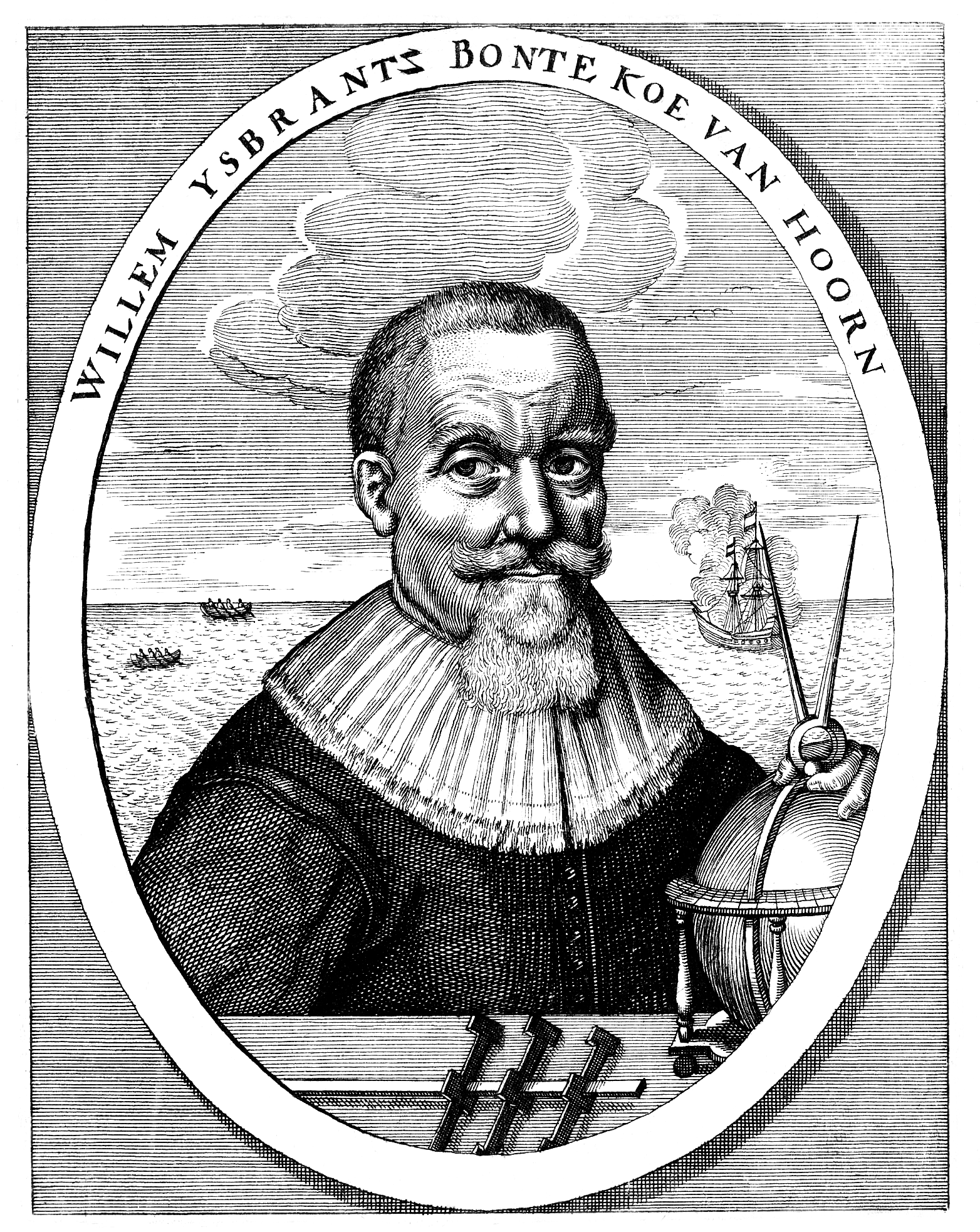
Bontekoe was born in Hoorn in 1587 into a seafaring family. In 1618 he enlisted in the service of the VOC and embarked on his first voyage in December 1618 as captain of the Nieuw Hoorn. The destination was Java by way of the Cape of Good Hope and Madagascar. It is from the account of his shipwreck on this voyage and subsequent exploits that Bontekoe’s lasting celebrity derives.
Disaster struck the Nieuw Hoorn near Sumatra on November 19, 1619, when the steward’s mate set fire to a cask of brandy by carelessly dropping a lit candlewick into the bunghole. The fire spread and threatened the store of gunpowder aboard. Attempts to douse the fire were unsuccessful, and Bontekoe ordered the powder to be thrown overboard. The task was begun, but the fire reached the 300 barrels of powder remaining on board, and “the ship burst into a hundred thousand pieces,” as Bontekoe would later recount. Luckily the ship’s longboat and shallop were already in the sea being towed, so many of the crew had abandoned the ship for these vessels before the explosion and were thus saved. The explosion blew Bontekoe into the sea and, wounded in the head, he clung to the shattered main mast before being taken aboard the longboat.
Seventy-two men survived the wreck, and 119 were lost. It was several weeks before the survivors found rescue. They were cold by night and in the blazing sun by day.
They made sails from their shirts, which they took down to catch water when it rained. They had bread, which soon ran out, but no water, though the fortunate arrival of seagulls and later flying fish provided a little welcome food. They drank their own urine, and against Bontekoe’s advice some drank seawater. They even flirted with cannibalism, but that temptation was put aside when they arrived at an island abundant with coconut palms. During one landfall they encountered hostile natives, who killed sixteen of the crew.
In time the remaining fifty-six survivors arrived at the Sunda Strait between Sumatra and Java. A crewman who had climbed the mast shouted down that he could see ships. They turned out to be Dutch ships, commanded by the explorer Frederick Houtman, who had spotted the survivors and sent out a longboat to investigate. Bontekoe and the merchant Heyn Rol went aboard Houtman’s ship, the Maagd van Dordrecht, and told of their adventures. Houtman provided a boat to take Bontekoe and Rol to Batavia, where they arrived the following morning at the residence of Governor-General Jan Pieterzoon Coen. 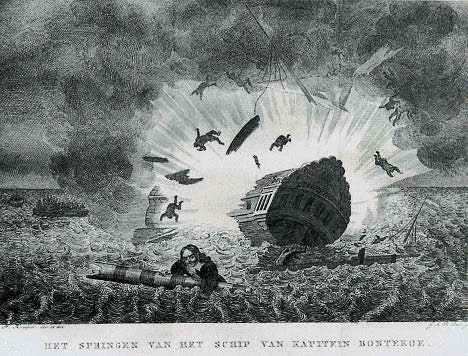
Despite Bontekoe’s recent ordeal, Coen made no move to send him home. In fact he received a new command, the 700-ton Groeningen, and he participated reluctantly in Coen’s campaign to harass the coast of China and establish a Dutch base there. Coen demanded too that China expel from Macau the Portuguese, whom the Dutch were fighting in the long Dutch-Portuguese War. The battle of Macau in June 1622 was the most decisive defeat by the Portuguese over the Dutch in the Far East, and remains the only major engagement fought between two European powers on the Chinese mainland.
It was not until January 1625 that Bontekoe finally sailed for home. He traveled on the Hollandia in the company of two other ships, the Gouda and the Middelburg. Bontekoe being a magnet for misfortune, it should come as no surprise that this voyage was not without its problems. Storms ravaged the ships while crossing the Indian Ocean. The Hollandia lost her mainmast, and the Middelburg lost all her masts. The Gouda was nowhere to be seen, but a large quantity of floating pepper indicated that she was lost. The Hollandia limped to Madagascar and spent three weeks undergoing repairs before resuming her voyage, arriving at Vlissingen on November 16, 1625. Bontekoe, having been away for almost seven years, was content to settle down in Hoorn as a retired skipper, to marry, and to live a quiet merchant’s life.
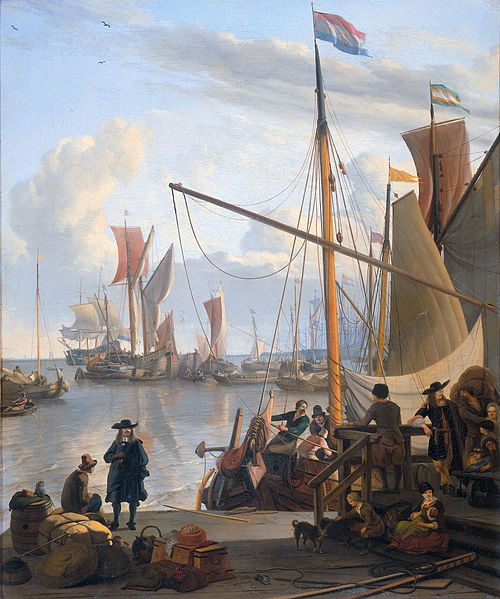
Many years later, a local bookseller called Jan Deutel persuaded him to tell the story of his travels. Bontekoe might well have been quite forgotten had it not been for the account of his adventures that Deutel published in 1646 under the title Journael ofte gedenckwaerdige beschrijvinge van de Oost-Indische reyse van Willem Ysbrantsz. Bontekoe van Hoorn, begrijpende veel wonderlijcke en gevaerlijcke saecken hem daer in wedervaren [Journal or memorable description of the East Indian voyage of Willem Bontekoe from Hoorn, including many remarkable and dangerous things that happened to him there]. In the 17th century there was a surge of travel literature, and the greatest interest was for books containing descriptions of journeys around the world or to the Indies. As the bold seafaring explorations of Europe’s nations increased and colonies were established, there was a need to bring these feats and discoveries to the eager public’s attention.
From its first edition, the Bontekoe book was a huge success. Deutel published a reprint the same year, and a cheaper reprint in 1648, a revised edition that marked the start of what can be called “the Bontekoe craze.” His story became the most popular and enduring of the many contemporary travel narratives, and was a true bestseller. It was reprinted thirty-eight times in the 17th century, and seventy times by 1800, and was translated into several languages. Part of the account’s appeal is its earnest and direct style, and a narrative full of appealing and lively details. Also, Bontekoe himself appears honest, straightforward, and unsophisticated, without a hint of self-importance, and a person of simple religious devotion. He comes across as easygoing and congenial, doubtless a rarity among VOC captains.
The book’s popularity continued through the 18th century, with increasingly cheaper editions. In the Netherlands Bontekoe’s story remained popular throughout the 19th century and into the 20th, and new versions were adapted for a fresh generation of readers. In 1996, to commemorate the 350th anniversary, a new Dutch edition included a descriptive bibliography of all recorded editions, adaptations, and translations.
In 1924, the Dutch writer Johan Fabricius based his book De Scheepsjongens van Bontekoe [Bontekoe’s Cabin Boys] on the original story. The book became a children’s classic, with many editions and translations [Java Ho! in English]. It spawned a film in 2007, a television production, and even a comic book version. Fabricius added three fictitious cabin boys, Hajo, Padde, and Rolf, to Bontekoe’s story, and statues of these celebrated boys have looked out over Hoorn harbor since 1968. How ironic that invented characters should be so celebrated and not the real hero of his own story.