Translations & Transitions Govert Loockermans, a Manhattan Merchant’s Correspondence & Papers More → |
Voyages Maritime routes that shaped the Dutch North Atlantic world More → |
Zotero Bibliography Research Source: 17th century scholarly, non-fiction publications More → |
Genealogical Research What’s in a Name? Discover your ancestors’ origins More → |
Translations & Transitions Govert Loockermans, a Manhattan Merchant’s Correspondence & Papers More → |
Voyages Maritime routes that shaped the Dutch North Atlantic world More → |
Zotero Bibliography Research Source: 17th century scholarly, non-fiction publications More → |
Genealogical Research What’s in a Name? Discover your ancestors’ origins More → |

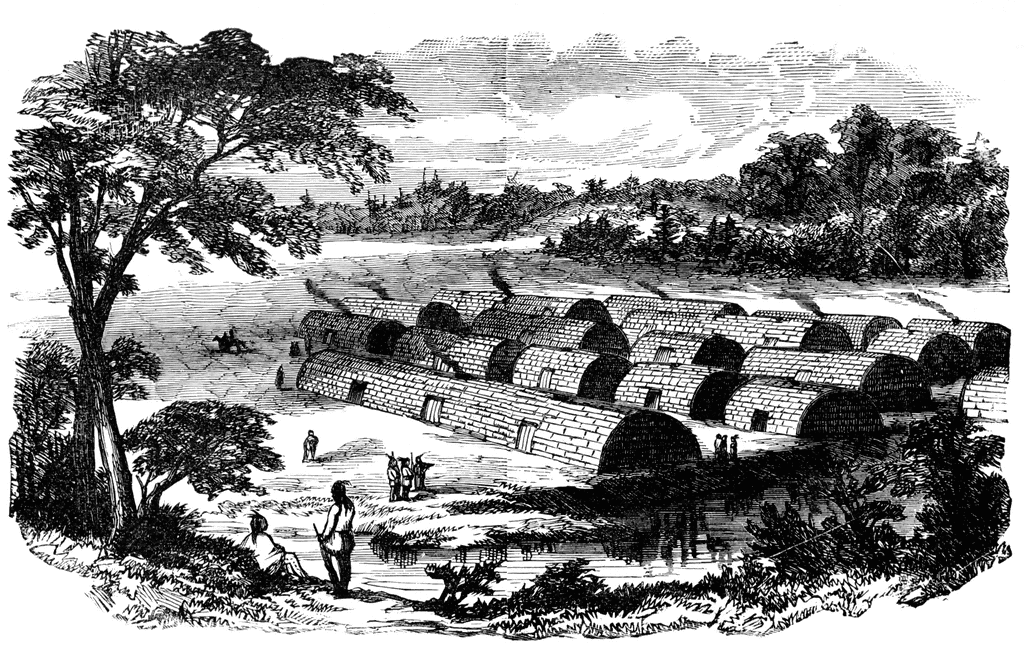
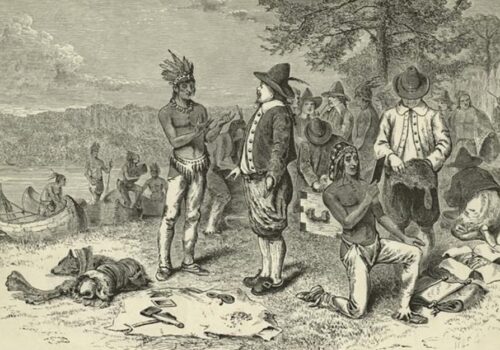
The languages that perplexed these Dutchmen were of two families: Eastern Algonquian and Northern Iroquoian. Many Native communities in the region, some of whose names were recorded by arriving Europeans while others were not, spoke an Eastern Algonquian language or dialect. Outside the boundaries of New Netherland were numerous central New England groups known as the Northern Indians, and to their north, the New England and St. Lawrence Algonquians. Within the boundaries of New Netherland, beginning in the immediate vicinity of Fort Orange, were the Mahicans, speaking a language of the same name. Farther down the Hudson Valley to Manhattan, in northern New Jersey, northeastern Pennsylvania, and on western Long Island, were Munsee-speakers–the Esopus, Wappingers, Minisinks, Tappans, Raritans, Canarses, Rockaways, and others. In the middle stretch of the Housatonic Valley were the Wampanoo-speaking Weantinocks, while nearest Long Island Sound and on eastern Long Island were speakers of Quiripi-Unquachog. In southern coastal New England were found the Mohegans, Pequots, Wampanoags, and Narragansetts, that like the rest, spoke Eastern Algonquian languages. For the Dutch in New Netherland, the Mohawks, speakers of a Northern Iroquoian language, were of critical importance as their confederates to the west–the Oneidas, Onondagas, and others–would carry furs to Fort Orange through their homeland.
THE DUTCH AMONG THE NATIVES
We use cookies to enhance your experience on our site. By continuing, you agree to our use of cookies. See our privacy policy page for the details.
Welcome! You can explore everything you're looking for in the NNI library. Simply type a keyword into the search bar and press Enter to begin your search.
Sign in to access exclusive features and keep track of your favorite content on NNI!
New membership are not allowed.
For over three decades, NNI has helped cast light on America's Dutch roots. In 2010, it partnered with the New York State Office of Cultural Education to establish the New Netherland Research Center, with matching funds from the State of the Netherlands. NNI is registered as a 501(c)(3) non-profit organization. Contributions are tax-deductible to the extent permitted by law.