Now Reading:

American Indian-Dutch Relations, 1609–1664
Font Selector
Sans Serif
Serif
Font Size
A
A
You can change the font size of the content.
Share Page

Exploring Dutch Heritage Through Research 

Exploring Dutch Heritage Through Research 
American Indian-Dutch Relations, 1609–1664

Introduction

The vignettes that follow reflect something of the shared experiences that took place between the Dutch and the original inhabitants of the region that would be called New Netherland. As historian James Axtell once put it, European invaders had encountered Native defenders. Yet the intent of the Dutch to control the lucrative trade in furs forced a partnership with Indians that, for the most part, presented advantages for both parties, although it sometimes lost its way. The outcome for many was often tumultuous amid misunderstandings, violence, and death. But compromises and accommodations were made and life went on, for better or worse. The colonial venture had begun.

Exhibit Credits

Exhibit written by William A. Starna, Professor Emeritus of Anthropology, State University of New York College at Oneonta. He is the author and editor of numerous books, including From Homeland to New Land: A History of the Mahican Indians, 1600-1830 (Nebraska, 2013), Adriaen van der Donck’s A Description of New Netherland (Nebraska, 2008), and Harmen Meyndertsz van den Bogaert’s A Journey into Mohawk and Oneida Country, 1634-35 (Syracuse, 2013).

Online production by Dennis Maika and Steve McErleane, both of the New Netherland Institute. Special thanks to Len Tantillo for the use of his artwork.

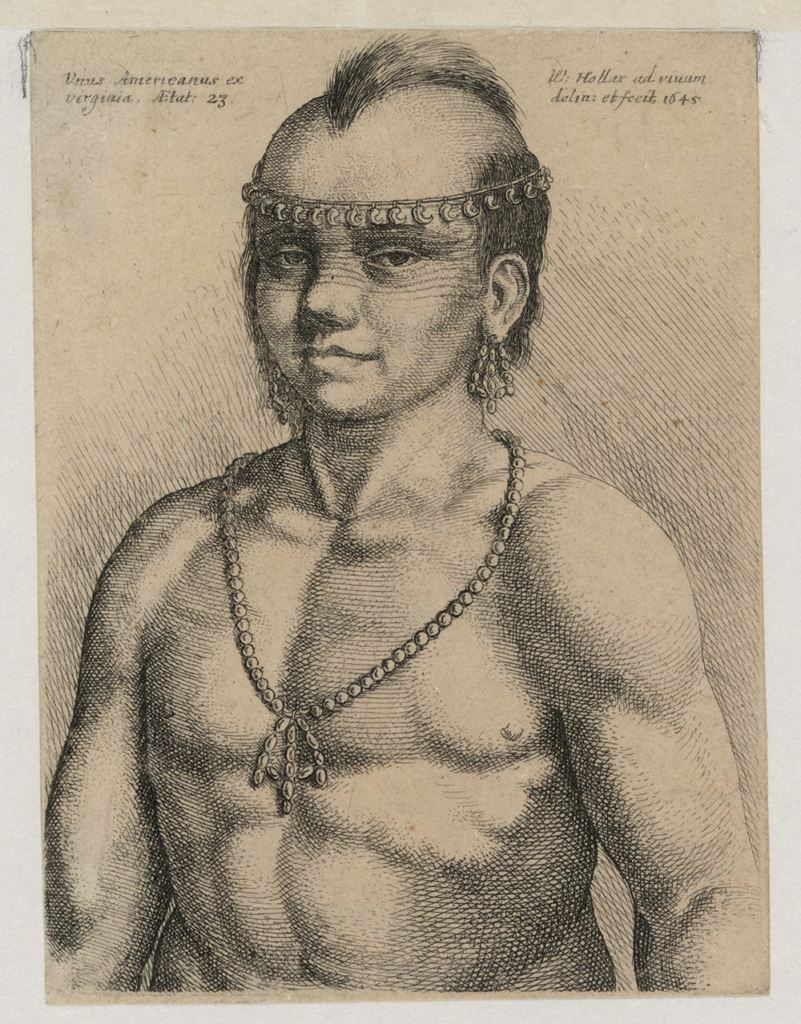
Unus Americanus Ex Virginia, by Wenceslaus Hollar, 1645 (probably a Munsee Indian), Library of Congress.
About New Netherland Institute

For over three decades, NNI has helped cast light on America's Dutch roots. In 2010, it partnered with the New York State Office of Cultural Education to establish the New Netherland Research Center, with matching funds from the State of the Netherlands. NNI is registered as a 501(c)(3) non-profit organization. Contributions are tax-deductible to the extent permitted by law.