


Good prize or not? The case of Juan Gaillardo Ferrera and thirty-seven enslaved Africans in New Amsterdam, 1652-1657 (2025)
by Erik Odegard
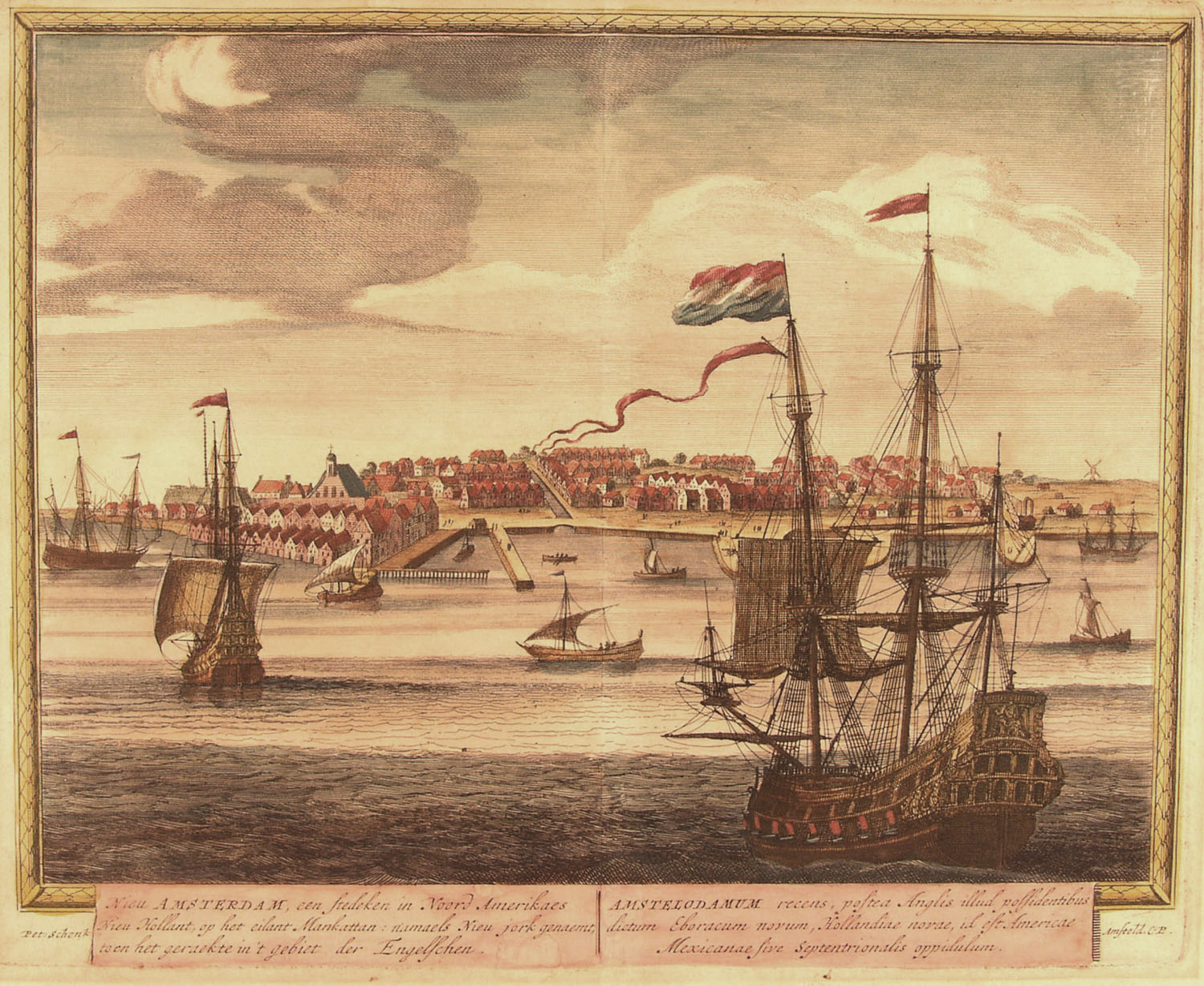
In October 1657 a meeting of specially-appointed commissioners was held in New Amsterdam, likely in the City Hall. The commissioners were appointed by Director-General Peter Stuyvesant to hear a complaint by a Spanish merchant against Stuyvesant and the council of New Netherland.1 The irate Spaniard, Juan Gaillardo Ferrera, was a native of Sanlucar de Barrameda, on the mouth of the Guadalquivir which connected Seville to the Atlantic Ocean but this was not his first visit to the Dutch settlement in North America. Back in 1652, Gaillardo Ferrera had been taken captive when the ship he was travelling on was taken near Moran Point, Jamaica. He had then been engaged on an intra-American slave trading venture, taken thirty-seven enslaved Africans to Santiago de Cuba. In 1656 he returned to New Amsterdam to bring a suit against Director-General and Council of New Netherland who had declared ship and the enslaved “good prize” and had allowed the capturers to sell the Africans in New Amsterdam, or so he claimed. This was, in Gaillardo Ferrera’s eyes, a grave injustice: the Dutch Republic and Spain were at peace and had been since 1648. Indeed, the Spanish court had worked assiduously and would continue to do so over the coming decades to bind Spain and the Dutch Republic together as this was seen as the best guarantee for continued Spanish sovereignty over the Southern Netherlands.2 If Gaillardo Ferrera’s complaint was correct, and the WIC-government in New Netherland had indeed declared ship and cargo good prize, this was a decidedly hostile act and would require compensation or risk inviting Spanish retaliation.
Examining the prize case of Juan Gaillardo Ferrera’s slave trading voyage sheds light on the role that New Amsterdam played in colonial privateering and highlights the importance of the legal process through which captures at sea could be legitimized. The episode also provides a rare glimpse of New Amsterdam’s early Black community. Gaillardo Ferrera submitted valuable evidence since he brought a list of the locations where the thirty-seven people ended up after being auctioned off in New Amsterdam.3 But first, let’s turn to the facts of the case as far as they can be discerned. It is actually difficult to settle on what happened exactly, since Gaillardo himself would change his story during the process. In 1655 the Spanish ambassador in the Netherlands who had become involved in the case submitted an official complaint to the States-General “against a certain Captain Sebastiaen Raeff and his Lieutenant Jan van Campen, concerning piracies committed against the inhabitants and subjects of the King of Spain in the West Indies.” Gaillardo thus brought a case against the captain and lieutenant of the vessel which allegedly had taken his ship, the Dutchmen Raeff and Van Campen. The latter was still in New Netherland, it was argued, and in January 1656, the States-General order Director-General Stuyvesant to send him to the Netherlands pede ligato (lit. “with chained feet”). This version of events was put on paper by Amsterdam notary Joachim Thielmans in April 1656. The case could not be resolved in the Netherlands, so Gaillardo was packed off again to New Netherland to pursue his case against the prize verdict there. But in New Amsterdam he would change his tune when the Stuyvesant and the Council argued that neither Raeff nor Van Campen had ever been in New Netherland. There had been a Spanish vessel brought into port in the spring of 1652, but the captor had been Geurt Thijssen. This made Gaillardo Ferrera change his version of events, arguing that this was an alias of Sebastiaen Raeff and he also changed his recorded itinerary to suit the account presented by Director-General and Council. Since the case was pursued against Director-General and Council, Stuyvesant could not preside the meeting. Rather, specially-appointed commissioners were appointed to hear the complaint and the defense of Stuyvesant and the Council, its members representing both company and civil authorities in New Amsterdam. Pieter Tonneman, a member of the New Netherland Council; burgomasters Allard Anthonij and P.L. van de Grift; and Hendrick Jansen vander Vin, a New Amsterdam schepen. were “specially committed, and qualified, as judges between Joan [sic] Gaillardo Ferrare” and the “Lord Director Gener.l and Councillors.” The Spaniard laid out his case, arguing that the sale of the thirty-seven enslaved Africans entailed a declaration of good prize, which contravened the treaty between Spain and the Dutch Republic.
Gaillardo Ferrera had to be assisted by Moses de Lucena as a translator, since he could neither speak nor understand Dutch himself. The lack of Dutch linguistic skills likely had been a problem for the Spaniard in 1652 as well, as Stuyvesant and the council argued that he had fundamentally misunderstood what had taken place in New Amsterdam in that year. They had not, they argued, made any rule on the validity of the prize whatsoever. This was not because the council of New Netherland was not allowed to rule in prize cases. Like the WIC-governments in Curaçao, Elmina and Recife before 1654, they were empowered to rule in prize cases and had done so numerous times in the 1630s and 1640s when Dutch privateers had brought Spanish prizes into port, the most notorious of which had been La Garce commanded by Willem Blaeuvelt. But in the case of Gaillardo Ferrera, the council of New Netherland had not issued a ruling on the validity of the prize since the privateer which had taken Gaillardo Ferrera had not sailed under a Dutch commission. Instead the ship came with a commission issued by “Chevalier du Poincy, Governor of St. Christoffel and Lieutenant General Du Roy de France pour les Isles Americques”. What Stuyvesant and the council had done was allow a ship from a friendly nation to sell off some of its “cargo” (human beings) so that it could buy provisions and make necessary repairs to safely continue its voyages. The validity of the prize was in the hands of Du Poincy on St. Christophe (St. Kitts). Stuyvesant argued that Gaillardo Ferrera was free to make his case there, and good luck to him. The commissioners ruled that Gaillardo Ferrera be given fourteen days to provide further evidence for his claims, but also prohibited from leaving the colony. Gaillardo Ferrera would remain in New Amsterdam until at least July 1658, requesting permission to leave in March of that year.
Our first impression today would perhaps be that the WIC-government in New Amsterdam acted decidedly sketchy in allowing the sale of the enslaved Africans. Susannah Shaw Romney described this as a case of abetting piracy. But in another prize dispute that was being appealed in New Amsterdam in the 1650s, the ruling went against the captors. The privateer La Garce which had operated out of New Amsterdam and which was financed by local investors had taken a Spanish ship the Caribbean after the peace with Spain had gone into effect. When captor and prize arrived in New Amsterdam later that year, Stuyvesant and the council refused to declare the vessel good prize. As late as June 1656, the council of New Netherland ruled, in reply to a petition brought by Augustyn Heereman, that the prize was taken after the peace was signed and could not be considered good prize. As much as Stuyvesant hated the Spanish, he would not unthinkingly condone illegal captures.
It is worth asking whether Gaillardo Ferrera’s actions were entirely in good faith. A standard procedure in the capture of prizes at sea was to show the commission under which the captor acted. He would likely have been shown the French commission issued on St. Christophe under which Geurt Thijssen and his men could capture the ship. France and Spain were at war and there was no likely ground to pursue restitution of property or payment of damages there. But if the case could be made into a diplomatic issue, complicating Dutch-Spanish relations, perhaps the WIC could be made to pay simply to make the issue go away. This had actually happened before: in the 1640s, when the armistice with Portugal went into effect, the States-General compelled the WIC to pay damages to Portuguese shipowners who argued their ships were taken after the armistice went into effect. Perhaps Gaillardo Ferrera’s case is one where everyone involved was acting in bad faith, and this is before we consider that what was at stake here was a conflict over the ownership of human beings.
So let us finally turn our attention to the people who were at the heart of the entire story but whose voices are never heard: the thirty-seven enslaved Africans whose lives were entirely upended by the capture of the ship and who would end up in North America rather than Cuba. Gaillardo Ferrera’s paperwork when he brought his case in October 1657 included a list of names and locations for these people, providing a valuable insight into the dispersal of this group of people after they were sold off by the captors. These people arrived in New Amsterdam shortly before the WIC, in the final years of its rule over New Netherland, would instigate regular slave trading voyages there. As such, this is one of the earliest groups of Black New Yorkers after the very early arrivals on board the Bruynvisch back in the 1620s. The list given by Fernando Gaillardo recorded the names that Europeans had given these people, along with the people who had formerly and at the time of making the list claimed ownership over them. In some cases, the list recorded family groups, which seem to have remained intact, at least in some cases. Lucia “y su marido” Joseph, were recorded as having been sent to Curaçao by the WIC to tend to the cattle there. Two other men, Paulo and Diego (or Jacob) had also been sent to Curaçao. Two women, Juliana and Maria along with three unnamed children were recorded as currently residing in the fort at New Amsterdam “with Jacob de Molenaer.” Another woman, Catalina, was now “with the potter’s son or daughter” along with two unnamed children. Three people, Maria, Jan and Luis were also recorded together in New Amsterdam. Manuel and Mookinga had been individually sent north, to Fort Orange, while Jan and Francisco were recorded together as now being “in the bay,” as were Bastiaen and Lucia. The remaining people were recorded individually and most likely remained in New Amsterdam itself or on Manhattan. Balthasar, for example, was recorded as “now the Lord General’s” and thus might have been sent to Stuyvesant’s farm north of New Amsterdam. Francisco, Gasinte, Antonio, Diego (or Jacob), Jan, Barbara, Christoffels, Fernando, Maria, Jan, Madelina, Susanna, a woman called “La Caubotera”, Tiga and one unnamed man likely remained in New Amsterdam. The happenstance of a meeting at sea between two ships meant they ended up in Dutch New Netherland (and Curaçao), rather than Spanish Cuba.
Erik Odegard (Ph.D. Leiden University, 2018) is currently assistant professor military history at the Netherlands Defense Academy in Breda. His first book was The Company Fortress: Military Engineering and the Dutch East India Company in South Asia, 1638-1795 (2024). Previously, Erik was a Post Doctoral Researcher at the International Institute for Social History (IISG) where he worked on as an NWO VENI project entitled “Investing in Dutch Brazil: Credit, Debt, and the Sugar Cycle in the Seventeenth-Century Atlantic World”, as well as working on a history of the Dutch West India Company as a privateering enterprise (1621-1674).