



Spuyten Duyvil in Fact and Fiction
Perhaps the most peculiar name of a neighborhood in the Bronx—thee northernmost of the five boroughs of New York City— is Spuyten Duyvil.
by Peter A. Douglas
The earliest reference is by the Dutch lawyer Adriaen van der Donck (c.1618-55) in 1653, where he owned land. Running between the Hudson River and the Harlem River by way of the Harlem Ship Canal is the Spuyten Duyvil Creek, a short tidal estuary that separates the northernmost tip of Manhattan from the Bronx. It passed its name on to the neighborhood of Spuyten Duyvil that borders the Hudson north of the creek.
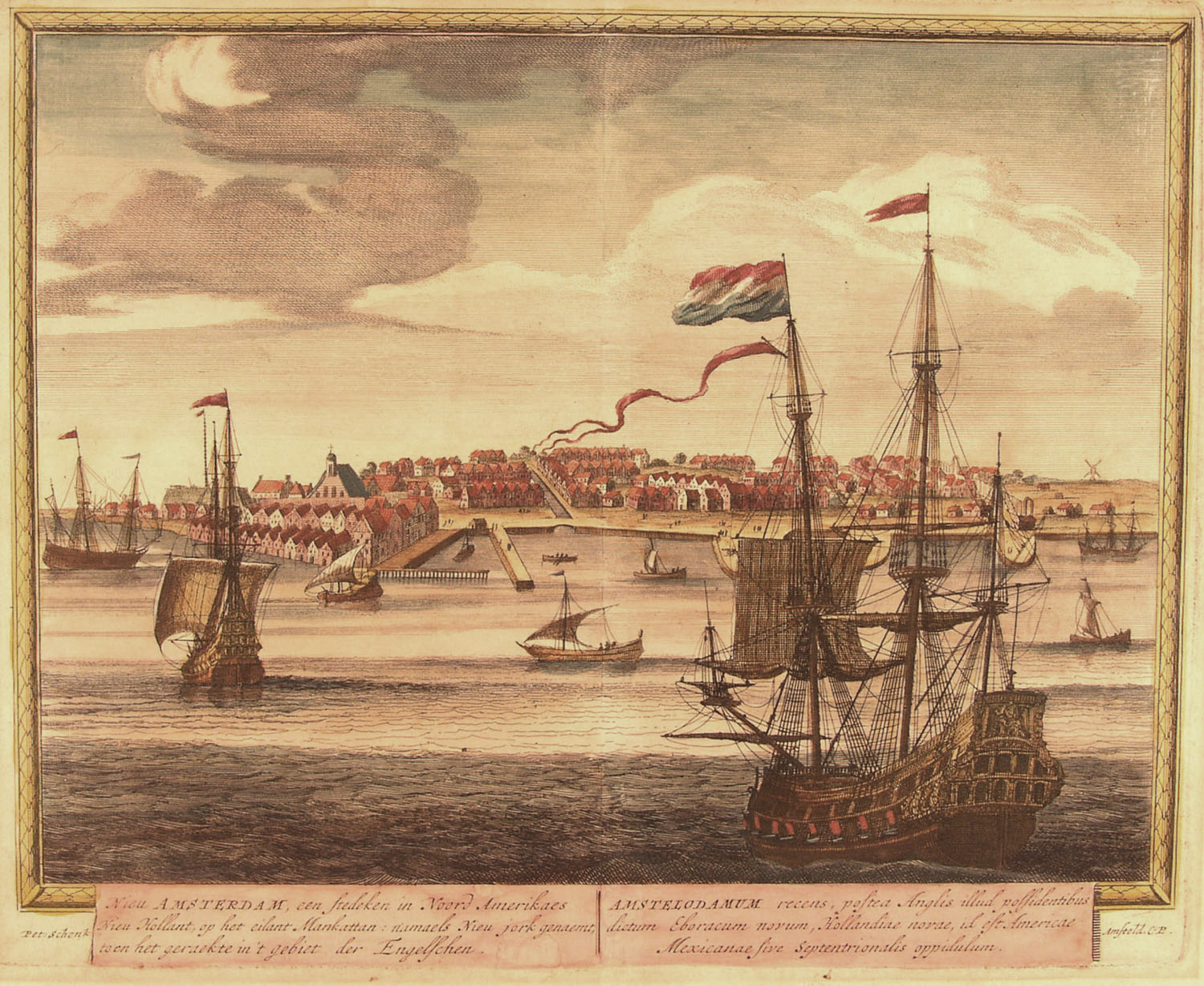
During the Dutch colonial period, travelers, farmers, and merchants found that crossing the Spuyten Duyvil Creek was difficult because of its strong-flowing tidal current. The significance of the creek is revealed through the laborious altering of its natural winding course for commercial purposes in the nineteenth century, the creek being too shallow for large boats. The present course of the creek differs greatly from how it was when New Amsterdam stood at the opposite end of the island. The Hudson Ship Canal opened in 1895 and cut off Marble Hill from Manhattan, with the Spuyten Duyvil Creek as its northern boundary. The creek was subsequently filled in, connecting Marble Hill with the Bronx, though it’s still governmentally part of Manhattan.
The meaning of Spuyten Duyvil, along with its spelling and pronunciation, is still often a source of some speculation and dispute. For a start, the following are anglicized and other spelling variations noted on early maps and documents: Speijt Denduyvel, Spikendevil, Spiteing Devill, Spiten Devill, Spiling Devil, Sputten Tyfel, Spike and Devil, Speak Devil, Spitten Devil, Speit den Duyvil, Spilling Devil, Speight den Duyvil, Spiting Divill, Spitin Divil, Spitting Duyvell, Spitton Divil, Spyt den Duyvel, Spayten Duyvil, Spiten Debill, Spuiten Duyvil. Thanks to an unfamiliarity with Dutch and hazy spelling conventions, it’s rich crop.
Whatever the spelling, the most persistent confusion concerns the meaning of the name. In discussing its meaning, some writers hedge their statements by saying, “according to legend,” “local legend describes,” or by referring to “the legend of Spuyten Duyvil.” In reality, it’s not so much a legend as the product of one man’s thoughts, and the book that resulted. Sure, if a legend means a story coming down from the past, and especially one that’s popularly regarded as historical (though not verifiable), then it might be called a legend. However, legends don’t usually have a specific and precisely datable origin, nor do they tend to be ascribable to the imagination of one man.
Spuyten Duyvil has been erroneously taken to mean “in spite of the devil” or “to spite the devil.” This is nothing more than a misinterpretation as a result of near-homophony, the imposing of English words on the unfamiliar Dutch, and thereby giving the phrase a new meaning. This has rightly been laid at the door of the author Washington Irving (1783-1859), whose humorous tale offers a bogus origin and meaning for the place name. Irving knew he was distorting history for amusement, but the question has always been—do his readers understand that?
Irving’s tale occurs in his A History of New York: From the Beginning of the World to the End of the Dutch Dynasty by an invented persona, Diedrich Knickerbocker, published in 1809. The story goes that upon learning of an English expedition to seize New Netherland, Director General Peter Stuyvesant (“the high-minded Pieter de Groot”) summoned Anthony van Corlaer, a trumpeter in New Amsterdam’s garrison, and ordered him ride up to “the pastoral borders of the Bronx,” and warn the population in the villages in the Hudson Valley, “charging them one and all to sling their powder-horns, shoulder their fowling pieces, and march merrily down to the Manhattoes.”
Van Corlaer is something of a comic character with a big red shiny nose, a man of large appetites, a brash and jolly toper, a womanizer, and altogether typical of Irving’s improbable Dutch buffoons. “It was a dark and stormy night,” writes Irving, when Anthony arrived at the Spuyten Duyvil Creek, and the water was raging. “The wind was high, and the elements were in an uproar,” and Anthony found no ferry available to take him across. But he was determined, and “bethinking himself of the urgency of his errand, took a hearty embrace of his stone bottle, swore most valorously that he would swim across in spite of the devil (Spyt den Duyvel,) and daringly plunged into the stream.” Half way across he was struggling “as if with the spirit of the waters.” He then “instinctively put his trumpet to his mouth, and giving a vehement blast—sank for ever to the bottom.”
Anthony’s tale is continued by “an old Dutch burgher, famed for his veracity,” who witnessed the scene. Irving’s stand-in author, Knickerbocker, admits to being “slow in giving belief” when the old man reported that he saw “the duyvel in the shape of a huge moss-bonker, seize the sturdy Antony by the leg, and drag him beneath the waves.” Some versions say that the fish was the devil in physical form. Irving continues with some firmness, “Certain it is, the place, with the adjoining promontory, which projects into the Hudson, has been called Spyt den Duyvel ever since.”
All this whimsy is not an explanation of why the place where the event occurred should have been named in that way, but we need to remember that this is fiction, and it doesn’t have to be rational. On the other hand, if you are, even in fun, stating the origin of the name of a real place, why be intentionally misleading? The story would have been just as funny without that distraction. Irving may or may not have had any idea what Spuyten Duyvil meant, but just chose to use what seemed a possible origin to enliven his boisterous fairy-tale.
Following Anthony’s death, the storyteller asserts “as to the moss-bonkers, they are held in such abhorrence, that no true Dutchman will admit them to his table, who loves good fish and hates the devil.” Irving’s vicious “moss-bonker” is another name for a fish called a menhaden, and as these creatures rarely exceed fifteen inches in length, the one that grabbed Van Corlaer must have been huge indeed. Irving goes on to mention the “notorious propensity of the people in those parts to sound their own trumpet.” This remark shows that Irving is nudging us and laughing with us, and that we are not meant to take any of this seriously.
To take Irving’s writing at face value would be a mistake, and if the nature of the tale itself, and the tongue-in-cheek manner of its telling, were not enough to create skepticism about the name’s alleged meaning, another reason for doubt is that some sources set the event in 1642—five years before Peter Stuyvesant set foot in New Amsterdam to take up his post as Director General. This isn’t Irving’s fault, for he mentions no date. No doubt this is a case of an original slipshod error being parroted by other lazy writers. If the event took place at all, it would have been in 1664 when the English did arrive to claim the colony, an easy fact to check.
Despite the clearly fanciful nature of Irving’s tale, and more persuasive arguments to the contrary, his explanation of the creek’s name has endured. Irving has been taken surprisingly seriously, and much has been written in scholarly analysis and comment. The eminent Dutch State Archivist and translator A.J.F. van Laer (1869-1955) rejected “in spite of the devil” for several linguistic reasons. Also, almost without exception, the Dutch place-names in this vicinity are either names descriptive of natural physical conditions, or loan names. In addition, there are elements in the words “Spuyten Duyvil” that suggest another meaning that’s perfectly logical because it fits in with the locality.
The Dutch word spiu means a sluice, drain, or outlet, while the verb spuiten means to spurt, gush, spray, spout, or erupt. This is a most appropriate word because of the notoriously turbulent nature of the Spuyten Duyvil Creek. In the story, Spyt den Duyvel is interpreted as “in spite of the devil,” but Dutch spyt or spijt means “regret,” not “spite.” The vowel sounds in the Dutch expression have been changed to suit the English tongue, which naturally changes the word and thus the expression’s meaning. Some have tried to link spuiten with “spate,” with shared connotations of the creek’s powerful flow. Other suggestions include that it’s a crude translation of various Indian names, or a corruption of the French “Esprit du Diable” (Spirit of the Devil) though the relevance of this is unclear. “Sprouting Meadow” has also been proposed, referring to a spring that arises from the foot of Inwood Hill. What’s going on is that we have English speakers, with no training in linguistics and perhaps a smattering of Dutch, grappling with the etymology of Dutch-origin American place names. The result can only be wild guesses.
The reasonable explanation is such that one has to wonder why Irving’s humorous misdirection was ever taken seriously at all. It’s unnecessary to propose all these far-fetched ideas because a literal translation is the most plausible explanation of the name, and “Spouting Devil” (or Spuitende Duivel in Dutch) does evoke the strong flow and rough water of the creek. The Spuyten Duyvil Creek being between the Hudson and Harlem Rivers, it is subject to a double tide, and is in almost constant flux.
The agitated state of the water is remarked upon in George R. Stewart’s American Place Names (1970), which tells us that Spuiten Duyvil comes from the Dutch meaning literally “spout- devil,” with reference to the dangerous tidal currents, though the book states that “the exact terms from which the present name is derived are uncertain.”
And where does the devil come into this? The name has also been translated as Spewing Devil, Spinning Devil, Spilling Devil, Devil’s Hose, Devil’s Spout, and Devil’s Whirlpool, none of which seem entirely satisfactory, though the general sense is conveyed. With some imagination we might conjecture that the use of “devil” in this context may have originated with the exclamation or curse of some lucky traveler who overcame the dangers of his passage of the tempestuous creek. The fierce and regular turbulence of the water could have been attributed to the devil’s work, hence the appearance of the devil-fish that drowned Van Corlaer. It has been conjectured too that a “devil” is a nickname given to any dangerous river crossing or ford, not just this one.
As for Washington Irving, this is neither the first nor the last time that his stories have been taken as factual in their portrayal of the nature of the Dutch colony and the activities of its inhabitants. Despite the pure absurdity of Van Corlaer’s fate, the tale’s purported explanation of Spuyten Duyvil has survived, its durability helped by Irving’s now classic work. His whimsical pen produced many droll and satirical portraits of New Netherland such as this, and all too often credulous readers have construed as fact his comic world full of quaint characters and caricatures, much to the detriment of the real story of New Netherland. Irving’s entertaining tales should be seen for what they are. We should not cloud the truth any further, because for most people what really happened in Dutch America is too far below the surface as it is.