

The Manhattan Deal: A Strange Fixation on Beads
One the many myths that blur the story of the Dutch “purchase” of Manhattan—one that is firmly cemented in the popular psyche—says that the price was mere “beads and baubles.”
by Peter A. Douglas
“Trinkets” is a word that recurs again and again in this context, a trivializing word that makes the Indians childlike and the Dutch stingy. Even though it’s deeply ingrained in the mythology of New York City, and lightweight American history in general, this trinkets business is not based on fact. Peter Schaghen’s 1626 letter that briefly reports the acquisition of Manhattan makes no mention of beads or trinkets—or goods of any kind in fact. The sum Schaghen mentions — “to the value of sixty guilders” — means the value of the trading commodities exchanged for the land, and, while these are not identified, it’s highly unlikely that they were mere trinkets.
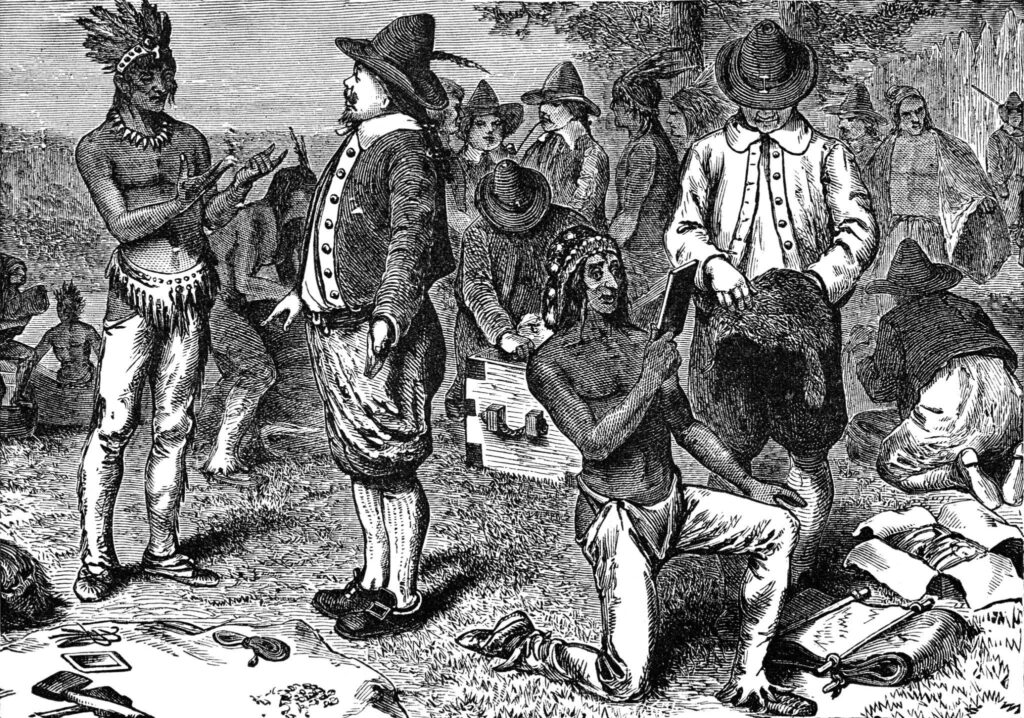 Other sources offer many variations on the bead theme by pulling imaginative “facts” out of nowhere, suggesting that the Indians were paid in skins, ribbons, embroidered coats, brass ornaments, scarlet cloth, brass buttons, bits of glass, blankets, and strips of colored cloth. Apparently what the supposedly gullible Indians would accept for the land is limited only by the imagination of the writer.
Such apparently canny property speculation on the part of the first white inhabitants of Manhattan seems even a matter of some formal civic pride in New York City, though unfortunately it’s tainted with a whiff of racism in the subliminal patronizing of the Indians. Dedicated in 1926, a memorial flagpole stands in Battery Park to commemorate the tercentenary of the establishment of New Amsterdam. On one side of the stone base is a sculpture in relief that depicts a prosperous Dutchman proffering strings of beads to a skeptical-looking native. The latter is wearing nothing but a loincloth and an anachronistic Western-style feathered headdress that’s quite wrong for the woodland tribes of Manhattan. There is an unpleasant urban smugness to this monument, which, along with the historical inaccuracies, including swallowing the hoary “bead myth” wholesale, have the effect of detracting from the pure municipal satisfaction that it seeks to build.
Given the West India Company’s directive to Director General Verhulst to be fair and legal in all dealings with the natives, along with the continuing Dutch need for a lucrative and friendly alliance, it’s unlikely that that they would set out to cheat the Indians, who, of course, were free to refuse a treaty they could not accept. It may well be that beads were included in the trade. There is no way to know, but we can be reasonably confident that, for the satisfaction of both parties the Indians would have received items that were practical, functional, and of sufficient use and value rather than mere ornaments and trifles to delight simple minds.
There is evidence of this. In a similar deal, that of the acquisition of Staten Island from the Lenape in 1630, the record survives to tell us that the natives were paid in useful trade goods that were valuable to them, many being metal items that the Indians could not manufacture themselves. No glass beads or trinkets are mentioned here; what the Indians received included cauldrons, duffel cloth, kettles, axes, hoes, and awls. If such goods were traded for Manhattan, and it seems certain that this was the case, then the Indians were the recipients of items of enormous and even revolutionary usefulness—the very latest, in fact, in practical Dutch domestic technology. So if there is no historical basis for the beads and baubles, where did the notion that the Indians received such things come from?
The “trinkets” twist to this story has been laid at the door of nineteenth century writers such as Martha Lamb. In her 1877 History of the City of New York, she writes: “He [Minuit] called together some of the principal Indian chiefs, and offered beads, buttons, and other trinkets in exchange for their real estate. They accepted the terms with unfeigned delight, and the bargain was closed at once.” This is pure invention and has no place in a book that purports to be history. Yet this version stuck and was repeated over and over, and among the uninformed it remains the Manhattan legend today.
We can’t blame just the early writers for such romantic embellishment; there are plenty of examples of how this fairytale survives today. For example, we read in publicity literature from the National Geographic Society: “Dutchman Peter Minuit purchased Manhattan from the Indians in 1626 for $24 worth of baubles.” Noted author and Brooklyn native Pete Hamill, swallowing the tale with no argument or reflection, can write in his 2004 memoir of “the company’s ‘purchase’ of Manna-hata for twenty-four dollars’ worth of beads and trinkets.” In the UK, the 1963 edition of Brewer’s Dictionary of Phrase and Fable says: “Manhattan Island was bought from the Indians for cloth and trinkets to the total value of about £5.” (A fable indeed!) Even the 1993 edition of The Columbia Encyclopedia does not hesitate to assert that “Minuit purchased Manhattan from the Native Americans for trinkets valued at $24,” giving the story an official endorsement that is consistently reiterated.
Because very little information about the purchase can be squeezed from Peter Schaghen’s letter, this is one of the myths that rushed in to fill the annoying vacuum and thus became a staple of American folklore. The myth is aided by several facts and suppositions. For one thing, beads, especially those made of glass, have been long and widely used as a form of currency, and American Indians used them in this way. The association of beads with money, and hence with trade and purchase, has perhaps helped stimulate the notion that chests full of beads were what Minuit took to his rendezvous with the Indians, though there is not a scrap of confirmation for this.
Doubtless this particular legend was reinforced by what seemed like the attractive idea that the slick Europeans were able to exploit the guileless natives and dupe them out of their rich land for worthless items. The tale is usually told with some glee and satisfaction, not to mention an unattractive hint of ethnic condescension. No “sides” can be taken when the deal, as it actually occurred, is fair to everyone, so for the Indians to have received beads is also convenient for anyone with an axe to grind, both for those who sympathize with the Indians and for those who favor the Dutch in this notorious transaction.
A big problem created by disregarding the facts is that this encourages even further invention, in this case allowing speculation about the participants to build. On the one hand, we can see the Indians as foolish and naïve to have been taken advantage of, while on the other hand they can be portrayed as simple and noble innocents, victims who are unskilled and quite inexperienced in matters of commerce with Europeans. And likewise it goes both ways with the Dutch—on the one hand the cheap beads cast a shadow on their reputation, showing them as crafty and unprincipled for masterminding a one-sided and hugely profitable land grab that cost them merely a load of shiny beads. Conversely, their swapping mere beads for thousands of acres of land can be viewed as really astute bargaining. Both parties can thus “win” or “lose” according to the bias and purpose of the writer.
Much of the explanation for the beads probably also lies in simple assumptions and anthropological theories. This idée fixe that the Indians accepted beads and other showy trifles for Manhattan has doubtless also been influenced by the erstwhile stereotype of the irrational primitive, and the general supposition that natives of all kinds and in all parts of the world show a gratifyingly childlike and uncomplicated delight in the white man’s dazzling gewgaws. It’s a valid point too that to the natives such items often held an important symbolic and ceremonial value that was not appreciated by the Europeans, and that colonists often did exchange cheap trifles such as beads for other more valuable goods, or land.
And lastly, as we have seen, whatever the origin of this spurious notion of the Indians’ receipt of such tawdry items for their land, unfortunately this scenario has been transmitted, formalized, and solidified over the years by countless overly creative and idealized depictions of Minuit’s transaction, both in print and in illustrations. This has helped guarantee that, despite the complete lack of evidence, beads and baubles were taken to be part of the treaty. The original error is self-perpetuating and self-reinforcing, constantly feeding on itself and getting blindly repeated again and again. Impervious to historical facts and rational speculation, this myth has proved hard to budge.