

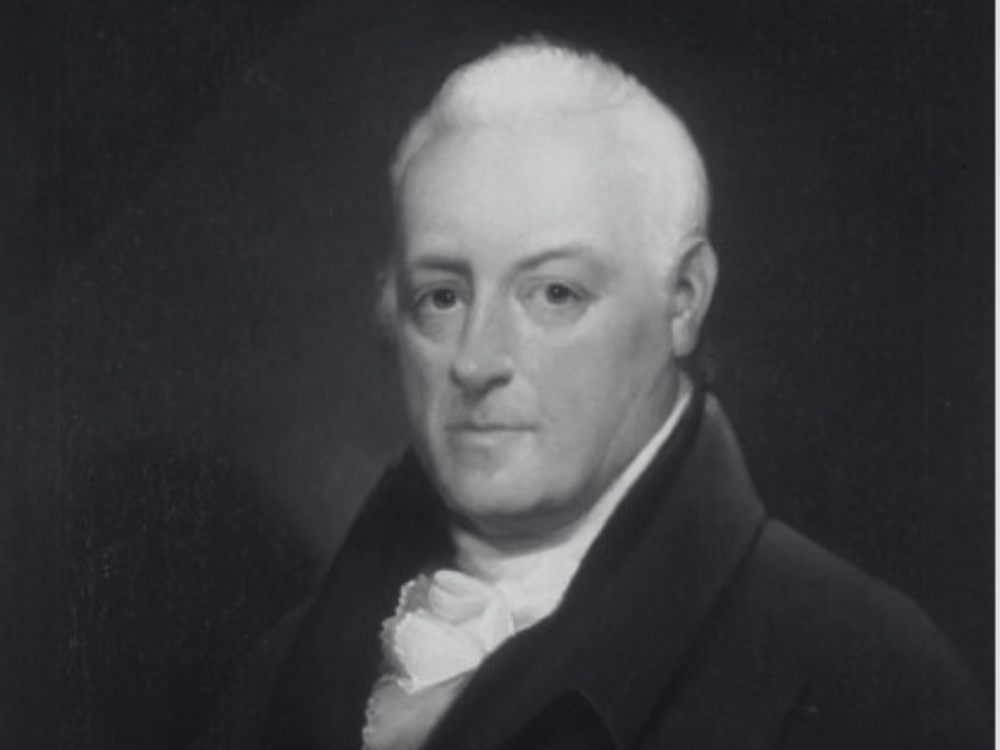
John Lansing, Jr. 1754-1829
John Lansing Jr. (1754–1829) was a New York jurist and political leader who served in the Continental Congress and attended the Constitutional Convention of 1787. Though he declined to sign the Constitution, he later became Chief Justice and Chancellor of New York.
- John Lansing, Jr.
Early Founder/Historic Leader
John Lansing, Jr. is considered one of the Founding Fathers of the United States of America. He was a delegate to the Constitutional Convention in 1787, at which the U. S. Constitution was adopted and the United States of America was officially formed. He was one of the non-signing delegates at the Convention, which meant that he participated in the Convention but was not one of the signers of the U. S. Constitution. He and some others opposed some of the language and terminology of the constitution and therefore declined to sign it.
Prior to his participation in the Constitutional Convention he became a member of the Continental Congress in 1785. He served in that capacity until 1787, when he declined to sign the U. S. Constitution.
John Lansing was born in Albany, New York on January 30, 1754. Following his basic schooling he studied law in Albany and under James Duane in New York City. He was admitted to the New York State Bar in 1775. He is best described as an American political leader and a jurist. He is of Dutch descent. The family name of his ancestors was spelled, Lansingh, and he was a member of the Dutch Reformed Church.
During the 1776-1777 time period he was the military secretary to General Philip Schuyler. In 1781 he was elected a member of the New York State Assembly and served in that capacity until 1789. He was appointed to be a justice of the New York State Supreme Court in 1790 and served in that capacity until 1798, when he became chief justice, and served as chief justice until 1801. In 1801 he was appointed to be the Chancellor of New York State, a position he held until 1814, when he was forced to retire because of age.
Although he had to retire from his chancellorship position he had not given up to devote more time to public service. In 1817 he was appointed to be a regent of the State University of New York. He served in that capacity until 1829 because of his death. He disappeared mysteriously on December 12, 1829, after leaving his hotel room to post a letter on board the Albany boat at the foot of Cortland Street in New York City. Lansing was 75 years old at the time of his death and was presumed drowned or murdered. No explanation was ever found for his disappearance. A cenotaph was erected at an unknown site to commemorate his many years of public service.
John Lansing was married and his wife’s name was Cornelia. Cornelia passed away five years following his disappearance, in 1834. There is little information on their children. Apparently there were three but only one survived beyond childhood. John Lansing was the uncle of Gerrit Yates Lansing, a Representative to the U. S. Congress from 1831 to 1837. The city of Lansing, Michigan was named after the Lansing Family.
Explore More Dutch Americans