


“Manhattan and the $24 Myth”
One of the immortal myths associated with the Dutch “purchase” of Manhattan is that they bought the island for $24. Let’s ignore for now the meaning of “purchase” in this context, for this is yet another myth that needs busting. Let’s forget too for now that Manhattan was not acquired by the Dutch parting with hard cash, though the constant reference to the $24 seems to imply this.
by Peter Douglas
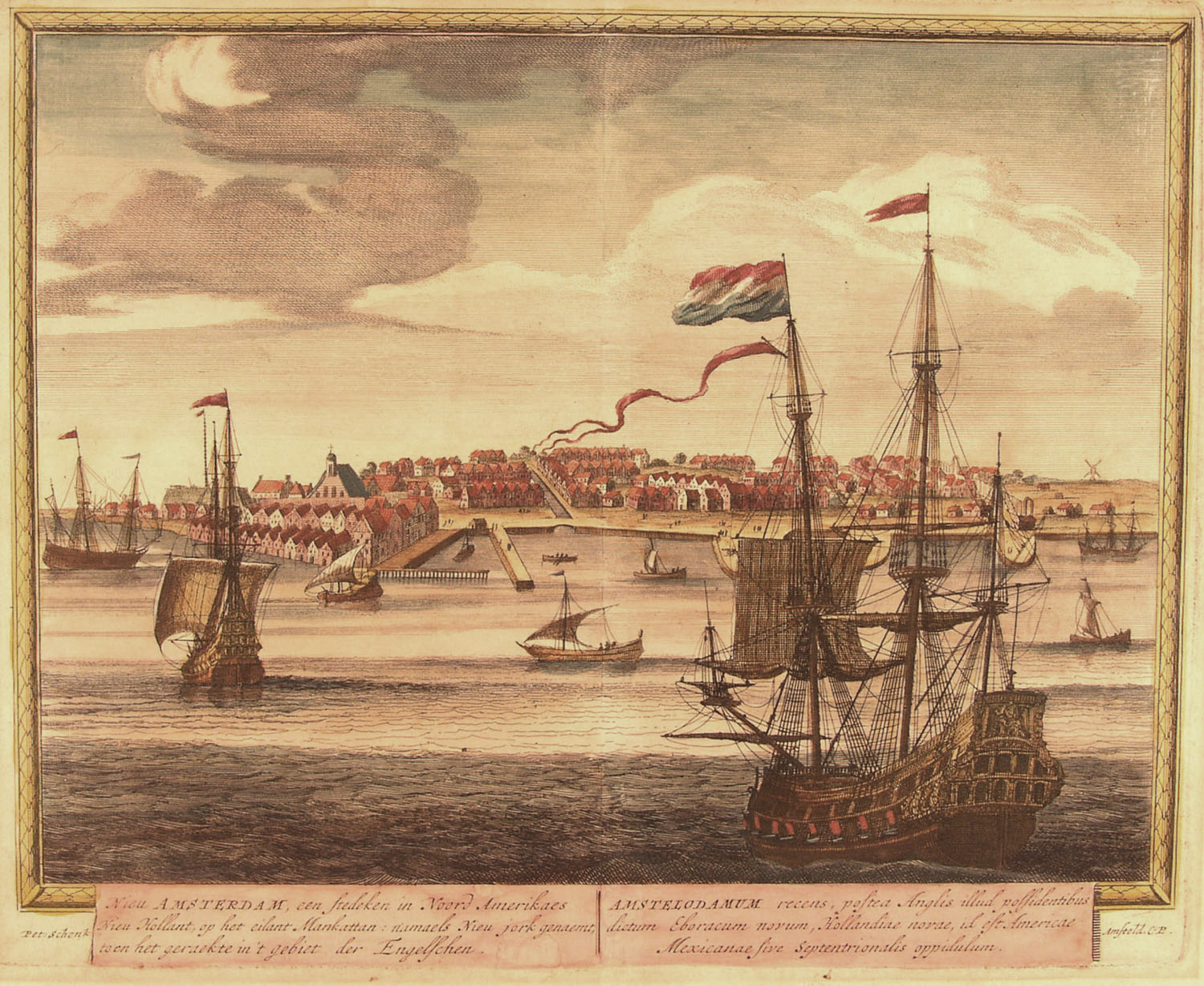
The persistent misconception about the $24 originates innocently enough with the famous memo written by Peter Schaghen in 1626. Schaghen was a representative of the States General in the Assembly of the Nineteen of the West India Company, and he reported the arrival of the ship Wapen van Amsterdam, recently arrived from New Netherland. Here in a single tantalizing sentence he refers to the acquisition of Manhattan: t’eylant Manhattes van de wilde gekocht, voor de waerde van 60 guld: is groot 11000 morgen. Translation: “They have purchased the Island Manhattes from the Indians for the value of 60 guilders. It is 11,000 morgens in size.”
From Schaghen’s reference to 60 guilders comes the subsequent $24 nonsense, though it wasn’t his fault. The sum of 60 guilders (actually the value of trade goods, not actual money) was converted to dollars at the prevailing rate in the mid-nineteenth century when Schaghen’s letter was discovered in the Netherlands. Edmund O’Callaghan wrote in his 1855 history: “The island of Manhattan,estimated then to contain twenty-two thousand acres of land, was therefore purchased from the Indians, who received for that splendid tract the trifling sum of sixty guilders, or twenty-four dollars.”
Thus the myth was born. It made no sense in 1855 and it’s even more absurd to use this dollar sum today, when its value is so muc less. It has never accurately reflected the value of the goods that Peter Minuit traded, and it certainly doesn’t indicate anything of the intrinsic value of the goods as understood by the Indians. For over a century and a half the $24 has remained curiously fixed in the popular mind. Moreover, the price has remained unhelpfully frozen at this misleading figure, and it is usually not even adjusted for inflation. This is the fallacy that is generally swallowed, and many early historians have done little to help, embroidering Schaghen’s account ever since, either ignorantly ensuring that the price of $24 is kept alive or doing little to get across accurately what few bare facts are known. In an informal survey I found that while few people knew much at all about theDutch Manhattan deal, many had heard of the notorious $24 purchase price. This is often accompanied by the related assumption that, because of the small sum, the wily Dutch clearly took advantage of the naïve Indians (fodder for future mythbusting, in fact).
With the $24 having taken hold, popular imagination went mad. For some reason, there grew a popular but essentially futile pastime to try to illustrate the power of compound interest (as if the Indians could have invested the $24) and calculate the current return on the original investment—how many million or billion dollars it now translates to, the sum that the Indians were, by inference, gypped out of. Some people also love trying to make comparisons and creating bogus relevance for this original sum in the modern economy, generally and wrongly assuming that the 60 guilders was nothing much (saying, for instance, how these days $24 would get you a parking space in Manhattan for only a few hours). In fact, in 1626 this was no small sum, and it doubtless translated into a generous quantity of trade goods. Sixty guilders was the price the West India Company would pay for thirty beaver skins or for twelve fathoms of wampum; it was three or four months’ wages for a sailor or an artisan back in the Netherlands, so Minuit’s party would have been well aware that the goods they traded were actually worth quite a lot of money.
The sort of meaningless investment whimsy described above, usually dreamed up for the benefit of the Indians, not Minuit,has sometimes been advanced, apparently seriously, to allow the Dutch to seem munificent, and thereby dodge the common accusation that their action in 1626 was fraudulent. What it does even better, of course, is underline (as if it needs to be stressed) the intrinsic difficulty of realistically evaluating business deals between dissimilar cultures (and cultures now very dissimilar to our own) that took place almost four centuries ago.
Unfortunately, and to its shame, even so august and supposedly erudite an institution as the Museum of the City of New York is one of the entities responsible for spreading this ridiculous myth. It achieves this with its annual “$24 Award.” Since 1971, the Museum has presented this annual award, a plaque holding twenty-four silver dollars, to individuals who have made lasting and significant contributions to the lives of the people of New York City. The award is, said the New York Times, “symbolic of the price the Dutch paid the Indians for Manhattan,” though some newspaper references to the award have the good grace to refer to the sum as “legendary.” The award is handed out on May 6, the date in 1626 when, supposedly and according to the Mayor’s Press Office, “…Peter Minuit purchased Manhattan island from Native Americans in exchange for goods worth $24.” With this sort of publicity it’s no wonder that sum is fixed in our heads. Well at least no one said anything about the island being bought for $24 worth of beads, baubles, and trinkets. But that’s another myth.