

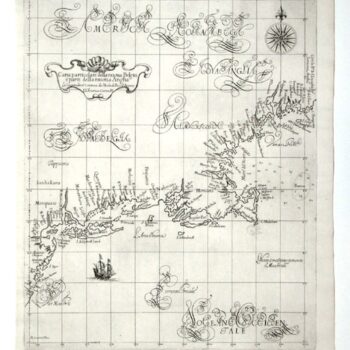
Mapmaker: Robert Dudley Tinting (adding color) either contemporaneously or later has always been a part of map making. An exception are the 130 maps of...
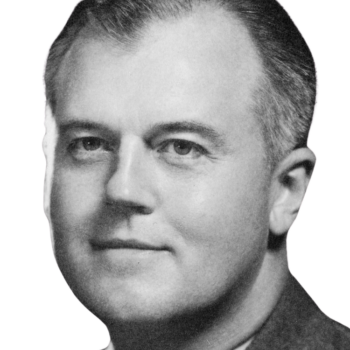
Robert J. Van de Graaff (1901–1967) was an American physicist and engineer best known for inventing the Van de Graaff generator, a high-voltage electrostatic device used in nuclear physics research and particle acceleration. He spent much of his career at MIT.
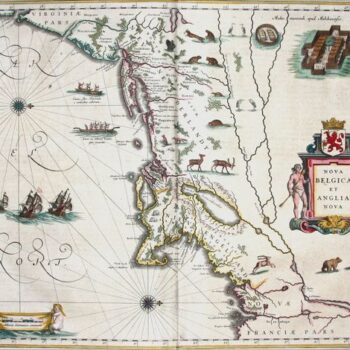
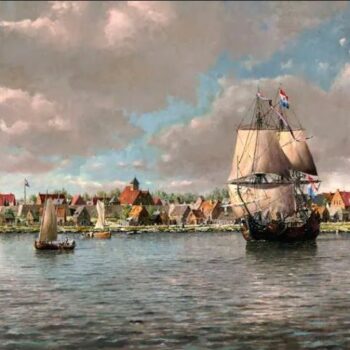
This map of New Netherland and New England, based on Adrian Block’s 1614 chart, defined Manhattan and Long Island as islands and became the cornerstone of Dutch claims in the lower Northeast. Richly decorated with regional fauna, it also shows fortified Mohawk villages, canoes, and European ships reflecting growing knowledge and economic potential.
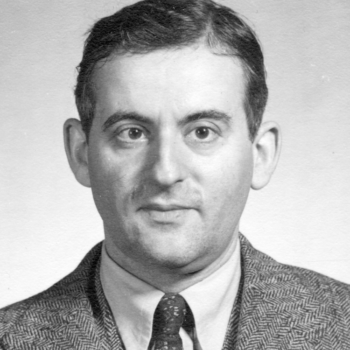
Samuel A. Goudsmit (1902–1978) was a Dutch American physicist who, with George E. Uhlenbeck, discovered electron spin in 1925. He later worked in the United States, contributing to atomic physics and serving in scientific intelligence during World War II.
In 1664, Dutch rule ended as New Netherland passed to the English. Peace treaties promised continued trade and justice, but Native peoples now faced new colonial powers—and, eventually, war, displacement, and upheaval.
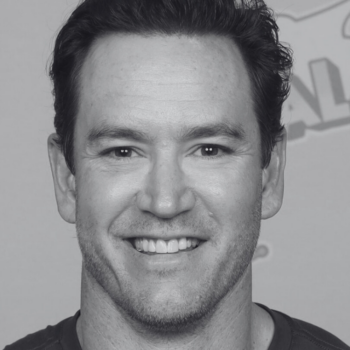
Mark-Paul Gosselaar (born 1974) is a Dutch American television actor best known for his role as Zack Morris on Saved by the Bell. He later starred in series including NYPD Blue and Raising the Bar.
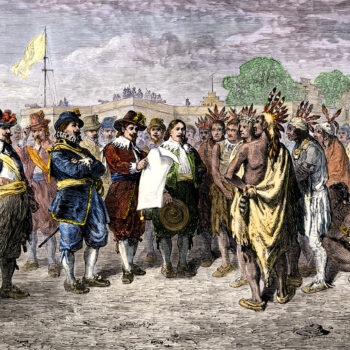
Conflict erupted in 1626 when Dutch troops joined the Mahicans against the Mohawks, sparking cycles of warfare driven by old rivalries, expanding settlements, and competition over fur-rich territory—culminating in the brutal Beaver Wars.
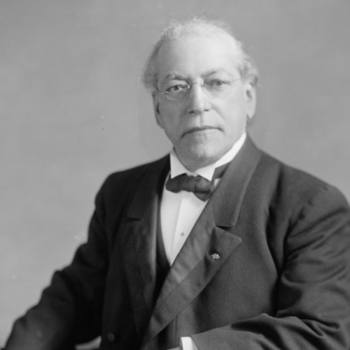
Samuel Gompers (1850–1924) was a labor leader and founding president of the American Federation of Labor (AFL). Serving for nearly four decades, he helped shape the American labor movement by advocating higher wages, safer working conditions, and organized collective bargaining.
Wampum, from the Massachusett word wampumpeag, meaning white beads, was known to the Dutch as sewant, derived from Delaware and Munsee terms. It became central to trade, diplomacy, and cultural exchange in New Netherland.
Rudy Van Gelder (1924–2016) was a pioneering American recording engineer known for shaping the sound of modern jazz. Working with labels such as Blue Note, Prestige, and Impulse!, he engineered classic recordings by artists including Miles Davis and John Coltrane.