

Customs, Cooking, and Folklore
Popular customs that the Dutch brought from the Low Countries to New Netherland remained entrenched in the mid-Atlantic region. Depending on one’s wealth, the gift of a pewter or silver spoon to commemorate the birth of a child and of a spoon rack as a wedding gift are two such customs.[1]
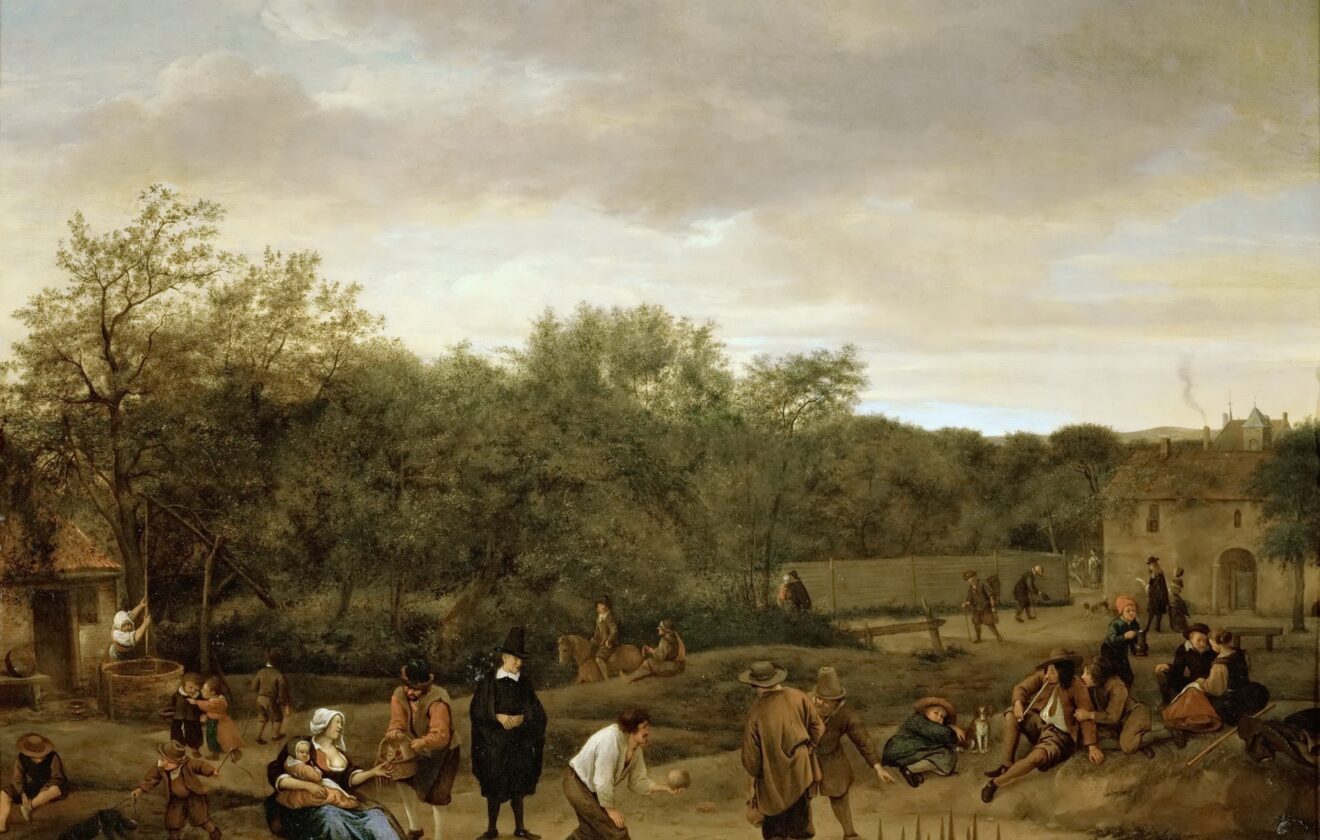
The custom of calling on one’s neighbors and sharing a drink with them on New Year’s Day survived into the twentieth century as did the first of May being the traditional day for signing leases, which became known as Moving Day in nineteenth-century New York.[2] Among other activities that became entrenched in America is the Dutch game of ninepins, or bowling. Ice skating, ice hockey, and winter sledding are also popular sports the Dutch introduced that continue in the present day.[3] A lasting legacy of the Dutch is found in the flags of New York City and Albany, both of which use a tricolor blue, white, and orange derived from the Prince’s flag of the Dutch Republic, and the modern use throughout the region of the Dutch word “Knickerbocker.”
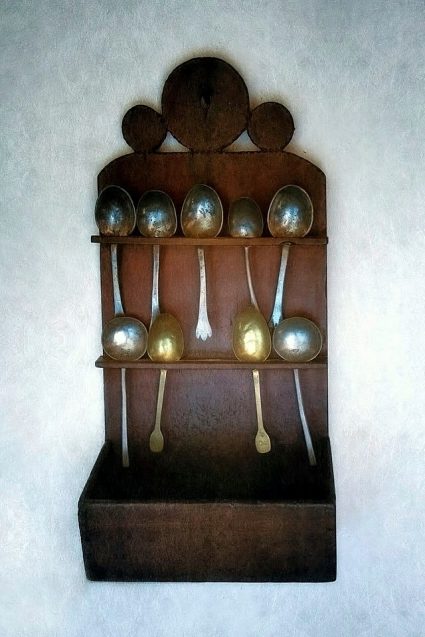
From first settlement, the Dutch brought with them European foodways. They introduced to the Hudson River Valley breads, butter, cheese, soup (vegetable mush) and porridge, salads, garden vegetables, fruit trees, and beef, pork, and chicken, among many other foods, and imported eastern spices such as pepper, nutmeg, and cinnamon. For beverages they brought with them wine, beer, and apple cider, and later introduced tea, rum, coffee, and chocolate. As a result, the foods that the Dutch brought into New Netherland in the seventeenth-century became the foundation for basic New York cookery to the present day. Bread eaten with butter (brood met boter), pancakes (pannenkoeken), waffles (wafels), doughnuts (oliebollen or donut), pretzels, cookies (koekjes), whole grains eaten with milk, pies and tarts, peas, garden salads, and coleslaw (koolsla) are among the foods that have become mainstays in American cuisine.[4]
The Dutch also introduced Northern European folkways that became New York and New Jersey traditions. Knock on wood for good luck or that a black cat, a broken mirror, or walking under a ladder mean bad luck are all superstitions the Dutch introduced.[5] Other traditional customs, often suppressed by Dutch Calvinists, reemerged with those of other cultures to create distinctly American holidays. Sint Maarten’s Eve, or Beggar’s Day, for example, when on November eleventh children went from house to house wearing disguises and carrying lanterns while begging for gifts of sweets and fruit, merged with the Irish-Celtic celebration of All Saints Eve on October 31 into the modern American Halloween. The American Christmas character of Santa Claus arose from the Dutch legend of St Nicholas, or Sinter Klaas, whose birthday is celebrated on December 6, is another Dutch tradition that became part of New York Christmas celebrations in the late eighteenth century. The practice of children leaving shoes or stockings out for St. Nicholas to fill with goodies on the eve of December 5th is still practiced by children throughout the United States on Christmas Eve.[6]
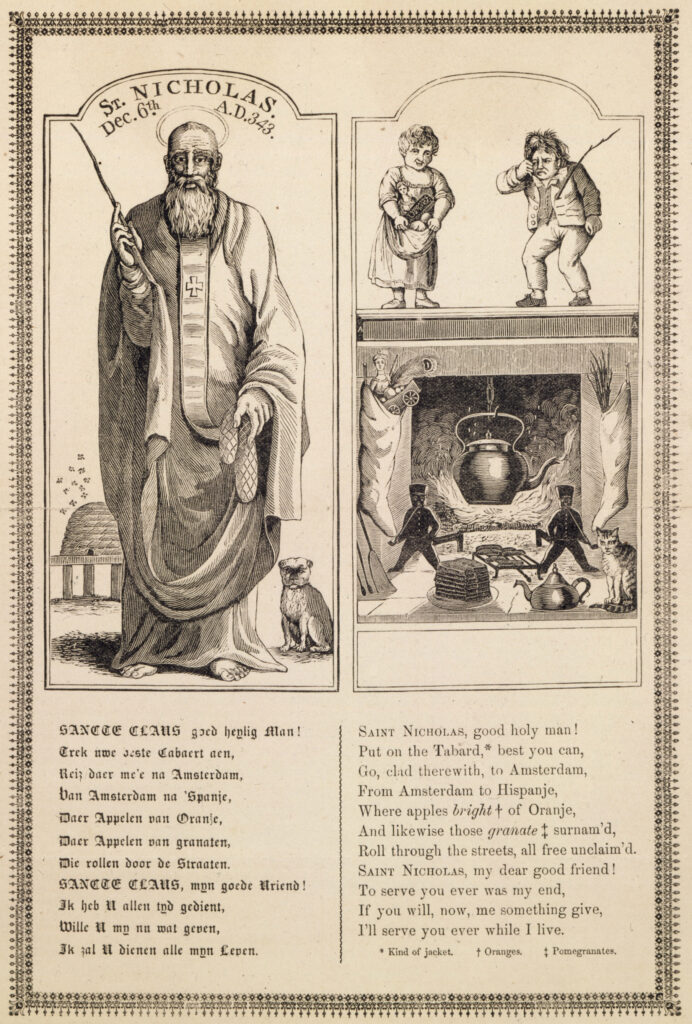
New-York Historical Society
Winter Entertainment
“And upon the Ice it’s admirable to see Men & Women as it were flying upon their Skates from place to place, with Markets upon their Heads & Backs.”
— Charles Wooley, 1678, A Two Years’ Journal in New York and Part of Its Territories in America (1701; rprt. Cleveland: Borrows Brothers Company, 1902 ), 71.
“Their Diversions in the Winter is Riding Sleys about three or four Miles out of Town, where they have Houses of entertainment as a place called the Bowery, and some go to friends Houses who handsomely treat them. Mr. Burroughs cary’d his spouse and Daughter and myself out to one Madame Dowes; a Gentlewoman that lived at a farm House, who gave us a handsome Entertainment of five or six Dishes and choice Beer and metheglin [spiced mead], Cyder, &c. . . I believe we mett 50 or 60 slays that day–they fly with great swiftness and some are so furious that they’le turn out of the path for none except a Loaden Cart.”
— Sarah Kemble Knight, 1704. The Journal of Madam Knight: A Woman’s Treacherous Journey By Horseback from Boston to New York In the Year 1704 (1829, reprt. Bedford Massachusetts: Applewood Books, 1992), 55-56.
1. Kenney, Stubborn for Liberty, 84; Roderic H. Blackburn and Ruth Piwonka, Remembrance of Patria: Dutch Arts and Culture in Colonial America, 1609–1776 (Albany: The Albany Institute of History and Art, 1988), 159-161, 277.
2. Esther Singleton, Dutch New York (New York: Dodd Mead and Company, 1909), 308-309; Charlotte Wilcoxen, Seventeenth Century Albany: A Dutch Profile (Albany: Albany Institute of History and Art, 1981, revised ed., 1984), 120-122; David L. Gold, “Moving Day in Old New York City: A Custom of Dutch Origin?,” de Halve Maen 80 (Spring 2007), 9-14.
3. William Elliot Griffis, The Story of New Netherland: The Dutch in America (Boston and New York, Houghton Mifflin Company, 1909), 151-154.
4. Peter G. Rose, The Sensible Cook: Dutch Foodways in the Old and the New World (Syracuse, New York: Syracuse University Press, 1989); Rose, Food, Drink and Celebrations of the Hudson Valley Dutch (Charleston, S. C.: The History Press, 2009).
5. Jonathan Kruk, Legends and Lore of Sleepy Hollow and the Hudson Valley (Charleston, S.C.: The History Press, 2011). Elizabeth Paling Funk, “Washington Irving and His Dutch-American Heritage” (Ph.D. diss., Fordham University, 1986).
6. Esther Singleton, Dutch New York (New York: Dodd Mead and Company, 1909), 308-309; Charlotte Wilcoxen, Seventeenth Century Albany: A Dutch Profile (Albany: Albany Institute of History and Art, 1981, revised ed., 1984), 120-122.