Translations & Transitions Govert Loockermans, a Manhattan Merchant’s Correspondence & Papers More → |
Voyages Maritime routes that shaped the Dutch North Atlantic world More → |
Zotero Bibliography Research Source: 17th century scholarly, non-fiction publications More → |
Genealogical Research What’s in a Name? Discover your ancestors’ origins More → |
Translations & Transitions Govert Loockermans, a Manhattan Merchant’s Correspondence & Papers More → |
Voyages Maritime routes that shaped the Dutch North Atlantic world More → |
Zotero Bibliography Research Source: 17th century scholarly, non-fiction publications More → |
Genealogical Research What’s in a Name? Discover your ancestors’ origins More → |
– 1665 announcement of the disposition of an estate along the upper Hudson
From the estate of Rutger Jacobsen, Arent bought a painting for 85 guilders, a ring for 39, and a silver beaker for 68. These articles joined other staples and luxuries which a prosperous burgher expected to enjoy.
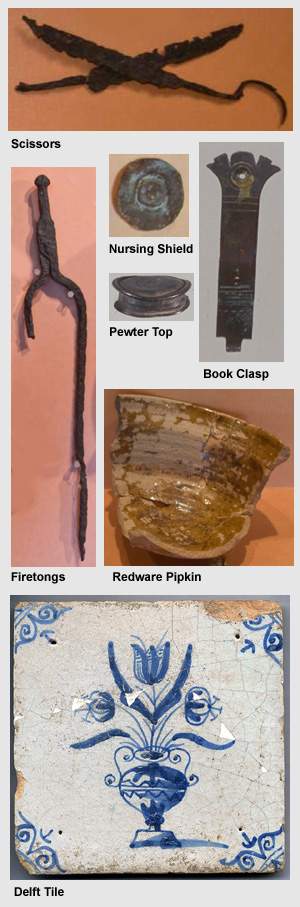
In the kitchen, the household cooked in lead-glazed earthenware. The food was served on traditional tin-glazed majolica and the newer blue and white style Delft manufacturers were selling. After dinner, the family might enjoy smoking pipes. Though Arent and Anthonia were not blessed with their own brood, visiting children might play with stoneware marbles or blow on whistles made from broken pipe stems.
Luxuries graced Arent’s table when he entertained. Guests enjoyed meals on Chinese porcelain or Italian ceramics. He poured them beer from stoneware jugs. They sipped wine from Venetian glasses.
At his hearth, Arent displayed his Dutchness. The surviving piece of his iron fire back was cast with a torso and upraised arm holding a staff. The design closely resembles another of the era inscribed “Hollandia” and “Pro Patria.” This example depicts a woman holding a lance topped with a hat. A crowned lion crouches before her. She sits within a fenced enclosure representing the “Dutch Garden.” Through such symbols a household like Arent’s tied itself to the Dutch Republic and the House of Orange.
Elsewhere in the house, artifacts such as mirror glass, book clasps, furniture hardware and gilded braid illustrate how Arent’s home was as well appointed as that of any successful merchant in the fatherland.
Read Related Documents in Translation:
First Recording of Sale for Estate of Rutger Jacobsen, December 9, 1665
Second Recording of Sale for Estate of Rutger Jacobsen, December 9, 1665
Artifacts from the Flatts except where noted.
We use cookies to enhance your experience on our site. By continuing, you agree to our use of cookies. See our privacy policy page for the details.
Welcome! You can explore everything you're looking for in the NNI library. Simply type a keyword into the search bar and press Enter to begin your search.
Sign in to access exclusive features and keep track of your favorite content on NNI!
New membership are not allowed.
For over three decades, NNI has helped cast light on America's Dutch roots. In 2010, it partnered with the New York State Office of Cultural Education to establish the New Netherland Research Center, with matching funds from the State of the Netherlands. NNI is registered as a 501(c)(3) non-profit organization. Contributions are tax-deductible to the extent permitted by law.