
Now Reading:

The Farmhouse

Font Selector
Sans Serif
Serif
Font Size
A
A
You can change the font size of the content.
Share Page

Exploring Dutch Heritage Through Research 

Exploring Dutch Heritage Through Research 

The Farmhouse

“Having a large, nicely furnished house, several servants … these were signs of status, and greatly contributed to one’s reputation.”

Janny Venema describing the lifestyle of upper Hudson society, ca. 1650,
in “Beverwijck: A Dutch Village on the American Frontier, 1652-1664

Arent grew up in Nijkerk, a rural community southeast of Amsterdam. His family’s farmhouse was of a common style known as a hallehuis, an aisled house. These buildings were constructed with H-shaped framing on stone or brick footings, creating a large open space for living quarters, stables and work areas such as a threshing floor. Living quarters occupied one end, the barn the other. An open hearth vented through a smoke hole in a thatch roof. Wattle and daub typically sided the buildings. As a family grew wealthier, it might add a brick firewall between the dwelling and the barn, a chimney, a brick façade, a cellar and interior walls.

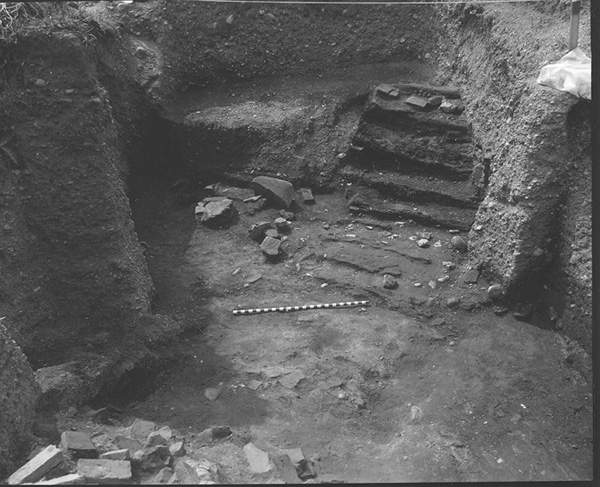
The “large farmhouse” Arent described in his 1643 letter matches the hallehuis style. The archaeologists uncovered the sorts of improvements a family would add as its business prospered. The cellars themselves are evidence, as are the building artifacts discovered in them.

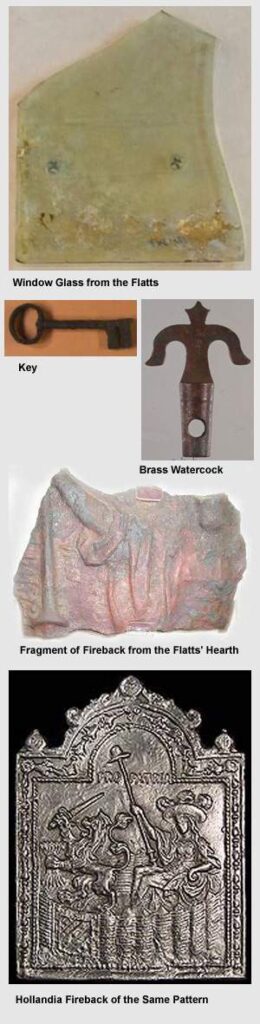
Brick fragments with plaster suggest Arent built a firewall and chimney. Pan tiles probably roofed the area around the chimney, replacing thatch. Inside, the open hearth was adorned with tin glazed tiles and plaster and shielded with a cast iron fire back. Leaded glass panes filled casement windows. Shutters protected them. Walls divided the interior.

All in all, Arent built a comfortable and well-appointed residence for himself and his wife Anthonia.

Cellar #1 of the Hallehuis at the Flatts
Artifacts of the Hallehuis (Aisled House) at the Flatts

Artifacts from the Flatts except where noted.

  • About New Netherland Institute

    For over three decades, NNI has helped cast light on America's Dutch roots. In 2010, it partnered with the New York State Office of Cultural Education to establish the New Netherland Research Center, with matching funds from the State of the Netherlands. NNI is registered as a 501(c)(3) non-profit organization. Contributions are tax-deductible to the extent permitted by law.