Now Reading:

Formulating a Plan

Font Selector
Sans Serif
Serif
Font Size
A
A
You can change the font size of the content.
Share Page

Exploring Dutch Heritage Through Research 

Exploring Dutch Heritage Through Research 

Formulating a Plan

“You have great plans about the farm at the Great Flats but see to it that it does not become too expensive and that care be taken about the servants so that the undertaking may do you credit and be of profit to me.”

– Kiliaen van Rensselaer to Arent van Curler, March 16, 1643

When Arent van Curler read those words from his great-uncle, he had been in New Netherland five years. Van Rensselaer sent the 18-year old he called mon cousin to become assistant to the commiss, the patroon’s chief representative and trading agent in his Colony of Rensselaerswijck. “One has to be servant before one can be master,” he told the youth, promising to promote him in proportion to his capacity.

Arent advanced quickly, to secretary and bookkeeper in a year, then commiss, whom the patroon expected not only to run the colony but to gain control of the fur trade. In letters Van Rensselaer constantly berated his grand-nephew for never sending the accounts. Nonetheless he had chosen his agent well. During the time he spent in the woods instead of over his paperwork, Arent built relationships with his native trading partners, the Mohawks and the Mahicans. He learned what they wanted in return for their furs. And he plotted how to out-maneuver the competition.

The farm at the Great Flatts was the cornerstone of his plan.

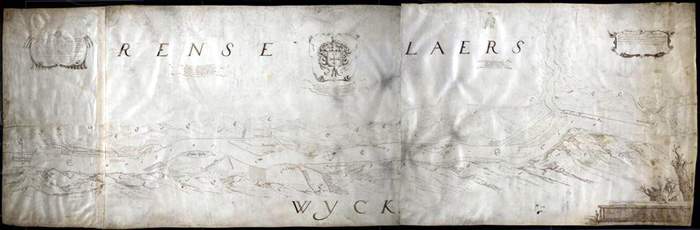
Map of Rensselaerswyck, c. 1632
Known as the Gillis van Scheyndel map of Rensselaerswijck, the original is held by the New York State Library. A reproduction is displayed in the New Netherland Research Center.
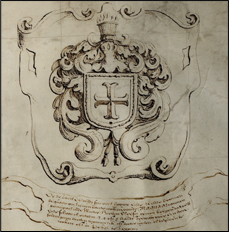
The Van Rensselaer Coat of Arms inset on a map of Rensselaerswijck, c. 1632

On November 19, 1629, the register of resolutions of the Amsterdam Chamber of the Chartered West India Company records that “Kiliaen van Rensselaer declares himself patroon on the North River of New Netherland beginning above and below Fort Orange, on both sides of the river with the islands therein, as many leagues downwards as the Assembly of the XIX has determined.”  In January, he instructed his agent Bastien Krol to buy the land from the Mahicans, the Mohawks and other nations who claimed it.  The first settlers arrived in 1630.  Van Curler followed 8 years later.

  • About New Netherland Institute

    For over three decades, NNI has helped cast light on America's Dutch roots. In 2010, it partnered with the New York State Office of Cultural Education to establish the New Netherland Research Center, with matching funds from the State of the Netherlands. NNI is registered as a 501(c)(3) non-profit organization. Contributions are tax-deductible to the extent permitted by law.