

for
Gravesend
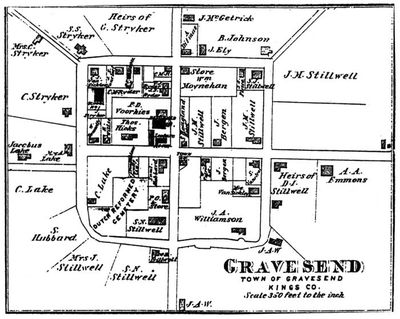
Map of the town of Gravesend
She was an aristocrat and an early champion of the cause of religious freedom. She was also the first woman to found a settlement in the New World. Her name was Lady Deborah Moody, and, by any definition, she was one of the most remarkable women of the seventeenth century. In England, she became a devotee of the anabaptist sect, which held that baptism should not be given to infants but must be withheld until a child has grown to understand its meaning. In the England of the time, these were inflammatory notions, and the country of her birth simply became too hot for her. She sailed for the New World colony of Massachusetts Bay in 1639, but found, to her chagrin, that it was, if anything, even less tolerant of religious differences. Then in 1643 she received an invitation from the director-general of New Netherland, Willem Kieft, to lead her small band of followers into his dominion, and found a settlement, where, she was promised, the residents would be free to practice their faith. Thus it was that Lady Moody founded an English town, Gravesend, in the midst of the five Dutch towns at the western end of Long Island. Gravesend was laid out according to a plan of Lady Moody’s own execution, in a square divided into four smaller squares. The central crossroads of the original settlement are apparent today in the crossing of McDonald Avenue and Gravesend Neck Road.
-
Along with Lady Moody, Anne Hutchinson was another pioneer of religious freedom in New Netherland. Read her story.
-
More on religious liberty (and the lack of it) in seventeenth century America.