


for
Staten Island
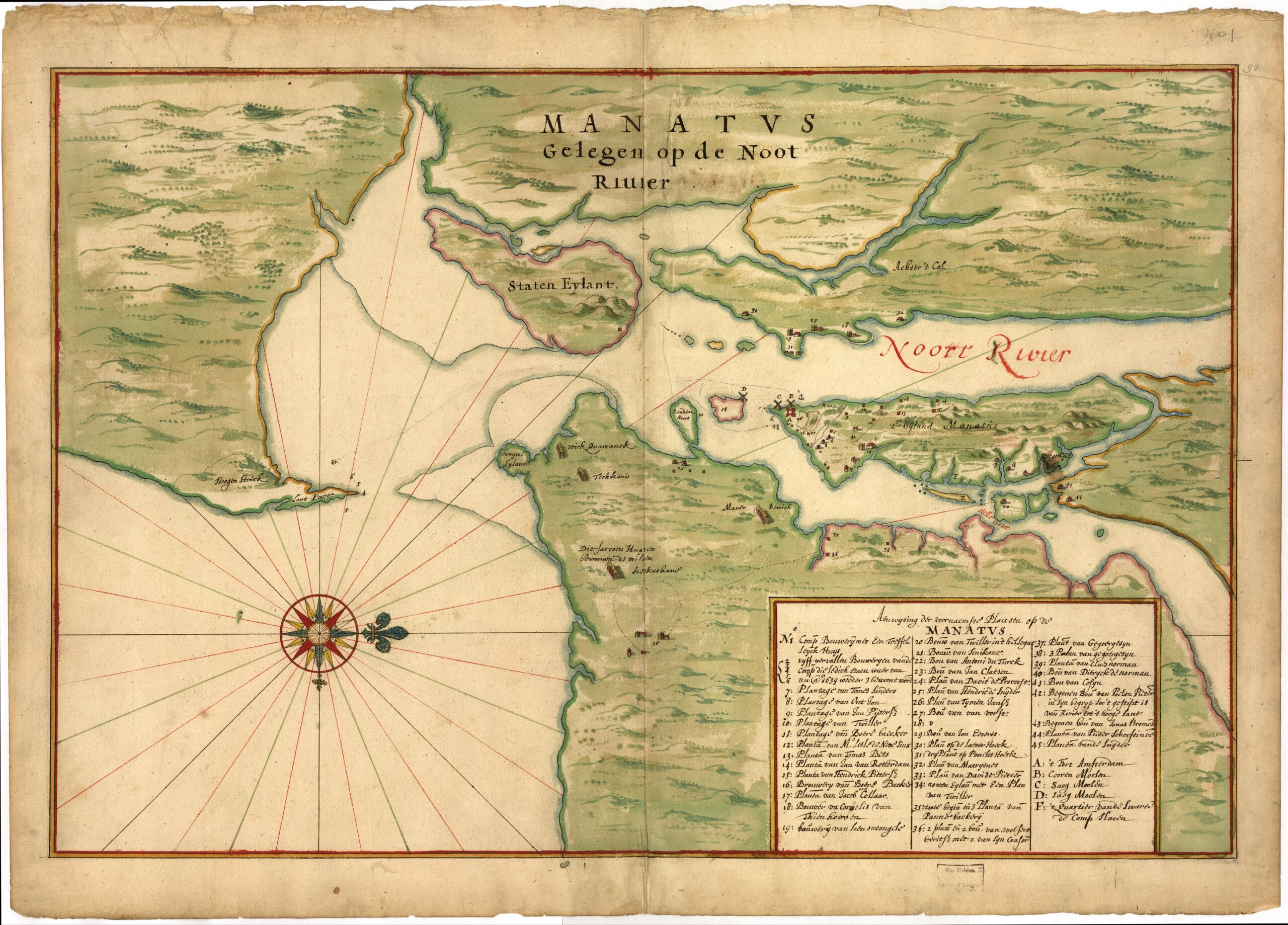 Staten Eylant as seen in the Manatus Map of the New York
The Manatus Map, created in 1639 during Willem Kieft’s tenure, is a pictorial map of the New York–New Jersey Harbor, depicting Manhattan, New Amsterdam, and surrounding New Netherland settlements.
One of the many sites of the former New Netherland to retain its Dutch name (Brooklyn and Harlem are others), Staten Eylandt was named for the Staten Generaal, or States General, the governing body of the Netherlands in the seventeenth century. Henry Hudson sailed past the island in the Half Moon in 1609, his mate remarking that “the land is very pleasant and high, and bold to fall withal.” Once the West India Company began to settle the Hudson River, this island at the mouth of the magnificent harbor, rich with trees and pasture land and nearly sixty square miles in size, caught their attention. In 1630, Pieter Minuit, as director general of New Netherland, purchased the island from the Unami Indians of the Delaware tribe for “Duffels, Kittles, Axes, Hoes, Wampum, Drilling Awls, Jews Harps, and diverse other small wares.” But the Dutch plantations on Staten Island didn’t fare well. In 1641, after the new director general, Willem Kieft, decided to levy a tax on local Indians, the Raritan tribe attacked the Staten Island plantation of the Dutch adventurer David de Vries, killing four people. It was the end of the colony’s relatively peaceful days among its Indian neighbors. The first permanent settlement on the island was Oude Dorp (“Old Town”), populated by French Huguenots. With only five percent of New York City’s population and no road access to Manhattan, Staten Island has always been the forgotten borough of the city. Staten Islanders have tended to feel dumped-on, and with good reason: the island’s Fresh Kills landfill is one of the largest in the world (it is visible by the naked eye from outer space). It was to Fresh Kills that the thousands of tons of debris from the World Trade Center attack of September 11, 2001, were hauled and analyzed.
- The Staten Island Ferry schedule
- Here is a list of famous Staten Islanders (in particular, the island seems to be a good breeding ground for musicians: Joan Baez, Christina Aguilera, David Johansen, Roy Clark, and the members of Wu-Tang Clan were all born here).